


Gunmen on motorcycles sprayed a van carrying employees from a community center with bullets on Tuesday, killing five female teachers and two aid workers, but sparing a child they took out of the vehicle before opening fire.
The director of the group that the seven worked for says he suspects it may have been the latest in a series of attacks targeting anti-polio efforts in Pakistan. Some militants oppose the vaccination campaigns, accusing health workers of acting as spies for the US and alleging the vaccine is intended to make Muslim children sterile.
Last month, nine people working on an anti-polio vaccination campaign were shot and killed. Four of those shootings were in the northwest where Tuesday’s attack took place.
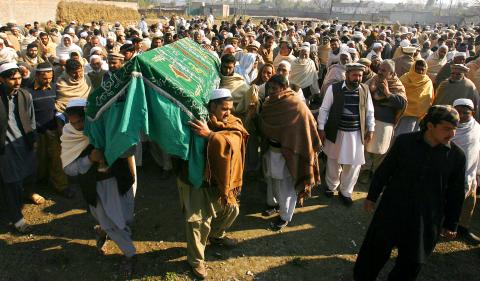
Photo: Reuters
The attack was another reminder of the risks to women educators and aid workers from Islamic militants who oppose their work. It was in the same conservative province where militants shot and seriously wounded 15-year-old Malala Yousufzai, an outspoken young activist for girls’ education, in October.
There was no immediate claim of responsibility for the latest shootings.
The teachers and health workers — one man and one woman — were killed in Khyber Pakhtunkhwa Province on their way home from a community center in the town of Swabi, where they were employed at a medical clinic and primary school. Their driver was also injured.
Javed Akhtar, the director of Support With Working Solution, said the medical clinic vaccinated children against polio, and many of the nongovernmental organization’s (NGO) staff had taken part in immunization campaigns.
Militants in the province have blown up schools and killed female educators. They have also kidnapped and killed aid workers, viewing them as promoting a foreign, liberal agenda.
Khyber Pakhtunkhwa Province, formerly called the Northwest Frontier province, borders the tribal areas of Pakistan along the frontier with Afghanistan to the west. Militant groups such as the Taliban have used the tribal areas as a stronghold from which to wage war both in Afghanistan and against the Pakistani government. Often, that violence has spilled over into Khyber Pakhtunkhwa Province.
The injured driver in Swabi told investigators that the gunmen stopped the vehicle and removed a boy — the son of one of the women — before indiscriminately opening fire, police officer Fazal Malik said. The woman’s husband rushed to the scene after receiving a phone call alerting him to the shooting.
“I left everything and rushed towards the spot. As I reached there, I saw their dead bodies were inside the vehicle and he [his son] was sitting with someone,” Zain ul Hadi said.
Swabi police chief Abdur Rasheed said most of the women killed were between the ages of 20 and 22. He said four gunmen on two motorcycles fled the scene and have not been apprehended.
The NGO conducts education and health programs and runs the community center in Swabi, Akhtar said. The group has been active in the city since 1992 and started the Ujala Community Welfare Center in 2010, he added. Ujala means “light” in Urdu.
Tuesday’s attack worried even veteran campaigners. Maryam Bibi, who founded an organization called Khwendo Kor, which carries out education and development programs in Khyber Pakhtunkhwa and the nearby tribal areas, said she and many of her employees live in fear that they will be targeted next.
“I’m really very worried now because our girls go to the field. Our work is in the villages,” Bibi said.
She said many of the female employees of such organizations are already under pressure from family and a culture that frowns on women working outside the home and mixing with men.
“On top of that, they’re shot dead,” she said.
In some areas like the northwest, aid groups have had to work to overcome community fears that they are promoting a foreign agenda at odds with local traditions and values. However, many residents in Swabi said the school and medical center provided a vital service to the community, and they mourned those who were killed.
The NGO director said all projects will be suspended as security measures are reviewed, but he vowed that they would resume their work soon.

An American scientist convicted of lying to US authorities about payments from China while he was at Harvard University has rebuilt his research lab in Shenzhen, China, to pursue technology the Chinese government has identified as a national priority: embedding electronics into the human brain. Charles Lieber, 67, is among the world’s leading researchers in brain-computer interfaces. The technology has shown promise in treating conditions such as amyotrophic lateral sclerosis and restoring movement in paralyzed people. It also has potential military applications: Scientists at the Chinese People’s Liberation Army have investigated brain interfaces as a way to engineer super soldiers by boosting

Indonesian police have arrested 13 people after shocking images of alleged abuse against small children at a daycare center went viral, sparking outrage across the nation, officials said on Monday. Police on Friday last week raided Little Aresha, a daycare center in Yogyakarta on Java island, following a report from a former employee. CCTV footage circulating on social media showed children, most younger than two, lying on the floor wearing only diapers, their hands and feet bound with rags. The police have confirmed that the footage is authentic. Police said they also found 20 children crammed into a room just 3m by 3m. “So

Jailed media entrepreneur Jimmy Lai (黎智英) has been awarded Deutsche Welle’s (DW) freedom of speech award for his contribution to Hong Kong’s pro-democracy movement. The German public broadcaster on Thursday said Lai would be presented in absentia with the 12th iteration of the award on June 23 at the DW Global Media Forum in Bonn. Deutsche Welle director-general Barbara Massing praised the 78-year-old founder of the now-shuttered news outlet Apple Daily for standing “unwaveringly for press freedom in Hong Kong at great personal risk.” “With Apple Daily, he gave journalists a platform for free reporting and a voice to the democracy movement in
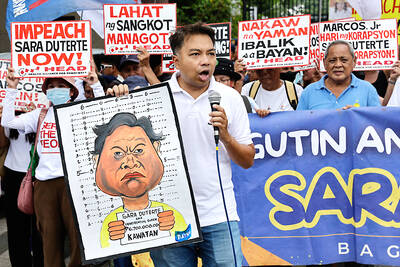
PHILIPPINE COMMITTEE: The head of the committee that made the decision said: ‘If there is nothing to hide, there is no reason to hide, there is no reason to obstruct’ A Philippine congressional committee on Wednesday ruled that there was “probable cause” to impeach Philippine Vice President Sara Duterte after hearing allegations of unexplained wealth, misuse of state funds and threats to have the president assassinated. The unanimous decision of the 53-member committee in the Philippine House of Representatives sends the two impeachment complaints to deliberations and voting by the entire lower chamber, which has more than 300 lawmakers. The complaints centered on Duterte’s alleged illegal use and mishandling of intelligence funds from the vice president’s office, and from her time as education secretary under Philippine President Ferdinand Marcos Jr. Duterte and the


 RSS
RSS