


Egypt’s Islamist President Mohamed Morsi was to meet with senior judges yesterday in a bid to defuse a crisis that erupted after he assumed sweeping new powers, sparking strikes and deadly protests.
The crisis talks, on the eve of rival rallies which threaten to deepen the country’s divisions, come a day after a member of his party was killed in clashes in the Nile Delta.
Ten people were also wounded in the clashes between supporters and opponents of the president, outside Muslim Brotherhood offices in Damanhour, a doctor at the hospital in the Nile Delta town told reporters.
Several offices belonging to the Muslim Brotherhood’s Freedom and Justice Party have been torched since Morsi’s announcement on Thursday of his enhanced powers.
Morsi’s constitutional declaration, which allows him to issue decisions and laws unchallenged on a temporary basis, has triggered a wave of protests across the country, and set him on course for a showdown with Egypt’s judges.
Courts in some provinces have suspended work in protest while the journalists’ union has decided in principle to go on strike and a sit-in by opponents of Morsi is being held in the iconic Tahrir Square, which was at the heart of last’s year revolution.
The constitutional declaration states that Morsi can issue “any decision or measure to protect the revolution,” which are final and not subject to appeal, sparking charges that he is taking on dictatorial powers.
In a move to assuage his critics, Morsi was to meet the Supreme Judicial Council late in the afternoon after his Justice Minister Ahmed Mekki held preliminary talks with the council, the president’s spokesman Yasser Ali said.
Ahead of the crisis talks, key opposition figure Mohamed ElBaradei ruled out any compromise with “a president who is imposing a dictatorship,” but Mekki said that curbs on the widened presidential powers could be discussed with the judges.
An amendment could be added to specify that “the irrevocable decisions of the president apply only to issues related to his sovereign powers and not administrative decisions,” the minister said, quoted by state news agency MENA.
On Sunday, Morsi stressed the “temporary nature” of the measures, valid only until a new constitution is adopted and elections held, and which “are not meant to concentrate power” but devolve it to a democratically elected parliament.
The measures were also “deemed necessary in order to hold accountable those responsible for the corruption as well as the other crimes during the previous regime and during the transitional period,” he said.
Former Egyptian president Hosni Mubarak was sentenced to life, along with his interior minister, over the killing of protesters in the uprising last year that eventually ousted him, in which some 850 activists died.
Six security chiefs were acquitted in the same case, sparking nationwide outrage.
New investigations have been ordered into the deaths, and Egypt’s new prosecutor general, Talaat Ibrahim Abdallah, said “revolutionary courts” would be set up.
The presidency also on Sunday stressed its commitment to engaging all political forces in dialogue “to reach a national consensus on the constitution, which will be the cornerstone of Egyptian modern institutions.”
Former UN nuclear watchdog director general ElBaradei and ex-presidential candidates Hamdeen Sabbahi, Amr Mussa and Abdelmoneim Abul Futuh said on Saturday that they would have no dialogue with Morsi until he rescinded his decree.
The Muslim Brotherhood has called a “million man” demonstration for today to coincide with a huge demonstration organized by Morsi’s opponents.
The Brotherhood’s Freedom and Justice Party says Thursday’s decree was a necessary move to prevent the courts from disbanding the Islamist-dominated panel drawing up the new constitution.
The judges have hit back, denouncing “an unprecedented attack on the independence of the judiciary and its rulings,” and calling for the courts to stop work nationwide.
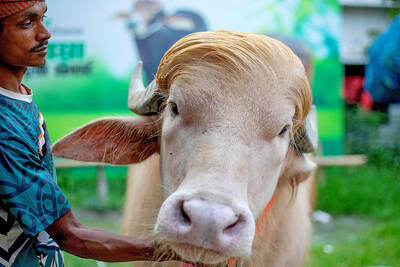
Crowds in Bangladesh are flocking to snap photographs with an unlikely social media star — an albino buffalo with flowing blond hair nicknamed “Donald Trump” that is due to be sacrificed within days. Owner Zia Uddin Mridha, 38, said his brother named the 700kg bull over its flowing helmet of hair resembling the signature look of the US president. “My younger brother picked this name because of the buffalo’s extraordinary hair,” he said at his farm in Narayanganj, just outside the capital, Dhaka. Mridha said that a constant stream of curious visitors — social media fans, onlookers and children — have come throughout

It began as a satirical online project. Now millions of young people in India are flocking to it as an outlet for their frustration. A parody political party called the Cockroach Janta Party, with the insect as its symbol, has exploded across India’s social media by turning absurdist humor into protest. Memes and short videos mocking corruption, joblessness and political dysfunction have flooded social media sites, where millions of users are embracing the cockroach — known for its ability to survive harsh conditions — as a tongue-in-cheek symbol of endurance. The online movement’s rise has been unusually rapid. The Cockroach Janta Party (CJP)
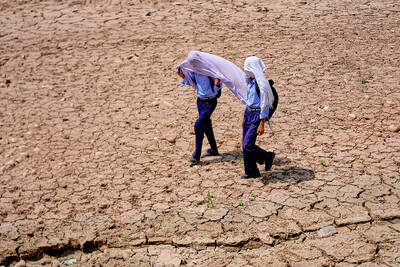
HOTTER: While Indians are accustomed to summer heat, climate change has caused northwestern India to warm faster than other parts of the country, an academic said Roads and markets have emptied during afternoons and some farmers have switched to nighttime work to avoid scorching temperatures as a heat wave grips large parts of India. The India Meteorological Department forecast maximum temperatures for yesterday of about 45°C in the capital, New Delhi, where authorities have opened temporary “cooling zones” to help people cope. The weather department warned that conditions would likely persist across several northern regions in the coming days, with temperatures staying well above seasonal averages. Authorities urged people to stay indoors during the hottest hours and take precautions against heat-related illnesses. India declares a heat wave whenever maximum temperatures

SPEAKING OUT: After Siranudh Scott’s allegations surfaced, celebrities and public figures took to social media to share their own experiences of sexual misconduct and abuse A high-profile alleged sexual abuse case within a wealthy Thai beer brewing family has prompted a wave of painful accounts from survivors of unconnected abuse in the conservative nation. Siranudh Scott, a member of the billionaire Thai family that founded the ubiquitous Singha beer brand, posted an emotional video this month accusing his elder brother Sunit of repeatedly abusing him when he was a teenager. Sunit, who is in his 30s, later denied the allegations in a video posted online, but Singha parent Boonrawd dismissed him from his executive role with the company on Tuesday last week. “I felt I needed to speak


 RSS
RSS