


JAPAN
iPhone maps dispute
Apple’s new iPhone 5 may have been criticized for its glitch-ridden new maps program, but it may have inadvertently provided a diplomatic solution to China and Japan’s ongoing row over the disputed Diaoyutai Islands (釣魚台). The new smartphone, which has dumped Google Maps in favor of its own version, has been ridiculed for misplacing major landmarks, shifting towns and even creating a new airport. However, amid a row over an outcrop of islands claimed by Tokyo and Beijing, as well as Taipei, Apple’s new iO6 software has provided a resolution of sorts. When a user searches for the islands, two sets of the islands appear alongside each other. “The map has one set of islands for each country. Is this a message from Apple that we civilians must not get engaged in a pointless dispute?” a Japanese blogger wrote.
south korea
Bridge collapse kills two
Two workers were killed and 12 others injured yesterday when the bridge they were building in the northern city of Paju collapsed, according to media reports.
A 55m-long section of the 539m-long bridge over the Imjin River collapsed, causing the workers to fall 15m down onto gravel and muddy ground, Yonhap news agency said. Most of the injured were listed as being in serious conditions in nearby hospitals. Police were investigating whether there was any breach of safety regulations, Yonhap said.
PHILIPPINES
‘Secret marshals’ deployed
Plain-clothed “secret marshals” have been deployed on public transport in Manila with orders to shoot down armed robbers in a crackdown against violent crime, the city’s newly appointed police chief said on Friday. In a message to armed criminals who victimize bus and public transport users, Chief Superintendent Leonardo Espina said: “If you want to live longer, then stop your criminality, stop the crimes that you create, because if you give us the opportunity to [get into a firefight] with you, we will do so.” The police chief, who assumed his post two weeks ago, was speaking on a tour of police stations in the capital of 15 million people, and warned holdup men that “numerous secret marshals” had been deployed.
AFGHANISTAN
Pakistani papers banned
Afghanistan banned all Pakistani newspapers from entering the country on Friday in an attempt to block the Taliban from influencing public opinion via the press. The order, issued by the Ministry of Interior, adds to the mounting tension between the neighboring countries. It focuses specifically on blocking entry of the papers at Torkham, a busy border crossing, and directed border police to gather up Pakistani newspapers in the three eastern provinces of Nangarhar, Kunar and Nuristan. In a statement, the ministry said the newspapers were a conduit for Taliban propaganda.
“The news is not based in reality and it is creating concerns for our countrymen in the eastern provinces of Afghanistan,” the ministry said in a statement. “Also, the newspapers are a propaganda resource of the Taliban spokesmen.” The tensions between the two countries were highlighted on Thursday at a UN Security Council meeting, when Afghan Foreign Minister Zalmai Rassoul called on Pakistan to stop shelling in the border province of Kunar, which he said has killed dozens of civilians.
VENEZUELA
Major gold mine deal inked
Venezuela and China signed an agreement on Friday to develop together one of the world’s biggest gold mines, with plans to exploit both the yellow metal and cooper there. President Hugo Chavez made the announcement after meeting at the Miraflores presidential palace with a delegation from China’s state-run International Trust and Investment Corp (CITIC) headed by its president, Chang Zhenming (常振明), about the deal to develop Las Cristinas mine in southern Venezuela. Last year, the Canadian firm Crystallex sought international arbitration against Venezuela after Caracas canceled its contract to develop Las Cristinas. Crystallex obtained the concession in 2002. Chavez, whose statement was carried on official VTV television, said that a second agreement was reached to produce a mineral deposits map for Venezuela, which he called a “high-caliber project” for the country’s development. Energy and Petroleum Minister Rafael Ramirez later said the map was a five-year project. Ramirez also said that Venezuela has contracts with CITIC to build 30,000 homes — 24,000 of which are already being built — as part of an ambitious government plan to make a dent in the country’s desperate lack of housing.
UNITED STATES
Contentious ads to go ahead
Starting tomorrow, advertisements describing Muslim militants as “savages” are to appear in New York’s subway system, courtesy of a right-wing US anti-Islamic group. “In any war between the civilized man and the savage, support the civilized man. Support Israel. Defeat Jihad,” read the adverts that the American Freedom Defense Initiative (AFDI) paid to be shown in the sprawling subway. AFDI chief Pamela Geller told CNN: “I’m running them because I can.” The conservative activist, who runs the Atlas Shrugs blog and heads a group called Stop Islamization of America, defended her use of the word “savage,” claiming that jihad, in the sense of holy war, targets innocent people. The Southern Poverty Law Center, which monitors hate groups, described Geller as “the anti-Muslim movement’s most visible and flamboyant figurehead.”
UNITED STATES
Tiger attacks cage-invader
A man was mauled by a 181kg tiger after leaping from a moving monorail train and plummeting over a protective fence at the Bronx Zoo, authorities said. The man was alone with the tiger for about 10 minutes on Friday before he was rescued by zoo officials, who used a fire extinguisher to chase it away. He suffered bites and punctures on his arms, legs, shoulders and back and broke an arm and a leg. Zoo director Jim Breheny said the man was lucky to escape the tiger’s clutches. “If not for the quick response by our staff and their ability to perform well in emergency situations, the outcome would have been very different,” Breheny said.
UNITED STATES
Tsunami flotsam hits Hawaii
The National Oceanic and Atmospheric Administration (NOAA) said a large plastic storage bin is the first confirmed piece of marine debris from last year’s Japanese tsunami to arrive in Hawaii. NOAA spokesman Ben Sherman says Japanese consular officials confirmed on Friday that the blue bin is from Fukushima. Makai Ocean Engineering staff spotted the bin floating in the ocean off Waimanalo earlier this week. Sherman says it is the 12th confirmed piece of tsunami debris to arrive in US or Canadian waters.

When a hiker fell from a 55m waterfall in wild New Zealand bush, rescuers were forced to evacuate the badly hurt woman without her dog, which could not be found. After strangers raised thousands of dollars for a search, border collie Molly was flown to safety by a helicopter pilot who was determined to reunite the pet and the owner. A week earlier, an emergency rescue helicopter found the woman with bruises and lacerations after a fall at a rocky spot at the waterfall on the South Island’s West Coast. She was airlifted on March 24, but they were forced to

HIGH HOPES: The power source is expected to have a future, as it is not dependent on the weather or light, and could be useful for places with large desalination facilities A Japanese water plant is harnessing the natural process of osmosis to generate renewable energy that could one day become a common power source. The possibility of generating power from osmosis — when water molecules pass from a less salty solution to a more salty one — has long been known. However, actually generating energy from that has proved more complicated, in part due the difficulty of designing the membrane through which the molecules pass. Engineers in Fukuoka, Japan, and their private partners think they might have cracked it, and have opened what is only the world’s second osmotic power plant. It generates

Hundreds of Filipinos and tourists flocked to a sun-bleached field north of Manila yesterday, on Good Friday, to witness one of the country’s most blood-soaked displays of religious fervor, undeterred by rising fuel prices. Scores of bare-chested flagellants with covered faces walked barefoot through the dusty streets of Pampanga Province’s San Fernando as they flogged their backs with bamboo whips in the scorching heat. Agence France-Presse (AFP) journalists said they saw devotees deliberately puncturing their skin with glass shards attached to a small wooden paddle to ensure their bleeding during the ritual, a way to atone for sins and seek miracles from
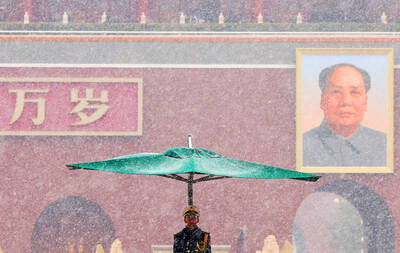
Chinese dissident artist Gao Zhen (高兟), famous for making provocative satirical sculptures of former Chinese leader Mao Zedong (毛澤東), was tried on Monday over accusations of “defaming national heroes and martyrs,” his wife and a rights group said. Gao, 69, who was detained in 2024 during a visit from the US, faces a maximum three-year prison sentence, said his wife, Zhao Yaliang (趙雅良), and Shane Yi, a researcher at the Chinese Human Rights Defenders group which operates outside the nation. The closed-door, one-day trial took place at Sanhe City People’s Court in Hebei Province neighboring the capital, Beijing, and ended without a


 RSS
RSS