


Iran has installed many more uranium enrichment machines in an underground bunker, diplomatic sources said on Thursday, potentially paving the way for a significant expansion of work the West fears is ultimately aimed at making nuclear bombs.
Iran denies allegations it is seeking a nuclear weapons capability. However, its refusal to curb its nuclear enrichment program has prompted tough Western sanctions and has heightened speculation that Israel may attack its atomic sites.
In a possible sign of further Iranian defiance in the face of such pressure, several sources said Iran had put in place additional enrichment centrifuges in its Fordow facility, buried deep inside a mountain to protect it against enemy strikes.
One source suggested hundreds of machines had been installed.
In another development likely to worry the West, they said satellite imagery indicated Iran had covered a building at a military site that UN inspectors want to visit with a brightly colored, tent-like structure.
Western diplomats have said they believe Iran is cleansing the Parchin site to remove any evidence of illicit nuclear activity at a place where the UN nuclear watchdog suspects it has conducted tests that had a military dimension.
Covering the building in question — which is believed to house a steel chamber for explosives experiments — may allow Iran to carry out sanitization or other work there which would not be seen via satellite pictures.
One Western envoy said that the suspected clean-up at Parchin was “intensifying” and that this made it doubtful that inspectors from the International Atomic Energy Agency (IAEA) would uncover any hard evidence there, even if they were allowed to go.
“Given the extent of the clean-up, it is indeed unlikely the agency, if it ever gets access, would find anything at Parchin,” the diplomat said.
There was no immediate comment from Iran’s mission to the Vienna-based UN atomic agency. It has previously dismissed the allegations about Parchin, which it says is a conventional military facility, as “ridiculous.”
The IAEA would press Iran again in talks yesterday for access to Parchin as part of its long-stalled probe into suspected nuclear weapons research in the Islamic state, even though it concedes that the alleged sanitization would hamper its probe.
The meeting, the first since previous discussions ended in failure in June, takes place after an upsurge in rhetoric from Israeli politicians this month suggesting Israel might attack Iran ahead of the US presidential election in November.
The talks are separate from Tehran’s negotiations with world powers that have made little headway since they resumed after a 15-month hiatus, but the focus on suspicions about Iran’s nuclear ambitions mean they are closely linked.
Lack of movement in both sets of talks could strengthen Israel’s belief that tougher Western sanctions are failing to sway Tehran, its archenemy, which has threatened wide-ranging reprisals if attacked.
Iran is showing no sign of backing down over what it says is its inalienable right to civilian nuclear energy and has pushed ahead with expansion of Fordow since it was launched last year.
“Our basic understanding is that they were continuing to install,” a Vienna-based diplomat said, adding the new centrifuges at the site were not yet operating.
Another diplomatic source said Iran appeared to have completed installing two more cascades — interlocked networks of 174 centrifuges each — at Fordow.
If confirmed in a new IAEA report on Iran due next week, the two alleged new cascades would be in addition to six cascades that were previously installed, of which four were refining uranium.
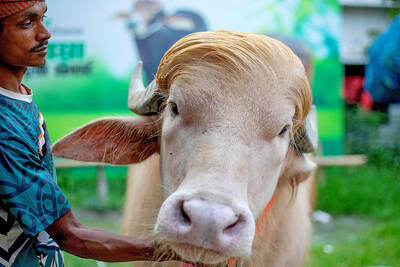
Crowds in Bangladesh are flocking to snap photographs with an unlikely social media star — an albino buffalo with flowing blond hair nicknamed “Donald Trump” that is due to be sacrificed within days. Owner Zia Uddin Mridha, 38, said his brother named the 700kg bull over its flowing helmet of hair resembling the signature look of the US president. “My younger brother picked this name because of the buffalo’s extraordinary hair,” he said at his farm in Narayanganj, just outside the capital, Dhaka. Mridha said that a constant stream of curious visitors — social media fans, onlookers and children — have come throughout

It began as a satirical online project. Now millions of young people in India are flocking to it as an outlet for their frustration. A parody political party called the Cockroach Janta Party, with the insect as its symbol, has exploded across India’s social media by turning absurdist humor into protest. Memes and short videos mocking corruption, joblessness and political dysfunction have flooded social media sites, where millions of users are embracing the cockroach — known for its ability to survive harsh conditions — as a tongue-in-cheek symbol of endurance. The online movement’s rise has been unusually rapid. The Cockroach Janta Party (CJP)
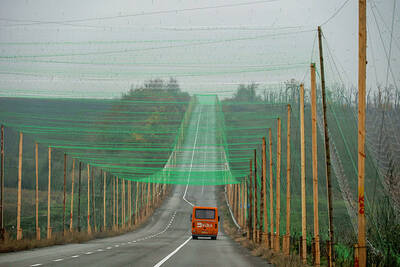
BIGGER ROLE: Beijing has said it maintains an impartial stance on the war in Ukraine, but by training Russian troops, China is far more involved than previously known China’s armed forces secretly trained about 200 Russian military personnel in China late last year, and some have since returned to fight in Ukraine, according to three European intelligence agencies and documents seen by Reuters. While China and Russia have held a number of joint military exercises since Moscow’s full-scale invasion of Ukraine in 2022, Beijing has repeatedly said that it is neutral in the conflict and presents itself as a peace mediator. The covert training sessions, which predominantly focused on the use of drones, were outlined in a dual-language Russian-Chinese agreement signed by senior Russian and Chinese officers in Beijing on
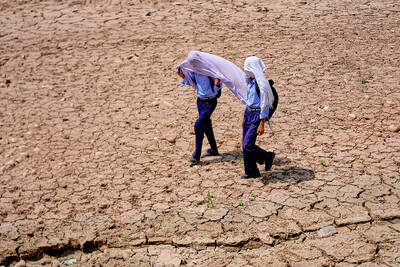
HOTTER: While Indians are accustomed to summer heat, climate change has caused northwestern India to warm faster than other parts of the country, an academic said Roads and markets have emptied during afternoons and some farmers have switched to nighttime work to avoid scorching temperatures as a heat wave grips large parts of India. The India Meteorological Department forecast maximum temperatures for yesterday of about 45°C in the capital, New Delhi, where authorities have opened temporary “cooling zones” to help people cope. The weather department warned that conditions would likely persist across several northern regions in the coming days, with temperatures staying well above seasonal averages. Authorities urged people to stay indoors during the hottest hours and take precautions against heat-related illnesses. India declares a heat wave whenever maximum temperatures


 RSS
RSS