


When Elaine Pearce left Sydney for the seaside peace of Old Bar 12 years ago she was assured her new house was a solid investment, with a century’s worth of frontage to guard against erosion.
But three neighbors have already lost their homes to the rising ocean and there are scores more at risk as roaring seas batter the idyllic beachside town, ploughing through 40m of foredune in just eight years.
“I wanted water frontage, and frontage I’m going to get,” Pearce joked.
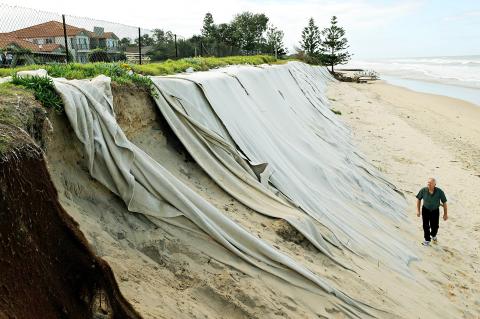
Photo: AFP
Property values have dived along her once exclusive cul-de-sac, with homes once worth A$1.5 or A$2 million (US$1.5 or US$2 million) now abandoned and offered for A$300,000. Weathered “For Sale” signs dot the sidewalk.
UNWANTED
Insurers will not cover homes for erosion and long-time local resident Allan Willan said the banks were even struggling to sell off the land on which the repossessed homes stand.
“They can’t even give it away,” said Willan, who estimates that another 5m of frontage could “easily” be lost in the next storm period.
“If it continues at this rate in seven years it’s going to be at the front door,” he said.
Old Bar is the most rapidly eroding and at-risk piece of coast in populous New South Wales (NSW) state, losing an average 1m of seafront every year and far outstripping other areas in terms of property at risk.
Andrew Short, director of Sydney University’s coastal studies unit and a government planning advisor, said the 4,000-person town was among the worst erosion sites in Australia, with huge volumes of sand routinely lost in storms.
HOT SPOTS
Currently there are 14 similar “hot-spots” along the densely populated NSW coast — a region home to some 5.8 million Australians — with about 100 properties at risk.
However, Short said “many hundreds of properties, if not thousands” would be at risk in the next 50 to 100 years as sea levels rise due to climate change, with planning authorities factoring in a 1m increase over the next century.
Australia’s government estimates that more than A$226 billion in commercial, industrial and residential property and road and rail infrastructure is at risk from erosion and inundation by 2100. That forecast includes 274,000 homes.
Old Bar has been in the grip of an unprecedented storm period, in terms of both frequency and strength, and University of New South Wales oceanographer Matthew England said it was a trend likely to intensify.
“The sea level rise is one thing, but we’re expecting storms to become more intense and storm surges are what really hits these low-lying coastal communities,” England said.
RISING WATERS
England said a 1m sea level rise could “really quickly” become 4m during a wild weather event, bringing “a really incredible rise of water right up the coast that just can do huge amounts of damage.”
Even with a 50cm sea-level rise the government has warned that severe weather events currently considered to be once in a century, such as the major flooding of Brisbane in 2010, would happen several times a year by 2100.
More than 30 people died and tens of thousands of homes were swamped in the floods that swept across northern Australia and peaked in the nation’s third-largest city, Brisbane, forcing the city to a standstill for several days.
Major cities were expected to face profound challenges from erosion and inundation, with the government warning in a 2009 report that Sydney’s airport faced closure in the next 100 years due to its low-lying waterfront location.
Ports, hospitals, power stations and other critical infrastructure were also deemed to be at risk.
Short said the issue was at a “tipping point” in the public’s consciousness, with new local planning guidelines showing future sea level projections and requiring people to take measures such as elevating their property.
MAMMOTH TASK
In the longer term, authorities faced a mammoth task to counter the problem, with roads, drainage systems and other infrastructure also needing lifting, he added.
England said Australia “certainly stands to be hit with massive increased costs” from sea level rise, with 85 percent of its population living near the coast and insurance and liability battles already looming in the courts.
“We’ve seen some properties already across the New South Wales coast being devalued by as much as 50 percent because of their vulnerability to storm surges,” he said. “And we’re only at the very start of the projected trend from human-induced climate change.”
The residents of Old Bar are banking on a government lifeline to help them build an A$10 million artificial reef offshore to protect their dwindling beach.
For her part, Pearce has little doubt about the cause: “Climate change. It’s worldwide, isn’t it.”

FAKE NEWS? ‘When the government demands the press become a state mouthpiece under the threat of punishment, something has gone very wrong,’ a civic group said The top US broadcast regulator on Saturday threatened media outlets over negative coverage of the Middle East war, after US President Donald Trump slammed critical headlines from the “Fake News Media.” The US president since his first term has derided mainstream media as “fake news” and has sued major outlets over what he sees as unfair coverage. Brendan Carr, head of the US Federal Communications Commission — which oversees the nation’s radio, television and Internet media — said broadcasters risked losing their licenses over news coverage. “The law is clear. Broadcasters must operate in the public interest, and they will

INFLUTENTIAL THEORIST: Habermas was particularly critical of the ‘limited interest’ shown by German politicians in ‘shaping a politically effective Europe Jurgen Habermas, whose work on communication, rationality and sociology made him one of the world’s most influential philosophers and a key intellectual figure in his native Germany, has died. He was 96. Habermas’ publisher, Suhrkamp, said he died on Saturday in Starnberg, near Munich. Habermas frequently weighed in on political matters over several decades. His extensive writing crossed the boundaries of academic and philosophical disciplines, providing a vision of modern society and social interaction. His best-known works included the two-volume Theory of Communicative Action. Habermas, who was 15 at the time of Nazi Germany’s defeat, later recalled the dawn of

The Chinese public maintains relatively warm sentiments toward Taiwan and strongly prefers non-military paths to improving cross-strait relations, a recent survey conducted by the Atlanta, Georgia-based Carter Center and Emory University showed. The “China Pulse” research project, which polled 2,506 adults between Oct. 27 last year and Jan. 1 this year, found that 86 percent of respondents support strengthening cultural ties, while 81 percent favor deepening economic interaction. The report, co-authored by political scientists at Emory University and advisors at the Carter Center, indicates that the Chinese public views Taiwan’s importance through a lens of shared history and culture rather than geopolitical

Cannabis-based medicines have shown little evidence of effectiveness for treating most mental health and substance-use disorders, according to a large review of past studies published in a major medical journal on Monday. Medical use of cannabinoids has been expanding, including in the US, Canada and Australia, where many patients report using cannabis products to manage conditions such as anxiety, post-traumatic stress disorder and sleep problems. Researchers reviewed data from 54 randomized clinical trials conducted between 1980 and May last year involving 2,477 participants for their analysis published in The Lancet. The studies assessed cannabinoids as a primary treatment for mental disorders or substance-use


 RSS
RSS