


A US cyberwar against Iran’s nuclear program may have only just begun and could escalate with explosions triggered by digital sabotage, experts say.
Although the Iranian regime remains vulnerable to more cyberattacks in the aftermath of the “Stuxnet” worm that disrupted its uranium enrichment work, Tehran may be receiving help from Russian proxies, some analysts say.
The nuclear program is “really not that well protected” from more digital assaults and Iran will be hard-pressed to safeguard its uranium enrichment efforts from tainted software, said David Albright, president of the Institute for Science and International Security.
“With Stuxnet, they lost about a year. And it caused a lot of confusion. They really didn’t know what hit them,” he said.
The US has every incentive to press ahead with a cybercampaign to undermine Iran’s atomic ambitions, according to analysts.
“I think that it could get more violent,” Albright said. “I would expect more facilities to blow up.”
“There is of course the possibility of sending in a team to modify a system in a way that would make it vulnerable, and then use a cyberweapon at a later date as a trigger event,” said David Lindahl, research engineer at the Swedish Defense Research Agency.
However, some cybersecurity experts suspect Russian proxies could be assisting Iran with its digital defense and possibly helped Tehran trace the origins of Stuxnet.
“The part that we probably miscalculated on in Stuxnet was the [possible] assistance of the Russians in attribution,” said James Lewis, senior fellow at the Center for Strategic and International Studies. “The Iranians never would have figured this out on their own.”
The elaborate Stuxnet malware caused centrifuges used to enrich uranium to spin out of control. The worm, meanwhile, sent back signals to operators indicating the centrifuges were operating normally.
After the malware was discovered in 2010, at least a thousand centrifuges had to be removed and analysts estimate Tehran’s program was set back by at least a year.
By pushing the boundaries of cyberwarfare, the US has left itself open to retaliation. Yet US officials clearly view the risks associated with digital strikes as dwarfed by those of an all-out war with Iran.
Air raids are “more likely to explode the region and certainly could lead to a conflict with Iran, and that would be very messy,” Lewis said. “Cyber[war] is much cleaner.”
Although unnamed officials told the New York Times that the US and Israel were behind the digital operations, cyberattacks allow for “plausible deniability,” Lewis said.
“Repeating something like Stuxnet or [computer virus] Flame will be much more difficult, because they [the Iranians] will spend a lot more energy trying to stop those activities,” Lindahl said. “But the defender needs to plug all holes, while the attacker need only find one.”

SPEAKING OUT: After Siranudh Scott’s allegations surfaced, celebrities and public figures took to social media to share their own experiences of sexual misconduct and abuse A high-profile alleged sexual abuse case within a wealthy Thai beer brewing family has prompted a wave of painful accounts from survivors of unconnected abuse in the conservative nation. Siranudh Scott, a member of the billionaire Thai family that founded the ubiquitous Singha beer brand, posted an emotional video this month accusing his elder brother Sunit of repeatedly abusing him when he was a teenager. Sunit, who is in his 30s, later denied the allegations in a video posted online, but Singha parent Boonrawd dismissed him from his executive role with the company on Tuesday last week. “I felt I needed to speak

SEEKING ORDER: Rodrigo Paz said that ‘anyone who wants to destroy the nation will have to deal with this president and the full force of the constitution’ Bolivian President Rodrigo Paz on Wednesday said that the nation was at a “breaking point” after nearly a month of protests that have caused shortages of food, fuel and medicine. Paz, who took office six months ago amid the worst economic crisis there in four decades, is battling a groundswell of fury over his policies. The political capital, La Paz, has been besieged by low-income workers and members of the indigenous majority calling for his resignation. “The country needs order and is reaching breaking point,” the 58-year-old said at a public event in La Paz, renewing his appeal for dialogue. On Tuesday, the Bolivian
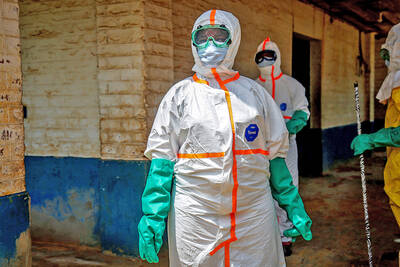
COMMUNITY CONFLICT: Concerns about disease spread from corpses has run up against friends and families’ desire to bury their dead as infection spreads in the area Angry residents of a town at the epicenter of the Ebola outbreak in the Democratic Republic of the Congo (DR Congo) attacked and burned a tent that was part of a health center where people are being treated for the virus, the staff there said Saturday. It was the second such attack in the region in a week. No one was hurt in the attack, according to reports but as patients ran out to escape the fire, 18 people with suspected Ebola infections fled the facility and are unaccounted for, a hospital director said. Angry residents arrived at the clinic in the

Forecasters in Europe yesterday warned of exceptional heat as record temperatures driven by a “heat dome” push temperatures well above seasonal norms across the continent. The surge follows a record-breaking Monday, with France logging its hottest day in the month of May on record, its weather agency said, and the UK also posting unprecedented highs. A so-called “heat dome” of warm air from northern Africa trapped under a high-pressure system over western Europe is behind the high temperatures not usually seen until high summer. Restrictions on outdoor work were imposed in parts of Italy, beaches in southwest France filled earlier than usual and


 RSS
RSS