


The gates of one of Nepal’s top private schools swing open and 20 children who hope to be the doctors, lawyers and scientists of tomorrow spill out into a smart Kathmandu suburb.
However, while their classmates come from the country’s wealthiest elite, these children were rescued seven years ago, dirty and sick, from a cowshed on the edge of the capital.
“I want to be a pilot when I leave school. I’d like to study science at university, maybe in France,” says Rita Bhandari, 14, who is in the top 2 percent of her year group at the prestigious Gyanodaya Bal Batika School.
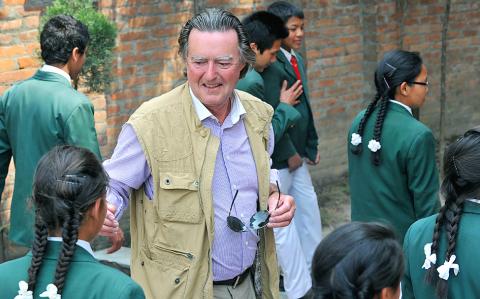
Photo: AFP
Like her 19 friends, Rita was handed to traffickers in impoverished western Nepal by her family in the hope of giving her a life away from the brutal civil war then sweeping through the countryside.
The children’s journey from the remote district of Humla saw them end up on the unforgiving streets of Kathmandu, where children are sold as sex slaves or forced into back-breaking labor in brick factories and mills.
Their salvation came when they were discovered by Irish businessman Gene Lane-Spollen and his wife, Maura, who were visiting Nepal and heard about a group of children living in a cattle shed.
“It was a cold March day and there was no sign of the children because it was dark,” said Gene, 64, a retired Coca-Cola executive who is based with his wife in France.
“We went upstairs on a ladder and there was no light, no windows upstairs at all. When your eyes got used to the dark you could see something and then we realized the barn was full of kids,” he said. “There was one big string across the room with all the clothes chucked over it and there was nothing else — not even any straw on the floor.”
Gene and Maura took all 20 children — who were then aged between three and nine — and set up a charity to house and educate them, enrolling the group in a local school to teach them to read and speak English and Nepali rather than their tribal language.
“Over the course of the next couple of years we found the children were developing a real sense of ambition or competitiveness among themselves, even though they lived as a big family,” Gene said.
The couple return frequently to monitor the pupils’ progress after appointing carers to instill a regime of study and discipline that has seen the youngsters catching and then overtaking their more affluent classmates.
Rita’s success is all the more remarkable given her start in life, losing her father in the 1996-2006 Maoist civil war and having to leave her mother and younger brother and sister behind when she was sent to Kathmandu.
“Gene is like our godfather,” she told reporters. “He changed my life.”
Most of the students have never been back to Humla and they get to ring home just once every other month, but many talk about returning one day.
“I will go back to my village and I will try to develop it. I want to help other people by establishing a school,” said Basanta Budhathoki, 15.
Chand Rai, who runs the home with his wife, Menuka, says he feels “blessed” to be the group’s surrogate father.
Rai said the children were not treated differently by their more affluent classmates at school as they have earned respect by being good at sport and lessons.
He admitted problems occasionally arise when they see their richer friends enjoying cinema trips and other privileges.
The children rise at 6am for prayers before their chores, and study for an hour before school. They are allowed an hour to unwind after classes, but then it’s back to the books. It is the strict routine which sets the home apart from other care centers in Kathmandu, where children are left to their own devices and often end up back on the streets.
But it is not cheap: Accommodation and schooling costs for the group amount to around 2.8 million rupees (US$35,000) a year, with Gene and Maura covering most of the expense and donors making up the rest.
“If they have good food, good medicine, good management and a good school, there’s nothing to stop them,” Gene said. “They can be whatever they want.”

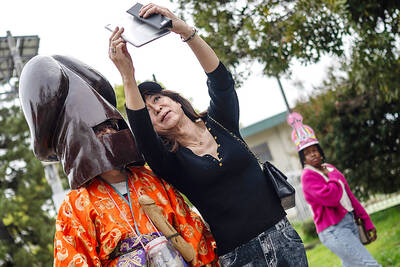
Showcasing phallus-shaped portable shrines and pink penis candies, Japan’s annual fertility festival yesterday teemed with tourists, couples and families elated by its open display of sex. The spring Kanamara Matsuri near Tokyo features colorfully dressed worshipers carrying a trio of giant phallic-shaped objects as they parade through the street with glee. The festival, as legend has it, honors a local blacksmith in the Edo Period (1603-1868) who forged an iron dildo to break the teeth of a sharp-toothed demon inhabiting a woman’s vagina that had been castrating young men on their wedding nights. A 1m black steel phallus sits in the courtyard of

HIGH HOPES: The power source is expected to have a future, as it is not dependent on the weather or light, and could be useful for places with large desalination facilities A Japanese water plant is harnessing the natural process of osmosis to generate renewable energy that could one day become a common power source. The possibility of generating power from osmosis — when water molecules pass from a less salty solution to a more salty one — has long been known. However, actually generating energy from that has proved more complicated, in part due the difficulty of designing the membrane through which the molecules pass. Engineers in Fukuoka, Japan, and their private partners think they might have cracked it, and have opened what is only the world’s second osmotic power plant. It generates

JAN. 1 CLAUSE: As military service is voluntary, applications for permission to stay abroad for over three months for men up to age 45 must, in principle, be granted A little-noticed clause in sweeping changes to Germany’s military service policy has triggered an uproar after it emerged that the law requires men aged up to 45 to get permission from the armed forces before any significant stay abroad, even in peacetime. The legislation, which went into effect on Jan. 1 aims to bolster the military and demands all 18-year-old men fill out a questionnaire to gauge their suitability to serve in the armed forces, but stops short of conscription. If the “modernized” model fails to pull in enough recruits, parliament will be compelled to discuss the reintroduction of compulsory service, German
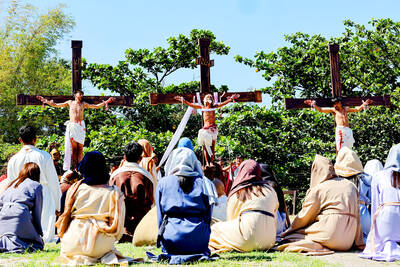
Hundreds of Filipinos and tourists flocked to a sun-bleached field north of Manila yesterday, on Good Friday, to witness one of the country’s most blood-soaked displays of religious fervor, undeterred by rising fuel prices. Scores of bare-chested flagellants with covered faces walked barefoot through the dusty streets of Pampanga Province’s San Fernando as they flogged their backs with bamboo whips in the scorching heat. Agence France-Presse (AFP) journalists said they saw devotees deliberately puncturing their skin with glass shards attached to a small wooden paddle to ensure their bleeding during the ritual, a way to atone for sins and seek miracles from


 RSS
RSS