


As the snow drifts through the towering evergreen trees, silence enshrouds this remote pilgrimage site, a place some consider the Bethlehem of North Korea.
It was in a rustic log cabin at the foot of Mount Paektu where Kim Il-sung, the founder of modern North Korea, led the fight for his country’s independence from Japanese imperialism more than 70 years ago, according to state-sanctioned accounts. Nearby is the lodge where his son and eventual heir, Kim Jong-il, was born, the accounts say.
The story of Kim Il-sung’s exploits at Mount Paektu is seen as the genesis of the official history of North Korea, a legend that borrows heavily from the methods and symbols of religion in a largely atheistic country.
As North Korea celebrates the centenary of Kim Il-sung’s birth, his past, like the misty peaks of Mount Paektu, remains veiled in myth. Some foreign historians dispute parts of Kim Il-sung’s eight-volume memoirs as well as the official biography published by North Korea in 2001, and many details are impossible to verify.
However, the prodigiously detailed memoirs do suggest that he drew from a wide range of early influences, including Christianity, Confucianism, communism and a native movement called Chondoism, to craft the mythology used to justify and enshrine his family’s rule.
“Kim [Il-sung] turned his whole family into a divine entity,” said historian Song Bong-sun at Korea University in South Korea. “He knew theocracies last longer than any type of regime.”
Though Kim Il-sung’s ancestral roots were in the southern city of Jeonju, he was born outside Pyongyang in 1912 to a poor, but devout Christian family of tenant farmers. He was named Kim Song-ju, or “pillar of the country.”
Years before his birth, US missionaries had arrived in Pyongyang, the nation’s capital, with books, medicine and Bibles. They were so successful in converting locals that by 1907 the city became known as the “Jerusalem of the East,” according to missionary accounts.
Kim Il-sung writes in his memoirs that he often accompanied his mother to church, although he later downplays her devotion by saying she mainly considered church a place of rest and respite.
Kim Il-sung also insists that his father, born to a church elder and schooled by missionaries, urged him to “believe in your own country and in your own people rather than in Jesus Christ.”
KIM’s COMMANDMENTS
Despite his later efforts as president to restrict religion, Kim Il-sung readily acknowledges the presence of Christians and Christianity in his early life. Its influence is clear: The 10 Principles of Kim Il-sung’s ideological philosophy hint at the 10 Commandments of Christianity and all three Kim rulers are referred to as “heaven-sent.”
At the time of Kim Il-sung’s birth, Korea was two years into colonial rule by Japan, a period Kim describes in his memoirs as a “living hell” for Koreans. Koreans were ordered to take Japanese names and speak only Japanese, in a bid to obliterate their language and culture.
The fight for Korea’s independence is a dominant theme in Kim Il-sung’s memoirs, called With the Century, apparently written in 1992 at age 80. Kim places himself in a long line of patriots, claiming that his great-grandfather played a key role in a famous attack on a US ship, the General Sherman, as it sailed up the Taedong River in 1866.
In his memoirs, he recalls what he describes as a momentous gathering in a bare room in Oct. 17, 1926, when he and his friends created the Down-with-Imperialism Union, and elected him president. Kim Il-sung says he considers that organization the root of the current ruling Workers’ Party of North Korea.
By 1927, he writes, activists had decided to make Mount Paektu their base. In 1929, at age 17, he was thrown into jail. He says in his memoirs that he used the time to plot an armed Korean revolution.
Kim Il-sung’s biography says he set up his guerrilla base in Manchuria in the early 1930s and sought to push across the border by establishing headquarters at Mount Paektu by 1936. However, some experts feel it is not clear whether he ever lived at Mount Paektu and Song says that Kim more likely served with communist Chinese forces rather than leading an independent guerrilla army.
Densely forested Paektu, straddling the Korean-Chinese border, was both a strategic defensive choice and a savvy symbolic one. Mount Paektu is Korea’s highest peak and its most volatile, with an active volcano that still threatens to erupt. It is where Korea’s first founder, the mythical Tangun, is said to have descended 5,000 years ago.
In the early 1940s, Kim Il-sung was back in Manchuria and made forays back to the secret camp at Mount Paektu, according to his official biography. A month after Japan’s defeat in August 1945, he sailed back to Korea with the Soviet army, clad in a Soviet military uniform, according to most accounts. He was 33.
As the Soviets and US divided trusteeship of liberated Korea along the 38th parallel, Soviet-backed Kim Il-sung stepped into the void left by the end of Japanese colonial rule. When Seoul held its own separate elections in 1948, a new nation sprang up in the north that September: the Democratic People’s Republic of Korea, with Kim Il-sung as head of state.
LOYALTY AND DEVOTION
During his career, Kim Il-sung created and served in every top title in North Korea: premier, chairman of the Central Military Commission, supreme commander of the army, general secretary of the Central Committee of the Workers’ Party and finally, president. Schooling, medical care and housing were all free. However, in return he demanded filial, near-religious loyalty and an adherence to the militaristic rules that govern life in North Korea.
Kim Il-sung also turned isolation into part of North Korea’s creed through a juche philosophy, which calls on his people to summon self-reliance even during hard times, such as the famine of the mid-1990s that killed hundreds of thousands of people.
“The juche spirituality is the force that unites North Koreans in the most dire situations,” said Shin Eun-hee, a Korean-Canadian theology professor at Seoul’s Kyunghee University who has lectured at Kim Il-sung University in the past.
Kim Il-sung threw the same mantle of reverence over his family, calling his son Kim Jong-il a “great man of the Mount Paektu type,” who shared his ideas and his personality.
That status now has been extended to grandson Kim Jong-un, who took over as leader following Kim Jong-il’s death in December last year.
The extent of reverence for the Kims can take foreigners by surprise — every sentence is prefaced with thanks to leaders and they are given credit for every achievement, small and large. Such aphorisms can seem practiced or obligatory; indeed, it is practically state law to pay thanks to the Kims.
“The process in which people start to see God and Jesus as absolute entities is very similar to the way Kim Il-sung and Kim Jong-il are revered,” observed Lee Su-won, a North Korea researcher at Dongguk University in Seoul.
Biblical shades come through clearly in the legend of Kim Jong-il’s birth at Paektu in 1942.
Some accounts suggest Kim Jong-il was born in Siberia in 1941. However, according to North Korea, his mother, Kim Jong-suk, gave birth to the future leader in a simple log cabin at the height of winter in 1942, swaddling the infant with military blankets until fellow guerrilla fighters came to her with a quilt stitched together with salvaged scraps of cloth. Guerrilla fighters spread the news of the baby’s arrival in messages painted in ink on the bark of trees across the Paektu region, the official history says.
Kim Il-sung’s memoirs make other religious and cultural references.
For instance, he recounts visiting an ethnic Korean community living on the Chinese side of Mount Paektu where most followed a religion called Chonbulgyo. He cites their belief that 99 fairies descend daily from the heavens to bathe in Lake Chon on Mount Paektu and that the people built a 99-room temple to house them.
Kim Il-sung also describes being intrigued by the Chondo religion, a native Korean movement characterized by the idea that all men are equal and bear the spirit of the heaven in themselves, said Jeong Jeong-sook, a chief educator for the sect in Seoul. As with juche, Chondoists consider people to be the masters of their own fates, Jeong said.
Freedom of religion is enshrined in North Korea’s constitution and there are still several sanctioned churches and Buddhist temples across the country. However, Kim Il-sung frowned upon the practice of religion and the official number of followers dropped drastically after he took power.
ALTAR-LIKE
By contrast, Mount Paektu has been recreated as an altar of sorts to Kim Il-sung, his wife and his son, who routinely are referred to as the “three commanders of Mount Paektu.”
By the 1980s, very little was left of the simple log cabins built in the 1930s apart from some decaying timber and a few charcoal briquettes. However, Kim Il-sung retraced his steps in 1986 and researchers unearthed a few cooking utensils that once belonged to his wife in the spot where the cabin once stood, guide Kim Kum-ran said. He ordered the encampments rebuilt the way they looked in 1937, down to the roebuck deer hooves used as door handles, she said.

Kouri Richins, a Utah mother who published a children’s book about grief after the death of her husband is to serve a life sentence for his murder without the possibility of parole, a judge ruled on Wednesday. Richins was convicted in March of aggravated murder for lacing a cocktail given to her husband, Eric Richins, with five times the lethal dose of fentanyl at their home near Park City in 2022. A jury also found her guilty of four other felonies, including insurance fraud, forgery and attempted murder for trying to poison her husband weeks earlier on Feb. 14, 2022, with a
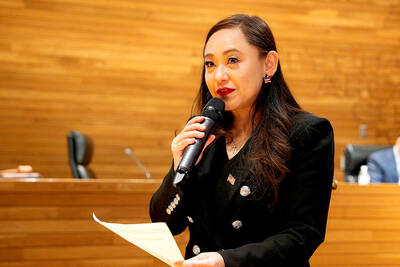
‘PERSONAL MISTAKES’: Eileen Wang has agreed to plead guilty to the felony, which comes with a maximum sentence of 10 years in federal prison A southern California mayor has agreed to plead guilty to acting as an illegal agent for the Chinese government and has resigned from her city position, officials said on Monday. Eileen Wang (王愛琳), mayor of Arcadia, was charged last month with one count of acting in the US as an illegal agent of a foreign government. She was accused of doing the bidding of Chinese officials, such as sharing articles favorable to Beijing, without prior notification to the US government as required by law. The 58-year-old was elected in November 2022 to a five-person city council, from which the mayor is selected
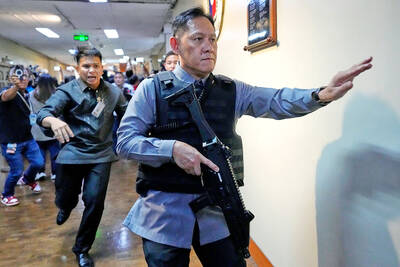
DELA ROSA CASE: The whereabouts of the senator, who is wanted by the ICC, was unclear, while President Marcos faces a political test over the senate situation Philippine authorities yesterday were seeking confirmation of reports that a top politician wanted by the International Criminal Court (ICC) had fled, a day after gunfire rang out at the Philippine Senate where he had taken refuge fearing his arrest. Senator Ronald “Bato” dela Rosa, the former national police chief and top enforcer of former Philippine president Rodrigo Duterte’s “war on drugs,” has been under Senate protection and is wanted for crimes against humanity, the same charges Duterte is accused of. “Several sources confirmed that the senator, Senator Bato, is no longer in the Senate premises, but we are still getting confirmation,” Presidential
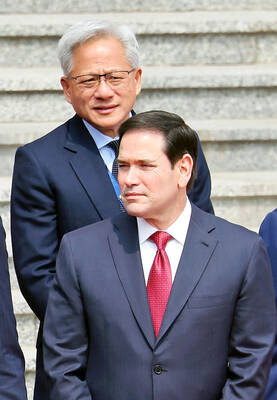
HELP DENIED? The US Department of State said that the Cuban leadership refuses to allow the US to provide aid to Cubans, ‘who are in desperate need of assistance’ US Secretary of State Marco Rubio on Wednesday said that Cuba’s leadership must change, as Washington renewed an offer of US$100 million in aid if the communist nation agrees to cooperate. Cuba has been suffering severe economic tumult led by an energy shortage that plunged 65 percent of the country into darkness on Tuesday. Cuba’s leaders have blamed US sanctions, but Rubio, a Cuban American and critic of the government established by Fidel Castro, said the system was to blame, including corruption by the military. “It’s a broken, nonfunctional economy, and it’s impossible to change it. I wish it were different,” he told


 RSS
RSS