


A plan by Persian Gulf countries to funnel millions of US dollars a month to Syrian rebels — payments earmarked for salaries for the fighters — could amount to a blank check for the opposition to build up an arsenal against Syrain President Bashar al-Assad’s forces, analysts say.
Although it might not be enough to turn the tide of the conflict, the money shows how Persian Gulf nations are using their enormous oil wealth to influence the direction of the Arab Spring and exert their status as a growing political force and counterweight to rival Iran.
However, as the violence drags on, there are concerns the promised funding could lead to even more bloodshed in the al-Assad regime’s crackdown on an uprising that has killed 9,000 people since March last year and appears to be descending into a civil war with dangerous sectarian overtones.
“My fear is that it will be a turning point, but not for the rebels,” said Fawaz Gerges, director of the Middle East Center at the London School of Economics.
Gerges said the conflict could become a “war by proxy” with powerful international players.
“No one knows what the cost of such a conflict will be on Syria and the region,” he said.
The money from the Persian Gulf nations is part of broader group of pledges by more than 70 countries, including the US, to send funds to dissidents inside Syria as diplomatic efforts have failed to oust al-Assad. The latest effort by UN-Arab League envoy Kofi Annan would have the regime pull back its troops by Tuesday, although there has been no letup in violence since Syria agreed to a ceasefire last week.
Desperately outgunned rebel fighters bemoan their inferior arms and the rising costs of weapons, and say only powerful munitions will allow them to face al-Assad’s large, professional army.
Details of the money pipeline are unclear. There is still no agreement on sending weapons directly to the rebels, in part because the opposition is loosely organized and it is not clear who exactly would get the weapons.
Western countries have refused to arm the rebels, saying it could usher in a civil war.
However, on Sunday, participants at a “Friends of the Syrian People” conference in Istanbul, Turkey, said Saudi Arabia and other Persian Gulf countries were creating a fund to pay members of the rebel Free Syrian Army and soldiers who defect from the regime and join opposition ranks.
One participant, who confirmed the Persian Gulf plan on condition of anonymity because details were still being worked out, said the fund would involve several million US dollars a month.
Louay Safi, a member of the opposition Syrian National Council, said on Monday that there is a “clear commitment” by Saudi Arabia, Qatar and the US for a fund to “help squeeze the Assad regime.”
“A great deal” of the fund would go for humanitarian aid, the opposition’s communication needs, but some would also go for the Free Syrian Army, he said.
The money is said to be -earmarked for salaries, but it was not clear whether there would be any effort to prevent the diversion of money to weapons purchases — a development that would bring new calls of “foreign meddling” by the regime.
Syria, which says the uprising is being driven by a foreign conspiracy, not popular will, dismissed the Istanbul gathering as a failure on Monday.
The state-run Tishrin daily said the decision to fund the rebels “demonstrates the size of foreign involvement in fueling the events in Syria.”
The upheaval in Syria presents an opportunity for the Persian Gulf’s Sunni rulers to bolster their influence and possibly leave Shiite powerhouse Iran without the critical alliances that flow through Damascus. Al-Assad’s regime, which is allied strongly with Iran, is led by the minority Alawite sect, an offshoot of Shiism.
Syria’s ties with the Persian Gulf nations have been strained in the past; al-Assad once called Saudi King Abdullah and other Arab leaders “half men” for being critical of Hezbollah over the 34-day war between the Shiite militant group and Israel in 2006.
Now, the Persian Gulf nations are leading the charge to oust al-Assad.
Although the rebels have said they are running low on cash and weapons, Damascus has a steady supply of arms from Russia and the backing of Iran. Money from the Persian Gulf states could go toward evening out the balance.
The Persian Gulf nations have used their power and money in different ways during the Arab Spring.
They stuck by former Egyptian president Hosni Mubarak until the very end of his regime, but sided against slain Libyan leader Muammar Qaddafi. Qatar opened money channels for Libyan opposition forces and helped coordinate the sale of rebel-held oil at a critical moment. Qatar and the United Arab Emirates also contributed to the NATO-led military mission that targeted Libyan troops and their arsenals.
At home, Persian Gulf leaders have opened the vaults to try to buy off possible dissent with a flood of new civil servant posts and handouts. In Saudi Arabia alone, nearly US$100 billion has been earmarked to boost services and jobs.
When Shiites rose up against the Sunni monarchy in Bahrain, Saudi Arabia sent troops to help the tiny Persian Gulf nation crush the protests — a move that was denounced by many as a sign of deep hypocrisy.
The funding pledges for Syria’s rebels could become the most vivid example of the Persian Gulf’s checkbook strategies amid the region’s upheavals. It is seen in Persian Gulf capitals as an investment to put their stamp on a possible post-al-Assad government and deliver a blow to rival Iran, which is not only an ally of al-Assad, but a patron of Hezbollah, as well.
Last week, Iranian Supreme Leader Ayatollah Ali Khamenei strongly opposed foreign intervention in Syria and made clear Iran would stand by al-Assad. For months, Washington has said Tehran was helping Damascus in its crackdown.
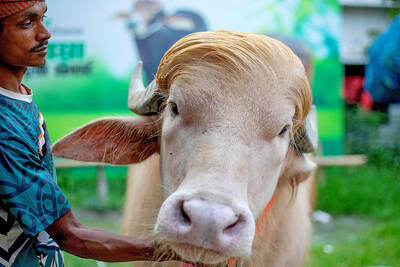
Crowds in Bangladesh are flocking to snap photographs with an unlikely social media star — an albino buffalo with flowing blond hair nicknamed “Donald Trump” that is due to be sacrificed within days. Owner Zia Uddin Mridha, 38, said his brother named the 700kg bull over its flowing helmet of hair resembling the signature look of the US president. “My younger brother picked this name because of the buffalo’s extraordinary hair,” he said at his farm in Narayanganj, just outside the capital, Dhaka. Mridha said that a constant stream of curious visitors — social media fans, onlookers and children — have come throughout

It began as a satirical online project. Now millions of young people in India are flocking to it as an outlet for their frustration. A parody political party called the Cockroach Janta Party, with the insect as its symbol, has exploded across India’s social media by turning absurdist humor into protest. Memes and short videos mocking corruption, joblessness and political dysfunction have flooded social media sites, where millions of users are embracing the cockroach — known for its ability to survive harsh conditions — as a tongue-in-cheek symbol of endurance. The online movement’s rise has been unusually rapid. The Cockroach Janta Party (CJP)
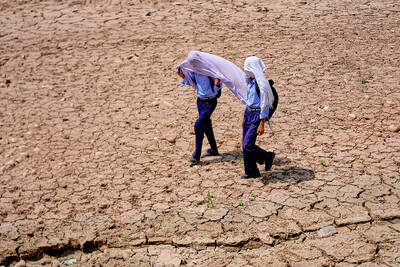
HOTTER: While Indians are accustomed to summer heat, climate change has caused northwestern India to warm faster than other parts of the country, an academic said Roads and markets have emptied during afternoons and some farmers have switched to nighttime work to avoid scorching temperatures as a heat wave grips large parts of India. The India Meteorological Department forecast maximum temperatures for yesterday of about 45°C in the capital, New Delhi, where authorities have opened temporary “cooling zones” to help people cope. The weather department warned that conditions would likely persist across several northern regions in the coming days, with temperatures staying well above seasonal averages. Authorities urged people to stay indoors during the hottest hours and take precautions against heat-related illnesses. India declares a heat wave whenever maximum temperatures
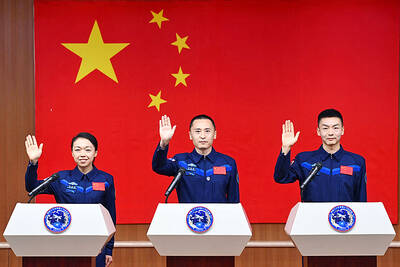
A Hong Kong astronaut is to join a Chinese space mission for the first time as part of a three-person crew launching today, as Beijing edges closer to its goal of landing people on the moon. The Tiangong space station — crewed by teams of three astronauts that are typically rotated every six months — is the crown jewel of China’s space program, boosted by billions in state investment in a bid to catch up with the US and Russia. The Shenzhou-23 mission is to blast off at 11:08pm from the Jiuquan Satellite Launch Center in northwestern China, carrying three astronauts to


 RSS
RSS