


Iranian media were largely silent yesterday on the US Navy’s rescue of 13 Iranians held by pirates in the Arabian Sea, making little mention of the incident — or that the US ships included an aircraft carrier Tehran had warned out of the region.
The official Islamic Republic News Agency (IRNA) reported only that a US warship “claimed” to have saved the Iranian fishermen from a weeks-long ordeal as captives of Somalian pirates.
“So far, Islamic Republic of Iran’s armed forces staff has not confirmed” the incident, IRNA said.
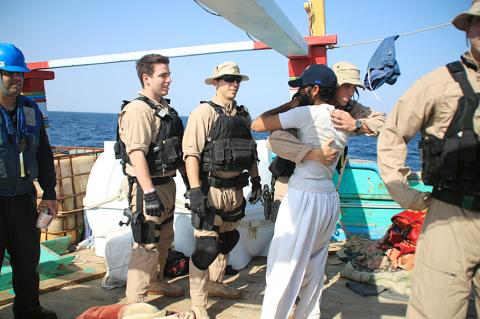
Photo: Reuters
The US said the rescue took place on Thursday by the USS Kidd, one of several warships escorting the aircraft carrier USS John C. Stennis, after the captain of the Iranian fishing dhow asked for help.
On Tuesday, Iranian military chiefs had warned the Stennis, which is currently attached to the US Fifth Fleet based in Bahrain, to stay out of the Gulf. Otherwise it would face the “full force” of Iran’s navy, spokesman Commodore Mahmoud Mousavi said.
A New York Times reporter and photographer, who were traveling on the Stennis, went aboard the Iranian fishing vessel, al-Mulahi, and spoke with its crew, as well as with several of the Somalians arrested by the US.
“It is like you were sent by God,” one of the Iranian fishermen, Fazel Ur Rehman, 28, was quoted as telling his US rescuers.
The captain, Mahmed Younes, 28, told the New York Times the pirates had captured his vessel in late November and had since been using it as a mother ship for their operations around the region.
Photographs of the Iranian dhow and crew, and of the arrested pirates, were published on the New York Times Web site.
A Pentagon spokesman, Captain John Kirby, said the Iranians and their dhow were released to make their way back to Iran, with fuel and provisions supplied by the Stennis’ carrier group.
The rescue came at a delicate time in the West’s longrunning showdown with Iran over its nuclear program, with Washington and its allies ramping up sanctions to try secure a change of heart from Tehran.
Iran has reacted by threatening to close the Strait of Hormuz, which links the Gulf to the Arabian Sea, and has warned against the Stennis’ redeployment to the Gulf.
The US has said it will not tolerate any closure of the strait — through which 20 percent of the world’s oil flows — and has insisted that it will continue to deploy warships to the Gulf.

Kouri Richins, a Utah mother who published a children’s book about grief after the death of her husband is to serve a life sentence for his murder without the possibility of parole, a judge ruled on Wednesday. Richins was convicted in March of aggravated murder for lacing a cocktail given to her husband, Eric Richins, with five times the lethal dose of fentanyl at their home near Park City in 2022. A jury also found her guilty of four other felonies, including insurance fraud, forgery and attempted murder for trying to poison her husband weeks earlier on Feb. 14, 2022, with a

DELA ROSA CASE: The whereabouts of the senator, who is wanted by the ICC, was unclear, while President Marcos faces a political test over the senate situation Philippine authorities yesterday were seeking confirmation of reports that a top politician wanted by the International Criminal Court (ICC) had fled, a day after gunfire rang out at the Philippine Senate where he had taken refuge fearing his arrest. Senator Ronald “Bato” dela Rosa, the former national police chief and top enforcer of former Philippine president Rodrigo Duterte’s “war on drugs,” has been under Senate protection and is wanted for crimes against humanity, the same charges Duterte is accused of. “Several sources confirmed that the senator, Senator Bato, is no longer in the Senate premises, but we are still getting confirmation,” Presidential

HELP DENIED? The US Department of State said that the Cuban leadership refuses to allow the US to provide aid to Cubans, ‘who are in desperate need of assistance’ US Secretary of State Marco Rubio on Wednesday said that Cuba’s leadership must change, as Washington renewed an offer of US$100 million in aid if the communist nation agrees to cooperate. Cuba has been suffering severe economic tumult led by an energy shortage that plunged 65 percent of the country into darkness on Tuesday. Cuba’s leaders have blamed US sanctions, but Rubio, a Cuban American and critic of the government established by Fidel Castro, said the system was to blame, including corruption by the military. “It’s a broken, nonfunctional economy, and it’s impossible to change it. I wish it were different,” he told

Myanmar yesterday published a parliamentary bill proposing the death sentence for those who detain or violently coerce people into working in online scam centers. Internet fraud factories have flourished in Myanmar, part of Southeast Asia’s scam economy, targeting Internet users worldwide with romance and cryptocurrency investment cons. The multibillion-dollar black market attracts many willing employees, but repatriated foreigners have also reported being trafficked to sites in Myanmar and tortured by scam center operators. The draft legislation would allow capital punishment for “violence, torture, unlawful arrest and detention, or cruel treatment against another person for the purpose of forcing them to commit online scams.” The


 RSS
RSS