


Syrian security forces, undaunted by the presence of Arab League observers, have killed at least 12 protesters as hundreds of thousands demonstrated against the government of Syrian President Bashar al-Assad, opposition activists said.
Five members of the security forces were also killed in a shooting in the city of Homs, the British-based Syrian Observatory for Human Rights said on Friday.
Al-Assad, 46, has signed up to an Arab League plan for a verifiable withdrawal of his troops and heavy weaponry from towns and cities, where they have been trying to crush protests that have raged since March.
However, the presence of Arab League monitors in hotspots across Syria since Monday has, if anything, energized the protesters, while provoking scepticism in Western countries.
Demonstrators determined to show the scale of their movement to the monitors threw rocks at security forces in the Damascus suburb of Douma, where troops tear-gassed the chanting crowds.
Five people were shot dead in the city of Hama and five in the city of Daraa as crowds braved army and police, the Observatory reported, adding that at least two dozen people had been injured in Douma.
“We are determined to show them [the monitors] we exist. Whether or not there’s bloodshed is not important,” an activist named Abu Khaled said by phone from the northern city of Idlib.
Most foreign media are banned from Syria and witness reports and videos are hard to verify.
An opposition supporter named Manhal said thousands had tried to reach the main square of Idlib to start a sit-in, but failed “because the security forces are firing a lot of tear gas and a few rounds of live fire.”
“People hoped the presence of monitors will prevent fierce attacks,” he said.
The Observatory said security forces had shot dead two people and wounded 37 in Idlib province.
Amateur video from Idlib showed monitors in white baseball caps and yellow safety vests wading through a sea of protesters.
Protesters flooded the streets of many towns, shouting: “Peaceful, peaceful,” and “The people want you executed, Bashar!”
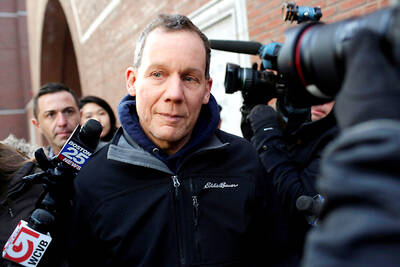
An American scientist convicted of lying to US authorities about payments from China while he was at Harvard University has rebuilt his research lab in Shenzhen, China, to pursue technology the Chinese government has identified as a national priority: embedding electronics into the human brain. Charles Lieber, 67, is among the world’s leading researchers in brain-computer interfaces. The technology has shown promise in treating conditions such as amyotrophic lateral sclerosis and restoring movement in paralyzed people. It also has potential military applications: Scientists at the Chinese People’s Liberation Army have investigated brain interfaces as a way to engineer super soldiers by boosting

Indonesian police have arrested 13 people after shocking images of alleged abuse against small children at a daycare center went viral, sparking outrage across the nation, officials said on Monday. Police on Friday last week raided Little Aresha, a daycare center in Yogyakarta on Java island, following a report from a former employee. CCTV footage circulating on social media showed children, most younger than two, lying on the floor wearing only diapers, their hands and feet bound with rags. The police have confirmed that the footage is authentic. Police said they also found 20 children crammed into a room just 3m by 3m. “So
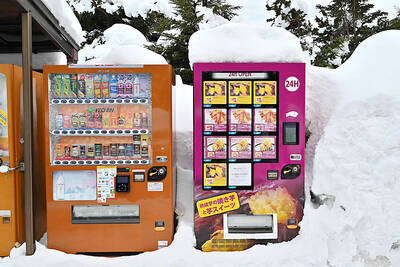
From post offices and parks to stations and even the summit of Mount Fuji, Japan’s vending machines are ubiquitous, but with the rapid pace of inflation cooling demand for their drinks, operators are being forced to rethink the business. Last month beverage giant DyDo Group Holdings announced it would remove about 20,000 vending machines — about 7 percent of their stock nationwide — by January next year, to “reconstruct a profitable network.” Pokka Sapporo Food & Beverage, based in Nagoya, also said last month it would sell its 40,000-machine operation to Osaka-based Lifedrink Co. “The strength of the vending machine
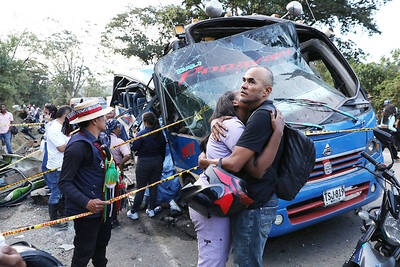
A highway bomb attack in a restive region of southwestern Colombia on Saturday killed 14 people and injured at least 38, the latest spate of violence ahead of next month’s presidential election. Authorities blamed the attack in the Cauca department — a conflict-ridden, coca-growing region — on dissidents of the now-disbanded FARC guerrilla army, who have been sowing violence across the country. “Those who carried out this attack ... are terrorists, fascists and drug traffickers,” Colombian President Gustavo Petro said on social media. “I want our very best soldiers to confront them,” he added. The leftist leader blamed the bombing


 RSS
RSS