


US President Barack Obama’s administration said that it was hitting two Lebanese-Colombian men and dozens of companies they run with sanctions for allegedly laundering money on behalf of Mexican and Colombian drug cartels.
Officials said on Thursday that one of the companies was tied to an alleged drug kingpin who has been accused of running a money-laundering scheme on behalf of the militant group Hezbollah.
The move blocks any assets in the US belonging to Lebanese-Colombian nationals Jorge Fadlallah Cheaitelly and Mohammed Zouheir El Khansa, and blocks Americans from doing business with them.
Panamanian and Colombian authorities did not immediately return calls seeking comment.
The US Treasury Department said Cheaitelly leads a Panama-based drug trafficking and money laundering organization with operations as far as Hong Kong. El Khansa is seen as a key partner.
The department also applied sanctions to nine people with ties to the men, and 28 entities in Colombia, Panama, Lebanon and Hong Kong.
The companies placed under US sanction include electronics stores, luggage outlets and several money-exchange businesses.
Office of Foreign Assets Control Director Adam Szubin said the US was forcing a major money laundering network out of the international financial system, undermining its ability to help the cartels.
According to the Treasury Department, Cheaitelly has ties with Ayman Joumaa, who has been indicted in US federal court on charges of leading a drug conspiracy that provided income for Hezbollah, which has been designated by the US State Department as a terrorist organization since 1997.
The Drug Enforcement Administration has alleged that Joumaa’s organization laundered money using 50 used car lots in the US. Cars were exported to Lebanon and West Africa.

SPEAKING OUT: After Siranudh Scott’s allegations surfaced, celebrities and public figures took to social media to share their own experiences of sexual misconduct and abuse A high-profile alleged sexual abuse case within a wealthy Thai beer brewing family has prompted a wave of painful accounts from survivors of unconnected abuse in the conservative nation. Siranudh Scott, a member of the billionaire Thai family that founded the ubiquitous Singha beer brand, posted an emotional video this month accusing his elder brother Sunit of repeatedly abusing him when he was a teenager. Sunit, who is in his 30s, later denied the allegations in a video posted online, but Singha parent Boonrawd dismissed him from his executive role with the company on Tuesday last week. “I felt I needed to speak

SEEKING ORDER: Rodrigo Paz said that ‘anyone who wants to destroy the nation will have to deal with this president and the full force of the constitution’ Bolivian President Rodrigo Paz on Wednesday said that the nation was at a “breaking point” after nearly a month of protests that have caused shortages of food, fuel and medicine. Paz, who took office six months ago amid the worst economic crisis there in four decades, is battling a groundswell of fury over his policies. The political capital, La Paz, has been besieged by low-income workers and members of the indigenous majority calling for his resignation. “The country needs order and is reaching breaking point,” the 58-year-old said at a public event in La Paz, renewing his appeal for dialogue. On Tuesday, the Bolivian
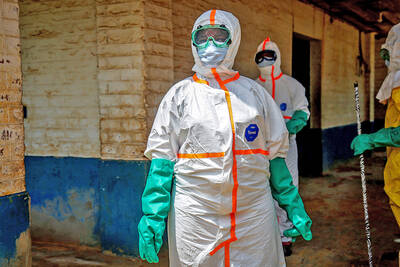
COMMUNITY CONFLICT: Concerns about disease spread from corpses has run up against friends and families’ desire to bury their dead as infection spreads in the area Angry residents of a town at the epicenter of the Ebola outbreak in the Democratic Republic of the Congo (DR Congo) attacked and burned a tent that was part of a health center where people are being treated for the virus, the staff there said Saturday. It was the second such attack in the region in a week. No one was hurt in the attack, according to reports but as patients ran out to escape the fire, 18 people with suspected Ebola infections fled the facility and are unaccounted for, a hospital director said. Angry residents arrived at the clinic in the

‘CROSSING THE LINE’: China’s embassy in Seoul criticized US Forces Korea Commander General Xavier Brunson, asking if his ‘hostile’ remarks were authorized by Washington South Korea and the US are in talks over recent public remarks by the commander of US Forces Korea, Seoul’s presidential office said yesterday, after the comments drew sharp criticism from China. In a recent podcast interview, US Forces Korea Commander General Xavier Brunson described South Korea as “the dagger in the heart of Asia” from China’s east coast, prompting the Chinese embassy in Seoul to say that he had “truly crossed the line.” The interview came amid growing speculation that Washington might seek to expand the role of US Forces Korea in countering the growing regional influence of China, a key


 RSS
RSS