


Pakistani President Asif Ali Zardari, who was in Dubai for medical treatment, returned yesterday to Pakistan, where tension is rising between his civilian government and the military over a memo accusing the country’s generals of plotting a coup.
It is not clear when the deeply unpopular leader who has uneasy ties with the army will return to work.
“The president is thankfully fit and healthy and that is why he has returned,” said Shazia Marri, information minister for Sindh province, of which Karachi is the capital. “However, his activities over the next few days will depend on what the doctors advise.”
Zardari could be damaged by the memo, reportedly crafted by the former Pakistani ambassador to the US, which wants ally Pakistan stable so it can help wind the war down in Afghanistan.
Businessperson Mansoor Ijaz, writing in a column in the Financial Times on Oct. 10, said a senior Pakistani diplomat had asked that a memo be delivered to the Pentagon with a plea for US help to stave off a military coup in the days after the raid that killed Osama bin Laden.
Ijaz later identified the diplomat as Husain Haqqani, the then-Pakistani ambassador to Washington who is close to Zardari.
Haqqani denied involvement in the memo, but resigned over the what has been dubbed “memogate.”
The Pakistani Supreme Court yesterday started hearings into a petition demanding an inquiry into who was behind it. As president, Zardari is immune from prosecution, but the controversy could seriously damage him politically.
If a link is proven, the military, which has long been distrustful of Zardari, could push for his ouster.
Although Zardari has been a largely ceremonial president since constitutional amendments last year, he wields considerable influence as leader of the ruling party and his forced departure would be a humiliation for the civilian leadership and would throw the country into turmoil.
While government officials have questioned Ijaz’s credibility, Pakistani army chief General Ashfaq Kayani has called for an investigation into the memo, which he said attempted to hurt national security.
Tension between Pakistan’s civilian government and military have bedeviled the nuclear-armed South Asian country for almost its entire existence, with the military ruling the country for more than half of its 64-year history after a series of coups.
About 30,000 Islamists staged a protest on Sunday to condemn the US and show support for Pakistan’s military, which has reasserted itself after a cross-border NATO attack and the memo that has weakened the civilian government.
Pakistan’s military, which has supported militants in Afghanistan and Indian Kashmir, was humiliated by the unilateral US special forces raid that killed bin Laden in a Pakistani town in May and faced unprecedented public criticism.
However, many Pakistanis rallied behind it after a Nov. 26 cross-border NATO air raid killed 24 Pakistani soldiers and plunged already troubled ties with Washington to a low point.
No evidence has emerged that the army was plotting a coup and the Pentagon at the time dismissed the memo as not credible.
Haqqani’s resignation was seen by many analysts as further weakening the civilian government, which is already beset by allegations of corruption and incompetence and is seen as failing to cope with many issues, such as the Taliban insurgency and a struggling economy.
The military, which determines security and foreign policy, dismisses any suggestion that it might stage a coup, but analysts say intervention could not be ruled out in the event of chaos.
Zardari was elected in 2008 on the back of a sympathy vote after his charismatic wife, former Pakistani prime minister Benazir Bhutto, was assassinated shortly after returning from self-exile.
The shortcomings of Zardari’s government might have only served to strengthen Pakistan’s generals and Zardari committed the cardinal sin for any Pakistani politician — he alienated the military.
At one point, Kayani hinted to the US ambassador to Islamabad that he might have to persuade Zardari to step down because of political turmoil, according to a 2009 cable released by WikiLeaks.
However, luckily for Zardari, it seemed the military concluded he was a better option than other political leaders it distrusted even more.
Criminal cases could haunt Zardari, who earned the title “Mr 10 Percent,” while Bhutto was in power, based on allegations he demanded kickbacks on state contracts.
Zardari was also accused of murder. He was never convicted and denied wrongdoing on all charges, but spent 11 years in jail.
In 2009, the Supreme Court scrapped a controversial amnesty law that had dismissed corruption charges against thousands of Pakistani politicians, including Zardari.
Even though Zardari is looking more politically fragile after memogate, stepping down would strip him of presidential immunity in the corruption cases.

GLORY FACADE: Residents are fighting the church’s plan to build a large flight of steps and a square that would entail destroying up to two blocks of homes Barcelona’s eternally unfinished Basilica de la Sagrada Familia has grown to become the world’s tallest church, but a conflict with residents threatens to delay the finish date for the monument designed more than 140 years ago. Swathed in scaffolding on a platform 54m above the ground, an enormous stone slab is being prepared to complete the cross of the central Jesus Christ tower. A huge yellow crane is to bring it up to the summit, which will stand at 172.5m and has snatched the record as the world’s tallest church from Germany’s Ulm Minster. The basilica’s peak will deliberately fall short of the

FRAYED: Strains between the US-European ties have ruptured allies’ trust in Washington, but with time, that could be rebuilt, the Michigan governor said China is providing crucial support for Russia’s aggression in Ukraine and could end the war with a phone call, US Ambassador to NATO Matthew Whitaker said. “China could call [Russian President] Vladimir Putin and end this war tomorrow and cut off his dual-purpose technologies that they’re selling,” Whitaker said during a Friday panel at the Munich Security Conference. “China could stop buying Russian oil and gas.” “You know, this war is being completely enabled by China,” the US envoy added. Beijing and Moscow have forged an even tighter partnership since the start of the war, and Russia relies on China for critical parts
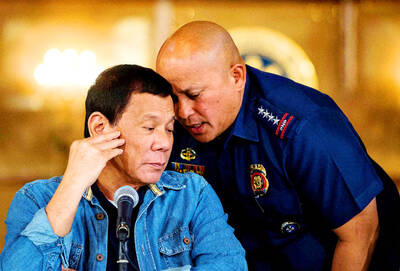
Two sitting Philippine senators have been identified as “coperpetrators” in former Philippine president Rodrigo Duterte’s crimes against humanity trial at the International Criminal Court (ICC), documents released by prosecutors showed. Philippine senators Ronald Dela Rosa and Christopher Go are among eight current and former officials named in a document dated Feb. 13 and posted to the court’s Web site. ICC prosecutors have charged Duterte with three counts of crimes against humanity, alleging his involvement in at least 76 murders as part of his “war on drugs.” “Duterte and his coperpetrators shared a common plan or agreement to ‘neutralize’ alleged criminals in the Philippines
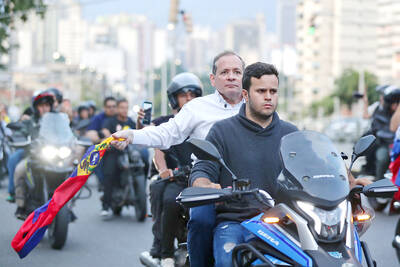
Venezuelan Nobel peace laureate Maria Corina Machado yesterday said that armed men “kidnapped” a close ally shortly after his release by authorities, following former Venezuelan president Nicolas Maduro’s capture. The country’s Public Prosecutor’s Office confirmed later yesterday that former National Assembly vice president Juan Pablo Guanipa, 61, was again taken into custody and was to be put under house arrest, arguing that he violated the conditions of his release. Guanipa would be placed under house arrest “in order to safeguard the criminal process,” the office said in a statement. The conditions of Guanipa’s release have yet to be made public. Machado claimed that


 RSS
RSS