


The US appears headed on a collision course with Iran that could lead to a war with “disastrous” consequences, an ex-advisor to former US president Jimmy Carter has said.
“We think we are going to avoid war by moving towards compulsion,” Zbignew Brzezinski, who was national security advisor to Carter in the late 1970s, told an audience at an Atlantic Council think tank event in Washington late on Tuesday.
“But the more you lean towards compulsion, the more the choice becomes war if it doesn’t work. That narrows our options in a very dramatic way,” said the former official, who remains an influential voice on US foreign policy.
Brzezinski said he was concerned about an escalation in “rhetoric,” as the US approach to Iran’s nuclear program appeared solely focused on forcing Tehran to comply with international demands, leaving Washington little flexibility.
“A lot of small decisions are being made which in the meantime narrow your freedom of choice in the future,” he said.
Brzezinski warned repeatedly of his concerns that the US could stumble into a war with Iran.
“If we slide into a conflict with Iran, in this or that fashion, the consequences for us will be disastrous, disastrous on a massive scale and also globally at the same time,” he said.
Brzezinski said there was a need “to galvanize this country into a deeper understanding” of international challenges facing the US.
“One of the most appalling things that I see is that we are more challenged than before in a more complex fashion,” he said.
“Our public is driven by fear, ignorance, demagogy to a very high degree and that I think has a paralyzing effect in intelligent management,” of foreign policy, he said.
Brzezinski, who endorsed US President Barack Obama in the 2008 campaign, described what he called a “strange situation,” with Obama and the Democrats failing to assert leadership while their Republican rivals were advocating extreme or ill-informed policies.
“The party in power is frozen, and the party out of power is raving mad,” he said.
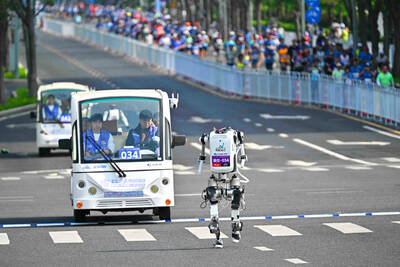
A humanoid robot that won a half-marathon race for robots in Beijing on Sunday ran faster than the human world record in a show of China’s technological leaps. The winner from Honor, a Chinese smartphone maker, completed the 21km race in 50 minutes and 26 seconds, said a WeChat post by the Beijing Economic-Technological Development Area, also known as Beijing E-Town, where the race began. That was faster than the human world record holder, Ugandan Jacob Kiplimo, who finished the same distance in about 57 minutes in March at the Lisbon road race. The performance by the robot marked a significant step forward
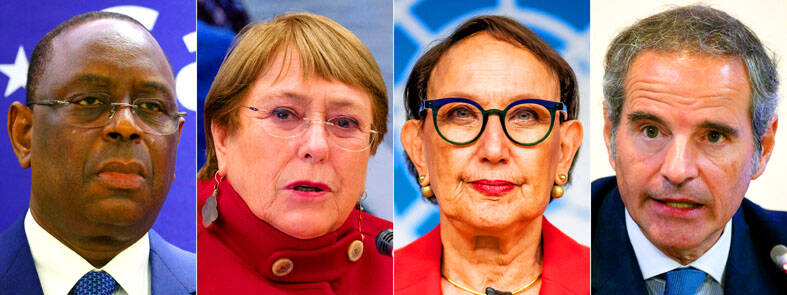
Four contenders are squaring up to succeed Antonio Guterres as secretary-general of the UN, which faces unprecedented global instability, wars and its own crushing budget crisis. Chile’s Michelle Bachelet, Argentina’s Rafael Grossi, Costa Rica’s Rebeca Grynspan and Senegal’s Macky Sall are each to face grillings by 193 member states and non-governmental organizations for three hours today and tomorrow. It is only the second time the UN has held a public question-and-answer, a format created in 2016 to boost transparency. Ultimately the five permanent members of the UN’s top body, the Security Council, hold the power, wielding vetoes over who leads the
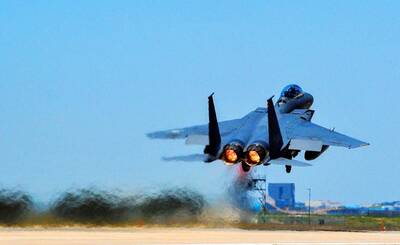
South Korea’s air force yesterday apologized for a 2021 midair collision involving two fighter jets, a day after auditors said the pilots were taking selfies and filming during the flight and held them responsible for the accident. “We sincerely apologize to the public for the concern caused by the accident that occurred in 2021,” an air force spokesman told a news conference, adding that one of the pilots involved had been suspended from flying duties, received severe disciplinary action and has since left the military. The apology followed a report released on Wednesday by the South Korean Board of Audit and Inspection,

An earthquake registering a preliminary magnitude of 7.7 off northern Japan on Monday prompted a short-lived tsunami alert and the advisory of a higher risk of a possible mega-quake for coastal areas there. The Cabinet Office and the Japan Meteorological Agency said there was a 1% chance for a mega-quake, compared to a 0.1% chance during normal times, in the next week or so following the powerful quake near the Chishima and Japan trenches. Officials said the advisory was not a quake prediction but urged residents in 182 towns along the northeastern coasts to raise their preparedness while continuing their daily lives. Prime


 RSS
RSS