


New Delhi reaches 100 next month, not knowing whether to mark the birthday with celebrations of its runaway success or to ignore a date that revives memories of British colonial rule.
On Dec. 12, 1911, King George V called all Indian princes and rulers to a durbar pageant on a flat piece of land north of the old city of Delhi and declared the national capital would move there from Calcutta, now known as Kolkata.
The decision, which came as a surprise even to senior British officers, was based on worsening unrest in the Calcutta region and Delhi’s more strategic position in the center of the subcontinent.
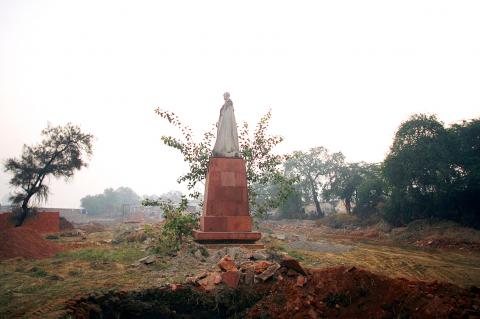
Photo: AFP
One hundred years on, Delhi is a vast megacity at the heart of India’s booming economy with up to 18 million inhabitants living in sprawling low-rise suburbs that stretch across the Yamuna floodplain.
“Yes, there is ambivalence on what to celebrate and how to celebrate,” Delhi Chief Minister Sheila Dikshit admitted early this month, as questions grow over whether any major events are planned for the city’s centenary.
“[The] ministry of culture has to draw up a plan ... I feel they don’t have a clear direction yet,” she added.
The site of the lavish 1911 durbar did not actually become “New Delhi,” as ground to the south of the old city was preferred, and the spot instead became a graveyard for British imperial statues discarded after independence in 1947.
Derelict and forgotten for decades, Coronation Park is now undergoing a slow renovation process, but it will not be ready for any celebrations on Dec. 12.
For A.G. Krishna Menon, the Delhi head of the Indian National Trust for Art and Cultural Heritage, glossing over the events of 100 years ago is to try to rewrite the past.
“This is a chance to increase awareness about the city around us,” he said. “There is a debate on whether we should be celebrating or not, but, as conservationists, we say it is part of history that must be recognized.”
“New Delhi was designed by the British, but could not have been built anywhere else due to the Indian craftsmen, builders and Indian sensibilities,” Menon added.
In the eyes of many visitors and locals, New Delhi’s grand imperial architecture is one of the great sights of India, including the 340-room presidential palace from where the British viceroy once ruled over the nation.
Menon believes the buildings and monuments are now rightly a symbol of national pride.
“When I stand there, a lot of things resonate. All of it adds up to a positive idea of the country,” he said.
Indians often point out that Delhi was previously a major Mughal capital and that the “New Delhi” built by British architects Edwin Lutyens and Herbert Baker was just the latest of several cities in the same area.
“This is an occasion to mark 1911 as the re-emergence of Delhi as a capital,” said Mahesh Rangarajan, an Indian historian who specializes in the British Raj.
“India lived under an occupying power then and the British thought they would be here for centuries when they built New Delhi, but the empire was gone just a few years later,” Rangarajan added. “Colonial rule was often painful, but it is seen here as just another layer of history.”
Lutyens himself harbored racist views about the Indian people and very few locals turned up to celebrate the city’s inauguration when it was finally completed in 1931.
Many British tourists often say they are fascinated by, if not always proud of, their country’s former presence in India and that they are struck by the lack of bitterness among locals.
Mark Tully, the veteran BBC reporter and doyen of British writers on India, sees the molding of old Delhi, imperial Delhi and the modern expanding city of today as a reflection of the nation’s flexibility.
“It is about Indians’ ability to live with variety, to preserve their culture, and yet to be affected by other cultures,” he said. “Some Indians feel very strongly that New Delhi is a colonial imposition and that this date is not something to celebrate, but I think they are in a minority.”
“I come from an old British Raj family and in more than 40 years living here, I have never once had that fact thrown in my face. Indians are remarkably mature about their colonial background,” Tully added.
Authorities in Delhi are still promising to arrange some kind of celebrations around Dec. 12, but most residents in the teeming and chaotic city will be unaware of its 100th birthday.
As the city grows rapidly with new metro lines, highways and satellite towns all mushrooming up, many citizens instead look ahead to a new global order in which India itself is becoming a dominant force.

‘IN A DIFFERENT PLACE’: The envoy first visited Shanghai, where he attended a Chinese basketball playoff match, and is to meet top officials in Beijing tomorrow US Secretary of State Antony Blinken yesterday arrived in China on his second visit in a year as the US ramps up pressure on its rival over its support for Russia while also seeking to manage tensions with Beijing. The US diplomat tomorrow is to meet China’s top brass in Beijing, where he is also expected to plead for restraint as Taiwan inaugurates president-elect William Lai (賴清德), and to raise US concerns on Chinese trade practices. However, Blinken is also seeking to stabilize ties, with tensions between the world’s two largest economies easing since his previous visit in June last year. At the
Nearly half of China’s major cities are suffering “moderate to severe” levels of subsidence, putting millions of people at risk of flooding, especially as sea levels rise, according to a study of nationwide satellite data released yesterday. The authors of the paper, published by the journal Science, found that 45 percent of China’s urban land was sinking faster than 3mm per year, with 16 percent at more than 10mm per year, driven not only by declining water tables, but also the sheer weight of the built environment. With China’s urban population already in excess of 900 million people, “even a small portion

UNSETTLING IMAGES: The scene took place in front of TV crews covering the Trump trial, with a CNN anchor calling it an ‘emotional and unbelievably disturbing moment’ A man who doused himself in an accelerant and set himself on fire outside the courthouse where former US president Donald Trump is on trial has died, police said yesterday. The New York City Police Department (NYPD) said the man was declared dead by staff at an area hospital. The man was in Collect Pond Park at about 1:30pm on Friday when he took out pamphlets espousing conspiracy theories, tossed them around, then doused himself in an accelerant and set himself on fire, officials and witnesses said. A large number of police officers were nearby when it happened. Some officers and bystanders rushed

Beijing is continuing to commit genocide and crimes against humanity against Uyghurs and other Muslim minorities in its western Xinjiang province, U.S. Secretary of State Antony Blinken said in a report published on Monday, ahead of his planned visit to China this week. The State Department’s annual human rights report, which documents abuses recorded all over the world during the previous calendar year, repeated language from previous years on the treatment of Muslims in Xinjiang, but the publication raises the issue ahead of delicate talks, including on the war in Ukraine and global trade, between the top U.S. diplomat and Chinese


 RSS
RSS