


Thailand’s ailing King Bhumibol Adulyadej — the world’s longest-reigning monarch — recently suffered a health problem that caused him to temporarily lose consciousness, his daughter revealed, linking the incident to stress over the country’s current flood crisis.
News that the health of 83-year-old king took what Princess Chulabhorn described as a brief turn for the worse came as Thailand reels from flooding that has inundated rural areas and parts of Bangkok and its suburbs. More than 500 people have died, damage is estimated at several billion US dollars and central Bangkok remains under threat.
Chulabhorn, the king’s youngest daughter, said on Friday during a visit to flood victims in Nonthaburi Province north of Bangkok that King Bhumibol had gone into shock and lost consciousness after suffering abdominal bleeding and a sharp drop in his blood pressure. She said that about 800cc of blood had been found in his bowel movements.
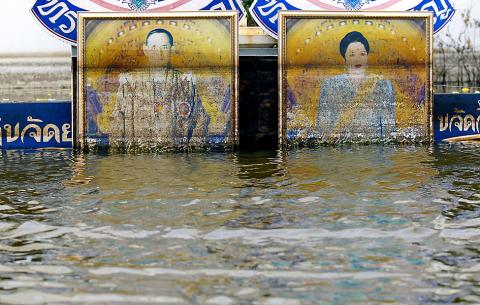
Photo: EPA
Chulabhorn said the king returned to normal health after being treated at the hospital where he has been staying for more than two years, according to the official royal news broadcast on Friday night. The king, who was coronated in 1950, was originally hospitalized on Sept. 19, 2009, with a lung inflammation. Official statements said he remained at the hospital for physical therapy and nourishment to recover his strength.
In May this year, he had an operation to relieve a condition that made him unsteady on his feet. A statement issued at the time said the spinal tap procedure was to relieve a condition — an excessive level of cerebrospinal fluid resulting in pressure on the brain — that is common in the elderly.
Chulabhorn said on Friday that after the May operation, the king “seemed to be at ease” until the flood crisis. The king has been shown from time to time on television speaking — sometimes with difficulty — at royal functions held at the hospital.
Chulabhorn said doctors told her the recent bleeding could have been caused by concern over the flooding.
“I asked the nurse what he had been doing in the past few days,” Chulabhorn said. “It turned out that he had been watching news about the flood. This indicates that His Majesty the King loves his people as his own children. He is very concerned and he usually doesn’t speak much, but [his concern] is seen in his physical condition.”
She did not specify when the health crisis took place, but her comments indicated it was more than a week ago. She had previously spoken about it on Monday, though not in such detail, and said on Friday that it happened the same day she had been visiting flooding victims in Ayutthaya Province, also near Bangkok. She visited a Buddhist temple there on Nov. 4.
The Royal Household Bureau, which is in charge of releasing news about the king, said yesterday that it could provide no further details on the king’s health.
Bangkok’s Siriraj Hospital, where the king is staying, said it could provide no information without the approval of the Royal Household Bureau, which had not yet been given.
It is potentially unlawful for private citizens to comment publicly on the king’s health. In 2009, four people were arrested on suspicion of using the Internet to spread rumors about the king’s health. Under the Computer Crime Act, spreading false information deemed harmful to national security is punishable by up to five years in prison and a fine of 100,000 baht (US$2,770).
Open discussion of the monarchy is also constrained by strict lese majeste laws that make criticism of the monarchy punishable by up to 15 years in prison.
The king traditionally has played a conciliating role in Thai society and his decline in health has coincided with trouble in the Southeast Asian nation. Thailand has been beset by woes since a 2006 military coup ushered in a period of political instability, marked by sometimes violent street protests.
His near-disappearance from the public scene has also raised concerns about what will happen after his passing. His son and heir-apparent, Thai Crown Prince Vajiralongkorn, does not command the same respect and affection as the king.

SPEAKING OUT: After Siranudh Scott’s allegations surfaced, celebrities and public figures took to social media to share their own experiences of sexual misconduct and abuse A high-profile alleged sexual abuse case within a wealthy Thai beer brewing family has prompted a wave of painful accounts from survivors of unconnected abuse in the conservative nation. Siranudh Scott, a member of the billionaire Thai family that founded the ubiquitous Singha beer brand, posted an emotional video this month accusing his elder brother Sunit of repeatedly abusing him when he was a teenager. Sunit, who is in his 30s, later denied the allegations in a video posted online, but Singha parent Boonrawd dismissed him from his executive role with the company on Tuesday last week. “I felt I needed to speak

SEEKING ORDER: Rodrigo Paz said that ‘anyone who wants to destroy the nation will have to deal with this president and the full force of the constitution’ Bolivian President Rodrigo Paz on Wednesday said that the nation was at a “breaking point” after nearly a month of protests that have caused shortages of food, fuel and medicine. Paz, who took office six months ago amid the worst economic crisis there in four decades, is battling a groundswell of fury over his policies. The political capital, La Paz, has been besieged by low-income workers and members of the indigenous majority calling for his resignation. “The country needs order and is reaching breaking point,” the 58-year-old said at a public event in La Paz, renewing his appeal for dialogue. On Tuesday, the Bolivian
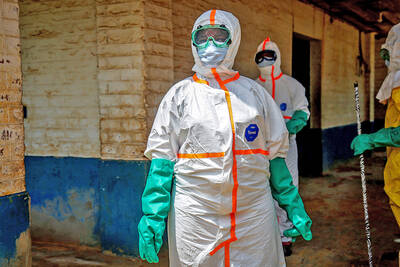
COMMUNITY CONFLICT: Concerns about disease spread from corpses has run up against friends and families’ desire to bury their dead as infection spreads in the area Angry residents of a town at the epicenter of the Ebola outbreak in the Democratic Republic of the Congo (DR Congo) attacked and burned a tent that was part of a health center where people are being treated for the virus, the staff there said Saturday. It was the second such attack in the region in a week. No one was hurt in the attack, according to reports but as patients ran out to escape the fire, 18 people with suspected Ebola infections fled the facility and are unaccounted for, a hospital director said. Angry residents arrived at the clinic in the

Forecasters in Europe yesterday warned of exceptional heat as record temperatures driven by a “heat dome” push temperatures well above seasonal norms across the continent. The surge follows a record-breaking Monday, with France logging its hottest day in the month of May on record, its weather agency said, and the UK also posting unprecedented highs. A so-called “heat dome” of warm air from northern Africa trapped under a high-pressure system over western Europe is behind the high temperatures not usually seen until high summer. Restrictions on outdoor work were imposed in parts of Italy, beaches in southwest France filled earlier than usual and


 RSS
RSS