


Once a river flowed under the low Pul-i-Sokhta bridge in Kabul, but now the thin stream is clotted with garbage, the banks are piled with refuse and crowds of heroin and opium addicts huddle in the shadows, some hanging like moths near the bridge’s supports, then slumping in the haze of narcotic smoke.
When outsiders venture in, dozens of the addicts — there are 200 or 300 here on any given day — drift over to see the newcomers. Most of the visitors are healthcare workers trying to persuade the addicts to visit their clinic for a shower and a medical screening.
This is another of Afghanistan’s afflictions: growing drug addiction and all the ills that come with it, not least HIV, which can be transmitted when addicts share needles. There were about 900,000 drug users in Afghanistan last year, according to the UN Office on Drugs and Crime, a marked increase from previous years. About 7 percent of the adult population of 14 million is using narcotics.
A vast majority take opium-based drugs, which are extraordinarily pure and very cheap — about US$3.50 for enough to get high, addicts say. Afghanistan is the world’s leading producer of opium poppy and the opium produced and sold here and its derivatives, including heroin, are among the most potent on earth. About 150,000 of those using opium-based drugs are injecting heroin, according to the WHO.
An indicator of the problem is a recent report by the Ministry of Public Health, in partnership with Johns Hopkins University, that found HIV present in about 7 percent of drug users, double the figure just three years ago, said Fahim Paigham, who until recently directed the Ministry of Public Health’s AIDS control program. In Afghanistan, the primary transmission of HIV is through shared needles.
The Pul-i-Sokhta bridge — which means “burned bridge” — is a refuge for many of Kabul’s heroin and opium addicts who used to gather in the ruins of the Russian cultural center on the east side of the city. They were forced out late last year. Some remained in the neighborhood, but many came to the bridge.
Some come every day to buy and use narcotics, crouching in dark corners to shoot up or gathering in groups to heat the opium powder until it melts into a black liquid and gives off smoke to inhale.
The ground under the bridge is thick with discarded syringes. Six mornings a week, a team of former addicts, nurses and a couple of social workers from the French non-profit healthcare organization Medecins du Monde forge ahead with large plastic disposal jugs in one hand and long-handled pincers in the other to pluck needles from the garbage. It is not uncommon to pick up 160 or 170 needles in a morning. They hand out fresh needles and alcohol swabs. The nurse treats the addicts’ seeping wounds where they have injected themselves too many times.
Not all the addicts are sure they can tolerate treatment, and some are so high they make little sense.
“I am the Bobby Devil of this town,” said a tall, bony young man in aviator glasses, sprawled next to a small group smoking heroin.
Bobby Devil is the stage name of an Indian actor well known here.
“I’ve been using for four years,” he added. “Last night, I went home with money and fresh fruit, and my wife and children told me to go away. They said, ‘You are a drug addict, you are a dog.’”
Could he quit?
“I can’t decide; both my wife and the drug are strong,” he said.
Many of the addicts say they want to stop using, but treatment options are woefully few. The government, through some Afghan non-profit groups, runs several detoxification centers and is building seven more, but the facilities offer almost no post-detoxification support and have a 92 percent relapse rate, according to the Ministry of Counternarcotics. The most efficacious treatment — opiate substitution therapy — has been all but blocked by the ministry despite pleas from the health ministry, whose doctors are worried about the rising incidence of HIV.
“The results from opiate substitutes like methadone are very positive,” Paigham said. “If you stop using heroin, you stop using the needles, and if you stop using the needles there is much less risk of spreading HIV.”
Methadone is typically given in syrup form here. However, officials at the Ministry of Counternarcotics are leery of it because the opiate substitutes do not cure addiction.
The Ministry of Counternarcotics undermined the country’s sole opiate substitution effort, a pilot program run by Medecins du Monde, that administers methadone to 70 addicts. The program has been strongly endorsed by the WHO as well as by participants and it has a waiting list. However, it twice blocked the import of the methadone, making it all but impossible for the heavily addicted participants to stick with the program.
For now the pilot program is running, but it has not been permitted to expand.
This year the number of drug addicts is expected to rise. Many Afghans start using narcotics when they seek work in Iran, which has one of the worst drug problems in the region. Increasingly, Iran is expelling addicted Afghans, shipping them back across the border. A few Afghan addicts say they were trying to quit while in Iran, which has a comprehensive system of methadone clinics, but most cannot imagine a way out.
“I started using in Iran from depression and sadness,” said Zainullah, 19, from Ghazni Province. “I was alone. I went there to find work, and I started smoking heroin.”
He returned to his farming village and his nine siblings six months ago, but a month later came to Kabul.
“Nobody likes a drug addict, so my family sent me here to quit,” he said. “Instead, here I am under the bridge, and I have increased my dose since I came.”
“If you could help me, please,” he said, raising his thin arms as if beseeching the aid workers. “I don’t know how to stop.”


Showcasing phallus-shaped portable shrines and pink penis candies, Japan’s annual fertility festival yesterday teemed with tourists, couples and families elated by its open display of sex. The spring Kanamara Matsuri near Tokyo features colorfully dressed worshipers carrying a trio of giant phallic-shaped objects as they parade through the street with glee. The festival, as legend has it, honors a local blacksmith in the Edo Period (1603-1868) who forged an iron dildo to break the teeth of a sharp-toothed demon inhabiting a woman’s vagina that had been castrating young men on their wedding nights. A 1m black steel phallus sits in the courtyard of

JAN. 1 CLAUSE: As military service is voluntary, applications for permission to stay abroad for over three months for men up to age 45 must, in principle, be granted A little-noticed clause in sweeping changes to Germany’s military service policy has triggered an uproar after it emerged that the law requires men aged up to 45 to get permission from the armed forces before any significant stay abroad, even in peacetime. The legislation, which went into effect on Jan. 1 aims to bolster the military and demands all 18-year-old men fill out a questionnaire to gauge their suitability to serve in the armed forces, but stops short of conscription. If the “modernized” model fails to pull in enough recruits, parliament will be compelled to discuss the reintroduction of compulsory service, German
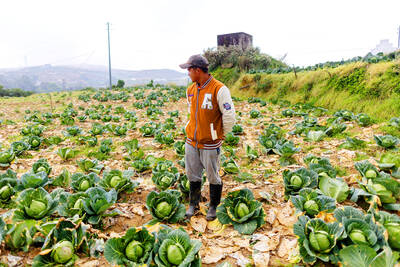
Filipino farmers like Romeo Wagayan have been left with little choice but to let their vegetables rot in the field rather than sell them at a loss, as rising oil prices linked to the Iran war drive up the cost of harvesting, labor and transport. “There’s nothing we can do,” said Wagayan, a 57-year old vegetable farmer in the northern Philippine province of Benguet. “If we harvest it, our losses only increase because of labor, transportation and packing costs. We don’t earn anything from it. That’s why we decided not to harvest at all,” he said. Soaring costs caused by the Middle East

For two decades, researchers observed members of the Ngogo chimpanzee group of Kibale National Park in Uganda spend their days eating fruits and leaves, resting, traveling and grooming in their tropical rainforest abode, but this stable community then fractured and descended into years of deadly violence. The researchers are now describing the first clearly documented example of a group of wild chimpanzees splitting into two separate factions, with one launching a series of coordinated attacks against the other. Adult males and infants were targeted, with 28 deaths. “Biting, pounding the victim with their hands, dragging them, kicking them — mostly adult males,


 RSS
RSS