


Peter Chi knows he has to cut back on his drinking. It is not much fun at the best of times and the worst have included hospitalization — after drinking fake alcohol — and the numerous evenings where he has passed out at the table.
“No one likes binge drinking, but it’s not under your control,” he said. “Of course I don’t like it, but there’s nothing I can do.”
Chi, from northeastern Liaoning Province, is not an alcoholic. Nor is he a party animal, despite his four-times-a-week binges. However, as a respectable headteacher in his 40s, he feels he has little choice but to indulge — or risk harming his career.
In the west, binge drinking is associated with young men and women spilling out of pubs and clubs in the early hours of the mornings, but in China drinkers are older and — in many cases — drinking not just for fun but for career reasons.
“If I drink, it doesn’t necessarily help me get promoted, but if I don’t, it’s less likely that I will be. So I must drink, even if it’s not pleasant at all,” Chi said. “People want to show they are forthright and try to get along with others ... It’s very normal to get an order to drink from bosses.”
In fact, some job adverts explicitly demand applicants who can hold their alcohol.
PRIORITIZED
“Candidates with good drinking capacity will be prioritized,” said an advert for the Hunan Zhike Public Security Engineering Company, an alarms and surveillance technology firm that is seeking a business manager.
“The job is to develop business through establishing closer connections with our clients. Drinking is a big part of the work,” the recruiter explained, adding that the successful candidate will need to handle from 250ml to 500ml of baijiu at a time.
The clear spirit, usually made from sorghum, ranges in price from as little as 5 yuan — less than US$0.80 — to tens of thousands of yuan for vintage bottles of the best brands. It is a staple of formal or celebratory dinners, often coupled with beer. It is also notorious for causing inebriation, since it is from 80 to 120 proof and frequently consumed in large quantities.
Alcohol certainly greases the wheels of business in the West, too, but people can usually stop after one or two glasses. In China, the opposite is often true: It is much easier to refuse an initial drink than to stop once you have started.
Foreigners are not immune to the pressure — one friend recalls being poured half pints of baijiu by an overly hospitable local official, who paused briefly only to vomit before topping up his glass again.
Drinking to develop and cement relationships has a long history in China.
As one traditional saying goes, “when one drinks with a friend, a thousand cups are not enough.”
That does not mean bingeing has been the norm: In the 1980s, a study of Chinese classical poetry concluded that heavy drinking had been in and out of favor over the years.
HABITS
Experts have suggested that Chinese habits — consuming alcohol with food, playing drinking games and toasting in a highly ritualized fashion — served to regularize alcohol intake and limit drunkenness.
However, in the last few decades, consumption has soared, fueled by increased personal freedoms and rising incomes.
“Excessive drinking, frequent drinking [five to seven days a week] and binge drinking behavior have reached epidemic proportions among current drinkers in China,” a study published in the journal Addiction said last month.
The authors, led by Li Yichong of the National Center for Chronic and Non-Communicable Disease Control, found that only 56 percent of men and 15 percent of women drink. However, of those, 57 percent of men and 27 percent of women binge.
Bingeing and excessive drinking were most common in men aged between 35 and 44 and frequent drinking increased significantly with age whereas, in “Anglo” cultures, alcohol consumption usually peaks in the late 20s or early 30s, the paper said.
The government has pledged to tackle driving under the influence — police caught half a million drunkards behind the wheel last year — but bingeing does not otherwise seem to lead to much anti-social behavior in China, so the main issue is the damage that drinkers are doing to themselves.

KINGPIN: Marset allegedly laundered the proceeds of his drug enterprise by purchasing and sponsoring professional soccer teams and even put himself in the starting lineups Notorious Latin American narco trafficker Sebastian Marset, who eluded police for years, was handed over to US authorities after his arrest on Friday in Bolivia. Marset, a Uruguayan national who was on the US most-wanted list, was passed to agents of the US Drug Enforcement Administration at Santa Cruz airport in Bolivia, then put on a US airplane, Bolivian state television showed. “The arrest and deportation were carried out pursuant to a court order issued by the US justice system,” Bolivian Minister of Government Marco Antonio Oviedo told reporters. The alleged kingpin was arrested in an upscale neighborhood of Santa

ACTIONABLE ADVICE: The majority of chatbots tested provided guidance on weapons, tactics and target selections, with Perplexity and Meta AI deemed to be the least safe From school shootings to synagogue bombings, leading artificial intelligence (AI) chatbots helped researchers plot violent attacks, according to a study published on Wednesday that highlighted the technology’s potential for real-world harm. Researchers from the nonprofit watchdog Center for Countering Digital Hate and CNN posed as 13-year-old boys in the US and Ireland to test 10 chatbots, including ChatGPT, Google Gemini, Perplexity, Deepseek and Meta AI. Eight of the chatbots assisted the make-believe attackers in more than half the responses, providing advice on “locations to target” and “weapons to use” in an attack, the study said. The chatbots had become a “powerful accelerant for
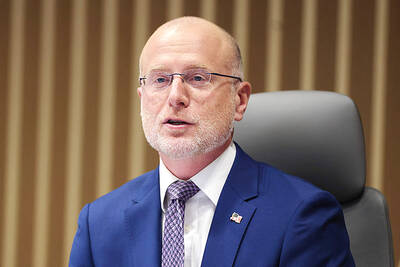
FAKE NEWS? ‘When the government demands the press become a state mouthpiece under the threat of punishment, something has gone very wrong,’ a civic group said The top US broadcast regulator on Saturday threatened media outlets over negative coverage of the Middle East war, after US President Donald Trump slammed critical headlines from the “Fake News Media.” The US president since his first term has derided mainstream media as “fake news” and has sued major outlets over what he sees as unfair coverage. Brendan Carr, head of the US Federal Communications Commission — which oversees the nation’s radio, television and Internet media — said broadcasters risked losing their licenses over news coverage. “The law is clear. Broadcasters must operate in the public interest, and they will

SCANDAL: Other images discovered earlier show Andrew bent over a female and lying across the laps of a number of women, while Mandelson is pictured in his underpants A photograph of former British prince Andrew and veteran politician Peter Mandelson sitting in bathrobes alongside late sex offender Jeffrey Epstein was unearthed on Friday in previously published documents. The image is believed to be the first known photograph of the two men with Epstein. They are currently engulfed in scandal in the UK over their ties to their mutual friend. The undated photograph, first reported by ITV News, shows King Charles III’s disgraced brother and former British ambassador to the US sitting barefoot outside on a wooden deck. They appear to have mugs with a US flag on them


 RSS
RSS