


The crumpled figure in seat 22 on the Air Greenland flight from Ilulissat to Kangerlussuaq was no Indiana Jones. But Dennis Thomas, a mining engineer viewing gold and diamond prospects in the Arctic, was happy to play up the part.
“I’ve been shot at and involved in all sorts of other scrapes,” the 62-year-old said as the plane cruised at 3,300m.
Thomas had spent 30 years scouring Latin America, the Far East and most other points around the globe, but this was his first time in Greenland. And it will not be his last. The Briton was impressed with what he had seen and said he would be back after discussions with various mining companies and investors who pay him a “finder’s fee” for putting them on to new, commercially viable, deposits.
“This is a very exciting place ... There is only one working mine, but in 10 years I would like to see them with half a dozen serious mines,” he said.
It is not just small operations like Thomas Mining Associates, based in West Sussex, England, that are newly on the hunt as ice caps melt in the far north. Major companies have recently set foot in Greenland hoping to carve out — literally — a new mineral frontier. Political visits from countries such as China are also on the rise. They are being driven by the demand for a variety of precious stones and other commodities, which has driven up prices and sent prospectors on a frantic search for new supplies.
Greenland has long been known to harbor everything from uranium — needed for nuclear plants — to so-called rare earth minerals used in hardware such as mobile phones, flatscreen TVs and modern weaponry.
The Arctic was largely off-limits because much of the land was considered unworkable, buried under hundreds of meters of snow and ice and with nothing in the way of traditional infrastructure. Global warming has changed that picture.
While Greenland’s traditional way of hunting wild animals is endangered by the melting ice cap, mineral mining is entering a new, potentially lucrative chapter. More and more of the land is becoming ice-free — unleashing greenhouse gases in the process, but offering new opportunities for diggers in the “white gold rush.”
New mining applications are being submitted for extraction, from Canada through Greenland to Finland. The Greenland government in Nuuk has underlined its commitment to new ventures by repealing a law that prevented any kind of uranium mining. The laws have been amended to grant exploration licences for radioactive elements such as uranium and thorium on a case-by-case basis.
It benefits firms such as -Australian-owned mining company Greenland Minerals & Energy Ltd (GMEL).
“It’s not permission to start mining, but it is permission to make studies for mines with uranium,” said Lars Emil Johansen, who recently retired as chairman of the company’s Greenland subsidiary, and was Greenland’s second prime minister. “It’s a very big step forward for the company.”
This is happening at Kvanefjeld — said by GMEL to be “one of the world’s most exciting emerging mineral projects” and believed to hold the world’s sixth-largest uranium deposit.
Meanwhile, one of the world’s biggest gold mines was recently opened at Kittila in the far north of Finland and others are already being planned in that country. Yet there is conflict over some of the plans. For example, there is vociferous opposition to a scheme by mining companies, including Anglo American, to produce gold and copper at the Pebble Mine in Alaska. Campaigners say such plans threaten the nearby Bristol Bay watershed, which supports the world’s most productive wild sockeye salmon fishery.
So far the only current mining operation in Greenland is the Nalunaq gold mine in the south of the country. It was restarted this year as a going concern by its owner, Angel Mining, registered in London. It has created jobs and little opposition, but there is concern over a larger industrial plan.
Henrik Stendal, head of the geology department at the Bureau of Minerals and Petroleum in Nuuk, Greenland, says he is hopeful there will increasing activity in his country. This is not least because rising temperatures mean there is more land to explore.
He spells out something that many in government think privately, but are reluctant to say openly: “You could say global warming is good for Greenland.”

‘GROSS NEGLIGENCE?’ Despite a spleen typically being significantly smaller than a liver, the surgeon said he believed Bryan’s spleen was ‘double the size of what is normal’ A Florida surgeon who is facing criminal charges after allegedly removing a patient’s liver instead of his spleen has said he is “forever traumatized” by that person’s death. In a deposition from November last year that was recently obtained by NBC, 44-year-old Thomas Shaknovsky described the death of 70-year-old William Bryan as an “incredibly unfortunate event that I regret deeply.” Bryan died after the botched surgery; and last month, a grand jury in Tallahassee indicted Shaknovsky on a charge of manslaughter. “I’m forever traumatized by it and hurt by it,” Shaknovsky added, also saying that wrong-site surgeries can happen “during

Former Chinese ministers of national defense Wei Fenghe(魏鳳和) and Li Shangfu (李尚福) were both sentenced to death with a two-year reprieve over graft charges, state news agency Xinhua reported on Thursday, underscoring the severity of the purge in the military. The armed forces have been one of the main targets of a broad corruption crackdown ordered by Chinese President Xi Jinping (習近平) after coming to power in 2012. The purges reached the elite Rocket Force, which oversees nuclear weapons as well as conventional missiles, in 2023. Earlier this year they escalated further, resulting in the removal of the top general in
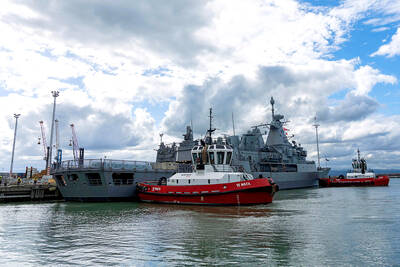
New Zealand is open to expanding its frigate fleet beyond its current two vessels, with New Zealand Minister of Defence Chris Penk saying “no options are off the table” as the government weighs buying new warships from Japan or the UK. The government yesterday said it is looking to replace its two aging Anzac-class frigates, which were both commissioned almost 30 years ago. The UK’s Type 31 and Japan’s Mogami-class warships are the options under consideration. Speaking in an interview, Penk said there is potential to increase the number of frigates the nation purchases. “We need a certain amount of capability as a

The Philippine Coast Guard yesterday said it deployed aircraft to issue radio warnings to a Chinese research ship in a disputed area of the South China Sea “swarming” with vessels from Beijing’s so-called maritime militia. The research vessel Xiang Yang Hong 33 (向陽紅33), which is capable of supporting submersible craft, was operating near a reef in the contested Spratly Islands (Nansha Islands, 南沙群島), which Taiwan also claims, the Philippine Coast Guard said. The Chinese ship was deploying a service boat toward the Spratly’s Iroquois Reef on Wednesday when it was spotted by a coast guard plane, “confirming ongoing unauthorized [marine scientific research]


 RSS
RSS