


US forces are obliged to help defend Philippine troops, ships or aircraft under a 1951 Mutual Defense Treaty if they come under attack in the disputed Spratly Islands (南沙群島) in the South China Sea, Philippine officials said, citing past US assurances.
The potentially oil and gas-rich Spratly Islands have long been regarded as one of Asia’s possible flash points for conflict.
China, the Philippines and Vietnam have been trading barbs and diplomatic protests recently over overlapping territorial claims to the islands, reigniting tensions.
Complicating the issue is the role the US could play in resolving the disputes. A Mutual Defense Treaty signed by US and Philippine officials on Aug. 30, 1951, calls on each country to help defend the other against an external attack by an aggressor in their territories or in the Pacific region.
Amid renewed tensions in the Spratlys, questions have emerged whether the treaty would apply if ill-equipped Philippine forces come under attack in the islands, all of which are claimed by China. Parts also are claimed by Taiwan, Brunei, Malaysia, the Philippines and Vietnam.
The Philippine Department of Foreign Affairs said in a policy paper that the treaty requires Washington to help defend Philippine forces if they come under attack in the Spratly Islands, citing US diplomatic dispatches that defined the Pacific region under the treaty as including the South China Sea. The South China Sea was not specifically mentioned in the pact.
A copy of the policy paper was seen on Wednesday.
Philippine Foreign Secretary Albert del Rosario also said in a recent interview that US officials have made clear that Washington would respond should Philippine forces come under attack in the South China Sea.
Del Rosario said by telephone from Washington that he would discuss the Spratly disputes, along with issues related to the 1951 defense treaty and other regional security concerns with US Secretary of State Hillary Rodham Clinton when they met yesterday.
The US embassy in Manila declined to discuss details of when the pact would apply.
“As a strategic ally, the United States honors our Mutual Defense Treaty with the Philippines,” said Alan Holst, acting public affairs officer at the embassy. “We will not engage in discussion of hypothetical scenarios.”
The defense treaty, which came into force in 1952, defined an attack as an armed assault on “the metropolitan territory of the parties” or their “armed forces, public vessels or aircraft in the Pacific.” While the US has a policy of not interfering in territorial disputes, the Philippine paper said: “It may be construed that any attack on our vessels, armed forces or aircraft in the Spratlys would make the treaty applicable and accordingly obligate the US to act to meet the common dangers.”
China has urged the US to stay out of territorial disputes in the South China Sea, saying they should be resolved through bilateral negotiations.
On Wednesday, Chinese Vice Foreign Minister Cui Tiankai (崔天凱) warned that Washington risks getting drawn into a conflict should tensions in the region escalate further.
Washington views the sea lanes in the area as strategically important.
“If the United States does want to play a role, it may counsel restraint to those countries that have frequently been taking provocative action and ask them to be more responsible in their behavior,” Cui said at a briefing.
He later added: “I believe that individual countries are actually playing with fire and I hope that fire will not be drawn to the United States.”
The Philippines has accused China of intruding at least six times in Philippine-claimed areas in and near the Spratly Islands since February. Among the most serious was a reported firing by a Chinese navy vessel on Feb. 25 to scare away Philippine fishermen from the Jackson Atoll.

Crowds in Bangladesh are flocking to snap photographs with an unlikely social media star — an albino buffalo with flowing blond hair nicknamed “Donald Trump” that is due to be sacrificed within days. Owner Zia Uddin Mridha, 38, said his brother named the 700kg bull over its flowing helmet of hair resembling the signature look of the US president. “My younger brother picked this name because of the buffalo’s extraordinary hair,” he said at his farm in Narayanganj, just outside the capital, Dhaka. Mridha said that a constant stream of curious visitors — social media fans, onlookers and children — have come throughout

It began as a satirical online project. Now millions of young people in India are flocking to it as an outlet for their frustration. A parody political party called the Cockroach Janta Party, with the insect as its symbol, has exploded across India’s social media by turning absurdist humor into protest. Memes and short videos mocking corruption, joblessness and political dysfunction have flooded social media sites, where millions of users are embracing the cockroach — known for its ability to survive harsh conditions — as a tongue-in-cheek symbol of endurance. The online movement’s rise has been unusually rapid. The Cockroach Janta Party (CJP)
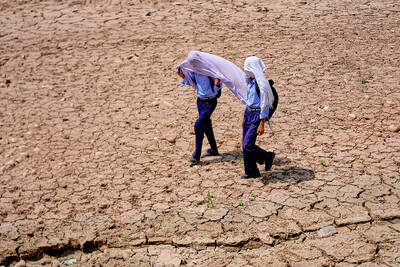
HOTTER: While Indians are accustomed to summer heat, climate change has caused northwestern India to warm faster than other parts of the country, an academic said Roads and markets have emptied during afternoons and some farmers have switched to nighttime work to avoid scorching temperatures as a heat wave grips large parts of India. The India Meteorological Department forecast maximum temperatures for yesterday of about 45°C in the capital, New Delhi, where authorities have opened temporary “cooling zones” to help people cope. The weather department warned that conditions would likely persist across several northern regions in the coming days, with temperatures staying well above seasonal averages. Authorities urged people to stay indoors during the hottest hours and take precautions against heat-related illnesses. India declares a heat wave whenever maximum temperatures

BIGGER ROLE: Beijing has said it maintains an impartial stance on the war in Ukraine, but by training Russian troops, China is far more involved than previously known China’s armed forces secretly trained about 200 Russian military personnel in China late last year, and some have since returned to fight in Ukraine, according to three European intelligence agencies and documents seen by Reuters. While China and Russia have held a number of joint military exercises since Moscow’s full-scale invasion of Ukraine in 2022, Beijing has repeatedly said that it is neutral in the conflict and presents itself as a peace mediator. The covert training sessions, which predominantly focused on the use of drones, were outlined in a dual-language Russian-Chinese agreement signed by senior Russian and Chinese officers in Beijing on


 RSS
RSS