


Colombian President Juan Manuel Santos enacted on Friday a landmark “Victims’ Law” aimed at redressing the estimated 4 million victims of the country’s long-running internal conflict.
It marks the first attempt by the country beset for more than 50 years by class-based conflict to reckon with the magnitude of its social costs.
The law creates mechanisms for compensating survivors of the tens of thousands, mostly civilians, killed since 1985 in Colombia’s dirty war. Stolen land is to be returned to hundreds of thousands of displaced.
Santos signed the law in the presence of UN Secretary-General Ban Ki-moon.
“Today is an historic day,” Santos said of the law, which he has made the centerpiece of his 10-month-old administration, speaking to a crowd of 600 guests including the military brass, the nation’s most senior judges and representatives of Colombia’s more than 2 million internally displaced.
“Our country is not condemned to 100 years of solitude,” Santos added, invoking the title of the novel by Colombia’s literature Nobel-winner, Gabriel Garcia Marquez, which depicts the nation fatalistically as one that can’t seem to escape endless cycles of violence.
Authorities say the law will take a decade to implement and cost at least US$20 billion. The challenges are immense. The conflict is anything but over, and the CODHES human rights group says say 49 people have been killed since 2002 seeking to reclaim stolen land, eight of them in this year alone.
In a brief speech, Ban’s praised the law, but said the work has just begun and it must produce results.
After all, the number of victims, arrived at by a public registration process, accounts for nearly one in 10 Colombians. And the country remains beset by conflict, though leftist rebels and right-wing bands hold sway over far less territory than they did a decade ago.
Many victims, though applauding the law, also expressed concern.
“I think that without seriously getting under control ‘para-politics,’ the ‘para-economy’ and those who have cleared out lands it will be very difficult to produce processes of restitution of land and reparations,” said Ivan Cepeda, longtime head of Colombia’s organization of victims of crimes of the state.
He was referring to Colombia’s so-called paramilitaries, privately funded far-right militias that emerged in the 1980s to counter kidnapping and extortion by leftist rebels.
However, the paramilitaries devolved into drug-trafficking gangs, who wealthy landowners used to extend their holdings at the expense of poor peasants, indigenous groups and Afro-Colombians.
The paramilitaries continue to exert a powerful, violent and corrupting influence in rural Colombia, where the central government remains relatively weak and local politicians and military officials sometimes aid and abet them.
Jailed paramilitary warlords who surrendered in exchange for promises of relative leniency have admitted to ordering more than 50,000 murders. Human rights activists say the death toll could be triple that amount.
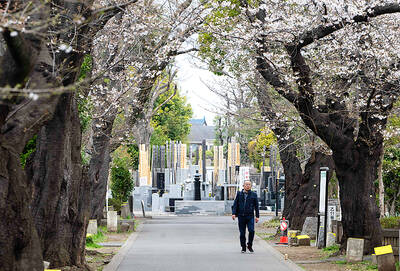
ROCKY RELATIONS: The figures on residents come as Chinese tourist numbers drop following Beijing’s warnings to avoid traveling to Japan The number of Chinese residents in Japan has continued to rise, even as ties between the two countries have become increasingly fractious, data released on Friday showed. As of the end of December last year, the number of Chinese residents had increased by 6.5 percent from the previous year to 930,428. Chinese people accounted for 22.6 percent of all foreign residents in Japan, making them by far the largest group, Japanese Ministry of Justice data showed. Beijing has criticized Tokyo in increasingly strident terms since Japanese Prime Minister Sanae Takaichi last year suggested that a military conflict around Taiwan could
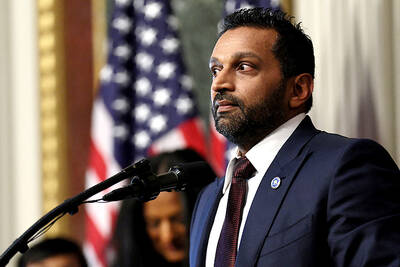
A pro-Iran hacking group claimed to breach FBI Director Kash Patel’s personal e-mail inbox and posted some of the contents online. The e-mails provided by the hacking group include travel details, correspondence with leasing agents in Washington and global entry, and loyalty account numbers. The e-mail address the hackers claim to have compromised has been previously tied to Patel’s personal details, and the leaked e-mails contain photos of Patel and others, in addition to correspondence with family members and colleagues. “The FBI is aware of malicious actors targeting Director Patel’s personal email information,” the agency said in a statement on
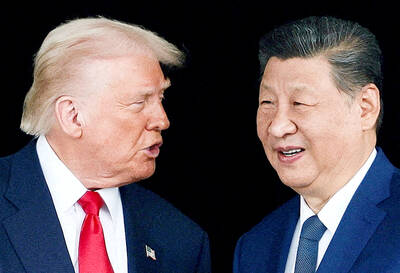
RIVALRY: ‘We know that these are merely symbolic investigations initiated by China, which is in fact the world’s most profligate disrupter of supply chains,’ a US official said China has started a pair of investigations into US trade practices, retaliating against similar probes by US President Donald Trump’s administration as the superpowers stake out positions before an expected presidential summit in May. The move, announced by the Chinese Ministry of Commerce on Friday, is a direct mirror of steps Trump took to revive his tariff agenda after the US Supreme Court last month struck down some of his duties. “China expresses its strong dissatisfaction and firm opposition to these actions,” a ministry spokesperson said in a statement, referring to the so-called Section 301 investigations initiated on March 11.

When a hiker fell from a 55m waterfall in wild New Zealand bush, rescuers were forced to evacuate the badly hurt woman without her dog, which could not be found. After strangers raised thousands of dollars for a search, border collie Molly was flown to safety by a helicopter pilot who was determined to reunite the pet and the owner. A week earlier, an emergency rescue helicopter found the woman with bruises and lacerations after a fall at a rocky spot at the waterfall on the South Island’s West Coast. She was airlifted on March 24, but they were forced to


 RSS
RSS