


Scientists say they’re close to producing new “super varieties” of wheat that will resist a virulent fungus while boosting yields up to 15 percent, potentially easing a deadly threat to the world’s food supply.
The research is part of a global drive to protect wheat crops from the Ug99 strain of stem rust. It will be presented next week at a conference in St Paul, Minnesota, that’s part of the Borlaug Global Rust Initiative, based at Cornell University in Ithaca, New York, organizers said on Thursday.
Scientists will also report that Ug99 variants are becoming increasingly virulent and are being carried by the winds beyond Uganda and other East African countries where they were first identified in 1999. Once infected with the deadly fungus, wheat plants become covered in reddish-brown blisters.
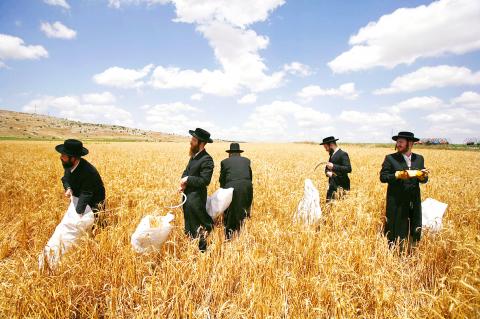
Photo: Reuters
According to a news release issued by the initiative ahead of the symposium, the fungus has now spread across all of eastern and southern Africa and it might just be a matter of time before it reaches India or Pakistan, and even Australia and the Americas.
“We are facing the prospect of a biological firestorm, but it’s also clear that the research community has responded to the threat at top speed and we are getting results in the form of new varieties that are resistant to rust and appealing to farmers,” Ronnie Coffman, who heads the Durable Rust Resistance in Wheat project at Cornell, said in the release.
Researchers will report at the conference that new varieties of wheat under development at the International Maize and Wheat Improvement Center in Mexico show resistance to all three kinds of wheat rust — stem rust including Ug99, yellow rust and leaf rust — the release said.
Some of those varieties also boost yields 10 to 15 percent, it said.
However, significant obstacles must be overcome before the resistant new varieties of wheat can replace the susceptible varieties that make up as much as 90 percent of the wheat now in production, the researchers acknowledged.
They called for more investments by wealthy countries and international institutions to continue developing the varieties, to help them keep them effective against diseases that continue to evolve and to develop the seed production and distribution infrastructure needed to put the new varieties in the hands of poor farmers in developing countries.
The new strains mark a huge advance, said Marty Carson, research director at the US Department of Agriculture’s (USDA) Cereal Research Laboratory at the University of Minnesota in St Paul.
“Anytime you can talk about a 15 percent boost in yields from existing varieties, I mean that’s phenomenal. And to get combined resistance to all three rusts, that’s also a very big deal,” said Carson, who wasn’t directly involved in that research.
His lab, which is heavily involved in the fight against Ug99, is hosting the conference along with the University of Minnesota.
Carson said in an interview that the wheat farmers in the developing world which the Mexican institute, known by its Spanish acronym CIMMYT, is targeting with these new varieties don’t have many other options, such as fungicides, for dealing with threats such as rust. And while he was skeptical about the 15 percent claim, he said even a lower yield increase would be a major accomplishment.
The Borlaug Global Rust Initiative was launched five years ago by the late Nobel Peace Prize winner Norman Borlaug in response to the Ug99 threat. Borlaug, an alumnus of the University of Minnesota, was a leader of CIMMYT. His research sparked the “Green Revolution” of the 1960s that transformed agriculture through high-yield, disease--resistant crops and other innovations, helping to more than double world food production by 1990. He’s credited with saving perhaps 1 billion people from starvation.
Ravi Singh, a wheat breeder at CIMMYT, helped lead the research on the new strains, which he is to present at the conference and publish later this year.
He said in an interview that the new varieties were developed through conventional -crossbreeding, not genetic engineering. They have been tested successfully for disease resistance in Kenya and Ethiopia, where Ug99 is endemic, as well as at the USDA lab in St Paul.
Donor-funded CIMMYT distributes its seed for free to keep it affordable, Singh said, and the new varieties will be planted in several countries for yield trials in the coming growing season in hopes they can enter widespread use in a few years.

PHISHING: The con might appear convincing, as the scam e-mails can coincide with genuine messages from Apple saying you have run out of storage For a while you have been getting messages from Apple saying “your iCloud storage is full.” They say you have exceeded your storage plan, so documents are no longer being backed up, and photos you take are not being uploaded. You have been resisting Apple’s efforts to get you to pay a minimum of £0.99 (US$1.33) a month for more storage, but it seems that you cannot keep putting off the inevitable: You have received an e-mail which says your iCloud account has been blocked, and your photos and videos would be deleted very soon. To keep them you need

The Israeli military has demolished entire villages as part of its invasion of south Lebanon, rigging homes with explosives and razing them to the ground in massive remote detonations. The Guardian reviewed three videos posted by the Israeli military and on social media, which showed Israel carrying out mass detonations in the villages of Taybeh, Naqoura and Deir Seryan along the Israel-Lebanon border. Lebanese media has reported more mass detonations in other border villages, but satellite imagery was not readily available to verify these claims. The demolitions came after Israeli Minister of Defense Israel Katz called for the destruction of

A US YouTuber who caused outrage for filming himself kissing a statue commemorating Korean wartime sex slaves has been sentenced to six months in prison, a court in Seoul said yesterday. Johnny Somali, 25, gained notoriety several years ago for recording himself doing a series of provocative stunts in South Korea and Japan, and streaming them on platforms such as YouTube and Twitch. South Korean authorities indicted Somali — whose real name is Ramsey Khalid Ismael — in 2024 on public order violations and obstruction of business, and banned him from leaving the country. “The court has sentenced him to six months in

The death toll from a shooting in western Afghanistan rose to 11 on Saturday, after gunmen targeted civilians at a picnic spot in Herat, the provincial authority said. Bullet marks were visible on a wall of the Sayed Mohammad Agha Shia shrine, while bloodstains marked a blanket abandoned at the scene. “Eleven people have been recorded dead and eight others wounded from Friday’s incident, with the condition of two of the wounded reported as critical,” Herat’s information office said in a statement. The update raises a toll of seven killed provided on Friday by the Afghan Ministry of Interior Affairs


 RSS
RSS