


The vacant car repair lot hardly looks out of place in a vibrant, but gritty part of the northern colonial city of Durango, famous as the set for John Wayne westerns.
Only a closer look reveals the secrets hidden at “Servicios Multiples Carita Medina,” clues to exactly what kind of “multiple services” were rendered. The freshly turned soil is sprinkled with lime to kill the smell and littered with discarded Latex gloves and an empty cardboard box: “Adult Cadaver Bag. 600 gauge, Long Zipper, For Cadavers of up to 75 inches. 15 pieces.”
In the most gruesome find in Mexico’s four-year attack on organized crime, police dug up 89 bodies in the repair lot, buried over time in plain sight of homes, schools and stores.
Then, like the killers, authorities left one of Mexico’s most puzzling crime scenes completely open and unprotected.
It was the largest of seven graves found in bustling urban areas of the city of almost 600,000, where a total of 219 bodies have been uncovered since April 11.
Publicly, authorities say they don’t know who’s inside the graves in a state that was home to Mexican revolutionary Pancho Villa, but that today is more synonymous with the country’s powerful Sinaloa drug cartel. Officials only say the mass graves probably hold the corpses of executed rivals from other gangs or possibly kidnap victims and even some police.
However, a new and more detailed account comes from a top federal police official, who spoke on condition of anonymity because of security reasons. The official said investigations indicate the grave holds rivals of the Sinaloa cartel and that the once orderly and brutally efficient gang is undergoing a bloody internal power struggle in Durango.
The Sinaloa cartel had seemed immune to the kind of missteps, mindless violence and internal power struggles that have plagued other drug gangs, to the extent that most Mexicans believed the Sinaloa cartel was either exceedingly sophisticated or in cahoots with the government.
However, the portrait now emerging from the 219 corpses is of a cartel that is riven by internal cracks, the official said.
In recent months, at least two local groups sought to break off from Sinaloa and control the drug shipment routes through Durango for themselves, the official said. A third group, known as the “M’s,” remained loyal to Sinaloa boss Joaquin “El Chapo” Guzman, who has been named one of the richest and most influential people in the world by Forbes magazine, with a fortune of more than US$1 billion.
A leading member of the “M’s” and the fourth-highest ranking Sinaloa operator in Durango, Bernabe Monje Silva, was arrested by federal police on March 27 and led police to the grave sites, the police official said.
Jorge Chabat, a Mexican expert on the drug trade, said that while the Sinaloa cartel is one of Mexico’s most stable gangs, it has had internal divisions, as witnessed several years ago when the Beltran Leyva brothers broke off to form their own cartel.
Chabat said disputes like the one in Durango “are part of the jockeying that goes on in the world of drug trafficking,” adding that the split will probably result in increased violence in Durango.
The Sinaloa and Zeta cartels had already been in a dispute for remote territory in Durango long dismissed as narco-land. Cartels grow marijuana and poppies in the secluded mountains, where outsiders don’t go without military escorts and rumors have it that Sinaloa boss Guzman himself has been hiding.
Last month, the discovery of 183 bodies in 40 graves in the northeastern border state of Tamaulipas caused an international furor, as families from the US, Mexico and Central America showed up in search of loved ones who had been reportedly pulled off buses, then vanished in the vast reaches of farmland near San Fernando, the scene of two mass killings in less than a year.
The Mexican government reinforced its troops there and made a sweep of 74 alleged Zetas members and collaborators — including some local police— whom officials say were responsible for the deaths.
But the larger discovery in Durango has been met with little more than a shrug and the swearing by neighbors that they never heard or saw anything unusual as assassins buried scores of bodies under city streets. Last week, no one was lining up to look for loved ones or to give DNA even as the difficult task of identifying bodies continues.
Some of the corpses in Durango have been in the ground less than six months, buried since the Sinaloa cartel’s internal dispute broke out; others have been there for as long as four years.
Working in refrigerated trailers brought in after the sheer number of bodies outstripped the capacity of the city’s morgue, experts wearing masks and sterile suits struggled to detect identifying signs, tattoos or fingerprints from the bodies that still retained some skin.
Authorities have only identified one victim so far, a 31-year-old man from the state of Durango. They would not give his name or other details.
Questions remained about how the gunmen could have used the burial ground to dump bodies for so long without being caught.
“The bodies weren’t buried all at one time, it was done gradually,” said Jorge Antonio Santiago, the spokesman for the Durango State Human Rights Commission. “In the face of that fact, we are also demanding an explanation of why nobody detected this.”
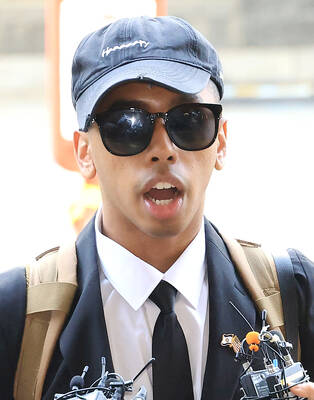
A US YouTuber who caused outrage for filming himself kissing a statue commemorating Korean wartime sex slaves has been sentenced to six months in prison, a court in Seoul said yesterday. Johnny Somali, 25, gained notoriety several years ago for recording himself doing a series of provocative stunts in South Korea and Japan, and streaming them on platforms such as YouTube and Twitch. South Korean authorities indicted Somali — whose real name is Ramsey Khalid Ismael — in 2024 on public order violations and obstruction of business, and banned him from leaving the country. “The court has sentenced him to six months in

Former Lima mayor Rafael Lopez Aliaga, a Peruvian presidential hopeful, gathered hundreds of supporters in Lima on Tuesday and gave authorities 24 hours to annul the first round of the country’s election over allegations of fraud. Lopez Aliaga is locked in a tight three-way race with two other candidates for second place in Sunday’s vote. The election runner-up wins a ticket to June’s presidential run-off against front-runner Keiko Fujimori. “I am giving them 24 hours to declare this electoral fraud null and void,” said Lopez Aliaga, surrounded by a crowd of several hundred supporters. “If it is not declared null and void tomorrow,

PAPAL RETORT: Pope Leo told reporters that he has ‘no fear, neither of the Trump administration nor speaking out loudly about the message of the Gospel’ US President Donald Trump has feuded with Pope Leo XIV over the Iran conflict — setting off an unholy row that could have serious political implications for the Republican leader back in the US. Trump has drawn barbs even from some allies over the attacks on the US-born pontiff, who has criticized the Trump administration over its immigration crackdown, the intervention in Venezuela and the Iran war. The president risks alienating the religious right in November’s crucial US midterm elections. So far the unprecedented clash between the leader of the most powerful military on Earth and the head of the world’s 1.4 billion

A 16-year-old boy has been charged with murder and aggravated sexual abuse in Florida in the death of his 18-year-old stepsister on a Carnival Cruise ship, the US Department of Justice said on Monday. Timothy Hudson was initially charged in February and subsequently indicted on March 10, but the breadth of the case was not known until a seal was lifted on Friday last week, weeks after US District Judge Beth Bloom in Miami said that he would be prosecuted as an adult at the request of the government. Anna Kepner had been traveling on the Carnival Horizon ship in November last


 RSS
RSS