


Much of central China is enduring its worst energy crisis in years, with factories and residents facing power cuts as supply runs short of demand — a problem worsening as drought dries rivers, reducing hydroelectric capacity.
Authorities are warning that manufacturers in booming industrial regions west of Shanghai may face even tighter power rationing as demand surges in the peak summer months as electricity generators curb output because of rising costs for coal and oil.
Though summer rains may eventually relieve the drought, with even the powerful Yangtze River running too low for shipping in some stretches, China appears to be hitting limits to its growth in a resource scarce-environment. The power crunch comes at a time when worries over inflation make rising energy costs and crop failures less welcome than ever.
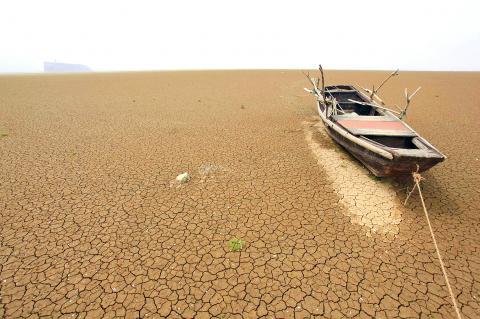
Photo: Reuters
The industry group China Electricity Council has estimated a power shortfall of 30 million kilowatts in the summer. That is only 3 percent of China’s generating capacity, but the shortages are concentrated in key manufacturing regions such as Zhejiang and Jiangsu, near Shanghai.
According to industry reports, petrochemical and plastics manufacturers and smaller factories are among those most affected.
Fast-growing China has long experienced periodic power shortages, especially in winter and summer when weather extremes boost demand for heating and cooling. However, the problems this year stem mainly from a failure of government-controlled electricity rates to keep pace with the costs paid by utilities for the coal that fuels about three-quarters of the country’s electricity generation.
Power companies are reluctant to invest in new projects, while many older, heavily polluting thermal plants are being closed down to help meet environmental targets.
The amount of new installed capacity is due to drop 10 million kilowatts next year from this year, while demand continues to climb at double-digit rates, Hu Zhaoguang (胡兆光), vice president of State Grid Energy Research Institute, said in comments posted on the Energy Research Observation Net.
The regional power distributor East China Grid Co estimates that power shortages could reach 19 million kilowatts this summer in Shanghai and four other nearby provinces, the newspaper China Daily reported yesterday.
The worst will be a shortfall of more than 11 million kilowatts, or 16 percent of total demand, in Jiangsu Province, upriver from Shanghai along the Yangtze, where drought has sapped water levels to their lowest ever at some points, stalling shipping.

SPEAKING OUT: After Siranudh Scott’s allegations surfaced, celebrities and public figures took to social media to share their own experiences of sexual misconduct and abuse A high-profile alleged sexual abuse case within a wealthy Thai beer brewing family has prompted a wave of painful accounts from survivors of unconnected abuse in the conservative nation. Siranudh Scott, a member of the billionaire Thai family that founded the ubiquitous Singha beer brand, posted an emotional video this month accusing his elder brother Sunit of repeatedly abusing him when he was a teenager. Sunit, who is in his 30s, later denied the allegations in a video posted online, but Singha parent Boonrawd dismissed him from his executive role with the company on Tuesday last week. “I felt I needed to speak

‘CROSSING THE LINE’: China’s embassy in Seoul criticized US Forces Korea Commander General Xavier Brunson, asking if his ‘hostile’ remarks were authorized by Washington South Korea and the US are in talks over recent public remarks by the commander of US Forces Korea, Seoul’s presidential office said yesterday, after the comments drew sharp criticism from China. In a recent podcast interview, US Forces Korea Commander General Xavier Brunson described South Korea as “the dagger in the heart of Asia” from China’s east coast, prompting the Chinese embassy in Seoul to say that he had “truly crossed the line.” The interview came amid growing speculation that Washington might seek to expand the role of US Forces Korea in countering the growing regional influence of China, a key

SEEKING ORDER: Rodrigo Paz said that ‘anyone who wants to destroy the nation will have to deal with this president and the full force of the constitution’ Bolivian President Rodrigo Paz on Wednesday said that the nation was at a “breaking point” after nearly a month of protests that have caused shortages of food, fuel and medicine. Paz, who took office six months ago amid the worst economic crisis there in four decades, is battling a groundswell of fury over his policies. The political capital, La Paz, has been besieged by low-income workers and members of the indigenous majority calling for his resignation. “The country needs order and is reaching breaking point,” the 58-year-old said at a public event in La Paz, renewing his appeal for dialogue. On Tuesday, the Bolivian

Forecasters in Europe yesterday warned of exceptional heat as record temperatures driven by a “heat dome” push temperatures well above seasonal norms across the continent. The surge follows a record-breaking Monday, with France logging its hottest day in the month of May on record, its weather agency said, and the UK also posting unprecedented highs. A so-called “heat dome” of warm air from northern Africa trapped under a high-pressure system over western Europe is behind the high temperatures not usually seen until high summer. Restrictions on outdoor work were imposed in parts of Italy, beaches in southwest France filled earlier than usual and


 RSS
RSS