


Where tensions run high, walls have climbed higher to try to stop rival Mexican gangs from taking the blood-stained chaos from the streets of Ciudad Juarez with them into prison.
Drug gangs and their hitmen — groups such as the Aztecas and the Mexicles — often continue their battles behind bars in the city, located across the border from El Paso, Texas, and right at the heart of Mexico’s raging drug war.
“The [6m] walls went up in late 2009,” prison spokesman Hector Conde said.
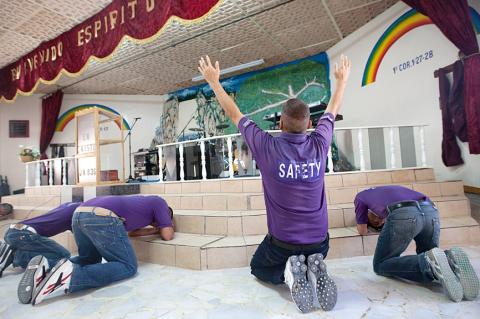
Photo: AFP
“Before, there were only chain-link fences that inmates would jump over pretty easily. There were riots all the time,” often leaving dozens dead and requiring helicopter-backed security operations to break them up, he said.
Conde declined to enter the block housing members of the Aztecas, a notorious gang of hitmen for the Juarez cartel.
“Some of the Aztecas were just moved to another facility recently, so these guys are really aggravated. They could carry out reprisals if you go in there,” he said.
Across the way, out of sight, were members of the Mexicles gang. They work for the Sinaloa cartel led by Mexico’s most famous fugitive, Joaquin “El Chapo” (Shorty) Guzman.
Officials blame the Juarez and Sinaloa cartels for most of the violence in Juarez as they fight for control of the lucrative drug trafficking routes into the US.
Last year, 3,100 people died in violent attacks in this northern city of about 1.2 million people — roughly 60 each week on average.
A surge of drug-related violence has left almost 35,000 people dead in Mexico since the government of Mexican President Felipe Calderon launched a military crackdown on the cartels in 2006, according to official figures.
The murder rate climbed to more than 10 a day in Juarez in February 2009, prompting Calderon to deploy more than 5,000 troops to the city.
Some of the murders are particularly gruesome, decapitated bodies, corpses hung from bridges. Children, even pregnant women, have been among the dead, but most are young gang members.
With factory salaries starting at less than US$50 a week, the financial lure of the drug gangs is huge in Juarez — one of the main thoroughfares for the cocaine that feeds the ever-strong US market.
Physical separation may help prevent jailed gang members from starting riots, but critics question maintaining gang labels behind bars.
“That gives them territory inside the prison and makes it an extension of what is happening outside on Ciudad Juarez streets,” said Gustavo de la Rosa, from the Chihuahua state human rights commission.
The gangs work with military-style organization and often control the jails imprisoning them, he said.
After checking no one was listening, a guard said there were about 2,400 inmates at the prison, 700 of them Aztecas housed in one block.
The prisoners were separated based on tattoos linking them to their gangs: The Aztecas with pyramids and Aztec symbols and the Mexicles sporting skulls and their gang name, prison pastor Victor Martinez said.
Tensions were lower in his section of the jail, which the prison authorities had decided was the best place to house convicted evangelical Christians.
“I feel safer here than on the streets or other parts of the prison,” said Otoniel Lucero Pena, 46, in for trafficking marijuana.
He said he was never in a gang.
Prisoners such as Pena gained most from the wall, Martinez said.
Five years ago, the Aztecas tried to make some of the evangelical prisoners work for them. When they refused, they attacked them, Martinez said.
“They started to beat drums to signal the start of a riot or clash. Then they jumped over the metal fence of the Christians’ sector, where there were 140 prisoners at the time. They killed three of them, but the others managed to escape to the women’s area,” Martinez said.

Kouri Richins, a Utah mother who published a children’s book about grief after the death of her husband is to serve a life sentence for his murder without the possibility of parole, a judge ruled on Wednesday. Richins was convicted in March of aggravated murder for lacing a cocktail given to her husband, Eric Richins, with five times the lethal dose of fentanyl at their home near Park City in 2022. A jury also found her guilty of four other felonies, including insurance fraud, forgery and attempted murder for trying to poison her husband weeks earlier on Feb. 14, 2022, with a

‘GROSS NEGLIGENCE?’ Despite a spleen typically being significantly smaller than a liver, the surgeon said he believed Bryan’s spleen was ‘double the size of what is normal’ A Florida surgeon who is facing criminal charges after allegedly removing a patient’s liver instead of his spleen has said he is “forever traumatized” by that person’s death. In a deposition from November last year that was recently obtained by NBC, 44-year-old Thomas Shaknovsky described the death of 70-year-old William Bryan as an “incredibly unfortunate event that I regret deeply.” Bryan died after the botched surgery; and last month, a grand jury in Tallahassee indicted Shaknovsky on a charge of manslaughter. “I’m forever traumatized by it and hurt by it,” Shaknovsky added, also saying that wrong-site surgeries can happen “during

‘PERSONAL MISTAKES’: Eileen Wang has agreed to plead guilty to the felony, which comes with a maximum sentence of 10 years in federal prison A southern California mayor has agreed to plead guilty to acting as an illegal agent for the Chinese government and has resigned from her city position, officials said on Monday. Eileen Wang (王愛琳), mayor of Arcadia, was charged last month with one count of acting in the US as an illegal agent of a foreign government. She was accused of doing the bidding of Chinese officials, such as sharing articles favorable to Beijing, without prior notification to the US government as required by law. The 58-year-old was elected in November 2022 to a five-person city council, from which the mayor is selected

DELA ROSA CASE: The whereabouts of the senator, who is wanted by the ICC, was unclear, while President Marcos faces a political test over the senate situation Philippine authorities yesterday were seeking confirmation of reports that a top politician wanted by the International Criminal Court (ICC) had fled, a day after gunfire rang out at the Philippine Senate where he had taken refuge fearing his arrest. Senator Ronald “Bato” dela Rosa, the former national police chief and top enforcer of former Philippine president Rodrigo Duterte’s “war on drugs,” has been under Senate protection and is wanted for crimes against humanity, the same charges Duterte is accused of. “Several sources confirmed that the senator, Senator Bato, is no longer in the Senate premises, but we are still getting confirmation,” Presidential


 RSS
RSS