


Security forces loyal to Ivory Coast strongman Laurent Gbagbo used heavy machine guns against women demonstrating in Abidjan, killing up to eight people, the UN peacekeeping chief said on Thursday.
Alain Le Roy, UN undersecretary-general in charge of peacekeeping, said he had told the UN Security Council that there were between six and eight dead from the latest attack on civilians in the Ivory Coast conflict.
The women were demonstrating in favor of Gbagbo’s rival for the presidency, Alassane Ouattara.
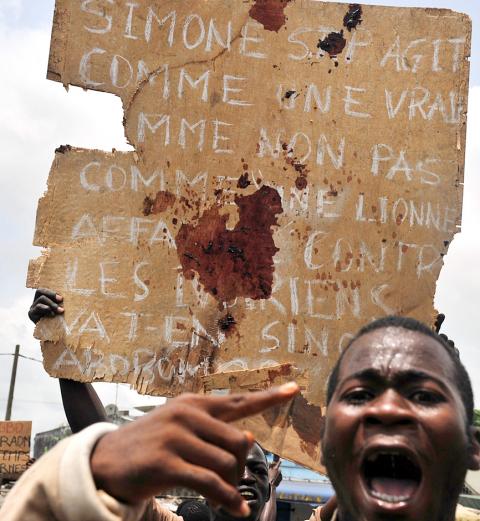
Photo: AFP
“I reported that to the council, six to eight [dead] by heavy machine guns, probably what we would call 12.7” weapons, Le Roy told reporters after the Security Council meeting.
He said UN peacekeepers were “immediately” on the scene.
“The situation is clearly deteriorating. We are on the verge of civil war, it is very clear. Violence is increasing,” Le Roy said.
The incident shocked a nation where women’s marches have historically been used as a last resort against an unrestrained army.
Because the president’s security force has shown almost no reserve in opening fire on unarmed civilians, the women decided this week to organize the march in the nation’s commercial capital, assuming soldiers would be too ashamed to open fire.
However, at least six of the thousands of women demonstrating on Thursday were killed on the spot, said Mohamed Dosso, an assistant to the mayor of Abidjan’s Abobo suburb, who said he saw the bodies.
Sirah Drane, 41, who helped organize the march, said she was holding the megaphone and preparing to address the large crowd that had gathered at a traffic circle in Abobo.
“That’s when we saw the tanks,” she said. “There were thousands of women. And we said to ourselves: ‘They won’t shoot at women.’ ... I heard a boom. They started spraying us ... I tried to run and fell down. The others trampled me. Opening fire on unarmed women? It’s inconceivable.”
The attack prompted an immediate rebuke from the US, which like most governments has urged Gbagbo to step down and has recognized his rival as the country’s legitimate president.
“The moral bankruptcy of Laurent Gbagbo is evident as his security forces killed women protesters,” US State Department spokesman P.J. Crowley said in a Twitter message.
In New York, the UN Security Council said it is “deeply concerned” about the escalation of violence in Ivory Coast and that it could lead to a resurgence of civil war there.
Nearly 400 people have been killed in the west African country, including 32 in the past 24 hours, almost all of them men who had voted for opposition leader Ouattara, according to UN figures combined with deaths confirmed by The Associated Press.
Last week, Gbagbo’s security forces entered the Abobo neighborhood and began shelling it with mortars, a shocking escalation indicating the army is willing to use war-grade weapons on its citizens. Before that, the bodies seen by reporters had bullet wounds where the point of impact was marked by a single stain of blood. Since the escalation, the bodies seen by reporters have arrived at the morgue in body bags dripping with blood.
A 14-year-old’s corpse had hundreds of shrapnel wounds across the chest, and the doctor who attempted to save him last week said the wounds were the result of a fragmentation grenade, similar to those used in Iraq and Afghanistan.
In Abobo, the official in the mayor’s office said that one of the women had been “torn to pieces” by the barrage of gunfire.
At least 200,000 people have fled the suburb, said Guillaume Nguefa of the human rights division of the UN mission in Ivory Coast.
“In Abobo district, the government is using heavy artillery weapons against people,” he said.
Last week, one of the morgues ran out of space, forcing workers to stack bodies on the floor. In January, the odor from the morgue could be smelled from the parking lot. Now, it projects itself across the street.
Ouattara’s camp has in the past two weeks gone from a largely peaceful resistance to an armed one as well, led by rebels from the north and soldiers defecting from Gbagbo’s army.
They now occupy a large section of Abobo called PK-18, where the army has not dared enter for four days. Those attempting to enter must pass checkpoints every 100m, where cars are searched by gunmen wearing amulets for protection, a practice widespread among the northern-based rebels.
Drane, the march organizer who is the executive secretary of the women’s wing of the Democratic Republican Rally, Ouattara’s party, said it was their idea to go out, because they could not stand seeing their men leave home.
“Every time that one of our men goes out, he is cut down,” she said. “And when a man falls, there is always a woman who suffers ... We want to say to Mr Gbagbo, who lost this election, that he needs to leave.”
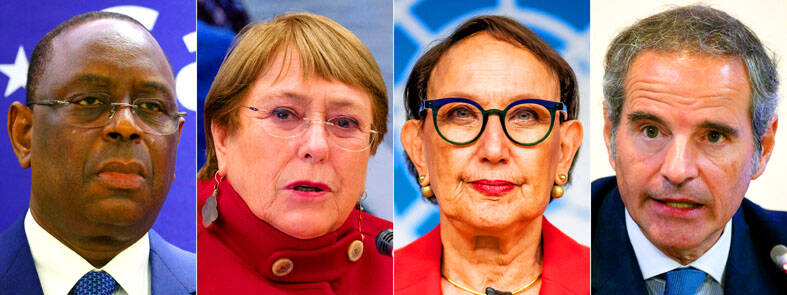
Four contenders are squaring up to succeed Antonio Guterres as secretary-general of the UN, which faces unprecedented global instability, wars and its own crushing budget crisis. Chile’s Michelle Bachelet, Argentina’s Rafael Grossi, Costa Rica’s Rebeca Grynspan and Senegal’s Macky Sall are each to face grillings by 193 member states and non-governmental organizations for three hours today and tomorrow. It is only the second time the UN has held a public question-and-answer, a format created in 2016 to boost transparency. Ultimately the five permanent members of the UN’s top body, the Security Council, hold the power, wielding vetoes over who leads the

South Korea’s air force yesterday apologized for a 2021 midair collision involving two fighter jets, a day after auditors said the pilots were taking selfies and filming during the flight and held them responsible for the accident. “We sincerely apologize to the public for the concern caused by the accident that occurred in 2021,” an air force spokesman told a news conference, adding that one of the pilots involved had been suspended from flying duties, received severe disciplinary action and has since left the military. The apology followed a report released on Wednesday by the South Korean Board of Audit and Inspection,

About 240 Indians claiming descent from a Biblical tribe landed at Tel Aviv airport on Thursday as part of a government operation to relocate them to Israel. The newcomers passed under a balloon arch in blue and white, the colors of the Israeli flag, as dozens of well-wishers welcomed them with a traditional Jewish song. They were the first “bnei Menashe” (“sons of Manasseh”) to arrive in Israel since the government in November last year announced funding for the immigration of about 6,000 members of the community from the states of Manipur and Mizoram in northeast India. The community claims to descend from

Young Chinese, many who fear age discrimination in their workplace after turning 35, are increasingly starting “one-person companies” that have artificial intelligence (AI) do most of the work. Smaller start-ups are already in vogue in Silicon Valley and elsewhere, with rapidly advancing AI tools seen as a welcome teammate even as they threaten layoffs at existing firms. More young people in China are subscribing to the model, as cities pledge millions of dollars in funding and rent subsidies for such ventures, in alignment with Beijing’s political goal of “technological self-reliance.” “The one-person company is a product of the AI era,” said Karen Dai


 RSS
RSS