


As Tunisia yesterday marked a month since the ousting of former Tunisian president Zine El Abidine Ben Ali, the interim government battled European pressure to curb an exodus of migrants and a key minister quit.
Tunisian foreign minister Ahmed Ounaies resigned on Sunday in a blow to the new authority a day before a visit by EU foreign policy chief Catherine Ashton that is focusing on democratic reforms since the removal of the strongman leader in a popular uprising.
The interim government, meanwhile, rushed security forces to coastal areas to stop a Europe-bound exodus of people fleeing poverty, a government source said, with thousands of immigrants flooding to Italy in recent days.

Photo: AFP
Maritime security “have arrested many people trying to cross the borders. Reinforcements have been sent,” the official said on grounds of anonymity, refusing to disclose further details.
Immigration was likely a top issue in talks between Tunisian Prime Minister Mohamed Ghannouchi and Ashton yesterday, after Italy appealed for urgent EU aid to halt a wave of North African immigrants.
About 5,000 undocumented migrants, many of them Tunisians, have arrived on Lampedusa over the last week.
Struggling local authorities called for more support on Sunday to help handle the increasing stream of migrants into the Sicilian island, which is closer to Africa than mainland Italy.
The situation has alarmed Italian Prime Minister Silvio Berlusconi’s government, which proclaimed a humanitarian emergency following a meeting on Saturday, giving authorities extraordinary powers setting aside normal bureaucracy to control migrant flows, in part by blocking incoming boats offshore.
Italian Foreign Minister Franco Frattini on Sunday repeated calls to the EU for help after one boat sank off Tunisia’s coast on Saturday, with at least one migrant reported dead.
Authorities have directed migrants to a Lampedusa soccer field, while hundreds slept under open skies in its port, wrapped in blankets. Local hotels and churches have also thrown open facilities.
Italy has called for an urgent EU meeting to work out an efficient response and it wants patrol boats stationed near the Tunisian coast to intercept migrants.
The immigrants say they are fleeing poverty and continued unrest in the North African state following the uprising that ousted Ben Ali on Jan. 14 after 23 years in power.
“The Tunisian system is collapsing,” Italian Minister of the Interior Roberto Maroni, of the anti-immigration Northern League party, said in an interview.
However, Tunisian officials slammed a suggestion by Rome that Italian police could be sent to the country to stem the flow of illegals.
“It is unacceptable,” government spokesman Taieb Baccouche told al-Arabiya television when asked to react to a statement by Maroni that he would ask Tunisia “for authorization for our forces to intervene in Tunisia to block the flux.”
“The Tunisian people reject the deployment of foreign soldiers on our territory,” Baccouche said, adding that control of the country’s coast “is up to the Tunisian authorities.”

An American scientist convicted of lying to US authorities about payments from China while he was at Harvard University has rebuilt his research lab in Shenzhen, China, to pursue technology the Chinese government has identified as a national priority: embedding electronics into the human brain. Charles Lieber, 67, is among the world’s leading researchers in brain-computer interfaces. The technology has shown promise in treating conditions such as amyotrophic lateral sclerosis and restoring movement in paralyzed people. It also has potential military applications: Scientists at the Chinese People’s Liberation Army have investigated brain interfaces as a way to engineer super soldiers by boosting

Indonesian police have arrested 13 people after shocking images of alleged abuse against small children at a daycare center went viral, sparking outrage across the nation, officials said on Monday. Police on Friday last week raided Little Aresha, a daycare center in Yogyakarta on Java island, following a report from a former employee. CCTV footage circulating on social media showed children, most younger than two, lying on the floor wearing only diapers, their hands and feet bound with rags. The police have confirmed that the footage is authentic. Police said they also found 20 children crammed into a room just 3m by 3m. “So

A highway bomb attack in a restive region of southwestern Colombia on Saturday killed 14 people and injured at least 38, the latest spate of violence ahead of next month’s presidential election. Authorities blamed the attack in the Cauca department — a conflict-ridden, coca-growing region — on dissidents of the now-disbanded FARC guerrilla army, who have been sowing violence across the country. “Those who carried out this attack ... are terrorists, fascists and drug traffickers,” Colombian President Gustavo Petro said on social media. “I want our very best soldiers to confront them,” he added. The leftist leader blamed the bombing
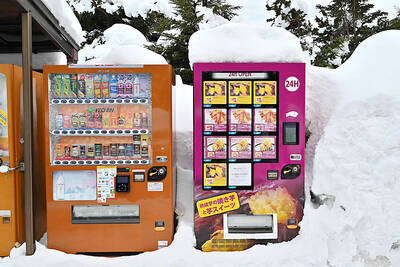
From post offices and parks to stations and even the summit of Mount Fuji, Japan’s vending machines are ubiquitous, but with the rapid pace of inflation cooling demand for their drinks, operators are being forced to rethink the business. Last month beverage giant DyDo Group Holdings announced it would remove about 20,000 vending machines — about 7 percent of their stock nationwide — by January next year, to “reconstruct a profitable network.” Pokka Sapporo Food & Beverage, based in Nagoya, also said last month it would sell its 40,000-machine operation to Osaka-based Lifedrink Co. “The strength of the vending machine


 RSS
RSS