

While Taiwan and others in Asia ring in the lunar Year of the Rabbit this week, Vietnamese are purring about the coming Year of the Cat.
Exactly why and when Vietnam dumped the rabbit and adopted the cat for its version of the 12 signs of the horoscope taken from China is up for debate and may have been partly the result of a complex translation error.
These days, though, the idea of hopping back to the rabbit would be highly disagreeable to most Vietnamese.
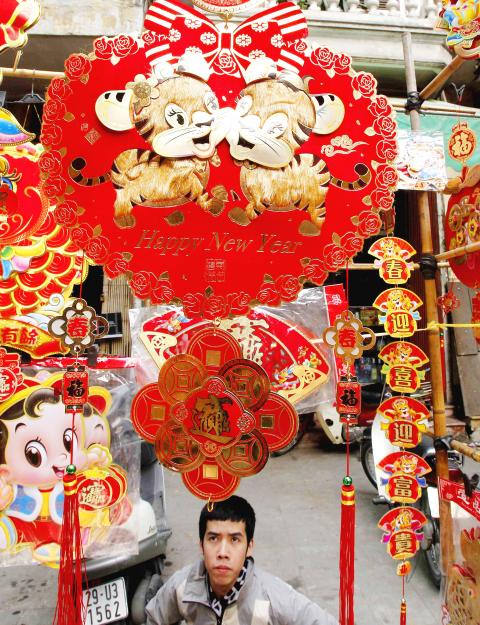
Photo: Reuters
Besides the cat, the other 11 signs are the ox, tiger, dragon, snake, rat, horse, sheep, monkey, rooster, dog and pig. Each is believed to bring its own peculiar and unique characteristics to the cycle.
“It’s appropriate that the Vietnamese swapped the cat into the calendar in place of the rabbit. Rabbits are a kind of rodent and the rat is also a rodent. The animals should be different,” pet enthusiast Nguyen Bao Sinh said.
The cat helps offset the dog, its natural enemy, said Sinh, who runs a pet hotel in Hanoi that charges 500,000 dong (US$25.65) a night per animal for a stay.
“This expresses a balance of yin and yang in the cosmos that is more complete, that better unifies the contradictions, and so it is richer and better to have the cat,” he added.
In China, the rabbit is thought to be one of the happiest signs, with people born in that year renowned for their kindness, reliability and loyalty, though with an air of mystery. In Vietnam, rabbits are considered food.
Cats also appear on the occasional menu as “little tigers,” although the practice of eating them is technically banned.
To most, though, they are clean, sociable and smart companions, and their year brings high hopes for harmony.
“The image of the cat is cultured and the nature of a cat is gentle, sociable and close to people,” said Hoang Ngoc Bao, a veterinarian and cat enthusiast.
“I want that gentleness, that sociability that is special to cats to make our society better so that we can live for the community and more humanely,” he said.
At an outdoor pet market not far away, Hanoi resident Cao Thu Ha was buying a new cat for the New Year, saying that cats are like children in bringing happiness to a family.
Fashion boutique owner Khuc Hoai Thuong has had about 20 cats over the years and is also a believer.
“When people have a love of pets, their demeanor is softened a bit,” said Thuong, who brought a two-month-old kitten to Sinh’s hotel shop to buy a new red satin outfit and to get groomed.
Pet shows have celebrated the coming year, with a feline show in Hanoi last week crowning a portly Siamese “Miss Cat.”
“I hope that in the New Year all people and all animals are healthy and have good luck and success,” said the cat’s owner, Nguyen Minh Ngoc. “I also hope that in the New Year there are more cat shows like this so that all the cats can show off their lovability.”

Philippine Secretary of National Defense Gilberto Teodoro Jr on Tuesday hit out at China at an international forum after a memo asserting Beijing’s position over their longstanding maritime dispute was delivered to him while he was speaking on stage. The unusual incident was captured on video at the Seoul Defense Dialogue as the secretary was responding to a question about “gray zone” coercion in the South China Sea. The video shows what appears to be a conference staffer placing it on the table next to him while speaking. “I have a note here, I think this is from China,” he said, describing

PAINSTAKING PROCESS: Ice makers freeze water for up to 72 hours, replace tainted water with a fresh batch once freezing begins, and are constantly stirring In the historic Japanese city of Kanazawa, craftsmen painstakingly shape and slice blocks of ice destined to chill negronis in some of the world’s trendiest bars. The men work for Kuramoto Ice, a century-old company in Ishikawa on the Sea of Japan coast and one of dozens of Japanese firms producing ultra-clear, premium ice. This luxury product, believed by those in the industry to melt more slowly than regular blocks, is a staple of Japan’s cocktail culture, but its popularity is also spilling over to bars abroad, from the US to Australia, who pay as much as ¥200 (US$1.28) per cube. Kuramoto Ice
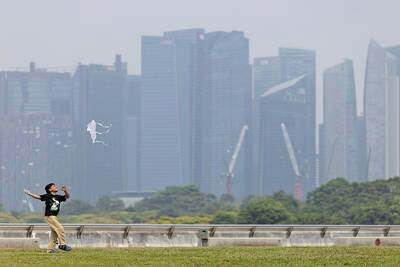
Singapore’s air quality hit an unhealthy level yesterday, as haze from forest fires raging in Indonesia continued to spread across swathes of Southeast Asia. The city-state is currently one of the 10 most-polluted major cities in the world, coming in at third in IQAir’s ranking. Kuching, in the Malaysian part of the island of Borneo, was No. 1. A government taskforce has “activated haze response plans” for schools, workplaces and community centers, Singaporean Minister for Sustainability and the Environment Grace Fu (傅海) said in a video message on Facebook. Most people could continue essential daily activities, but the elderly or vulnerable should

WAR CRIMES? An investigation found that a network of countries are supplying Sudan’s RSF with weapons, including drone blamed for large civilian casualties Foreign weapons, military technology, fighters and logistical networks are helping sustain Sudan’s conflict and expanding the warring parties’ ability to strike deep into civilian areas, a UN fact-finding mission said in a report published yesterday, warning that some attacks might amount to war crimes. Sudan’s war erupted in April 2023 following a power struggle between Sudan’s military and the Rapid Support Forces (RSF) ahead of a planned transition to civilian rule. The conflict has devastated the country, displaced more than 14 million people and created what the UN has described as one of the world’s worst humanitarian crises. The UN mission said


 RSS
RSS