


As the war in Afghanistan enters its 10th year, the US military is shaking up its traditional training regimen to prepare troops for the country’s complex battlefields.
At boot camps nowadays, soldiers are taught to think on their toes as they prepare for missions that will require them not only to fight shadowy enemies on rough terrain, but also protect civilians caught in the crossfire.
“Thirty years ago, it was blind obedience. Today we teach them to think,” says Command Sergeant Major John Calpena, who honed his skills during a 29-year-long career, with deployments to Iraq. “We expect them to think. We force them to make a decision under stress.”
First aid courses now teach soldiers to make tourniquets from scratch, while the traditional black and white bull’s-eyes at shooting ranges have been replaced by moving targets, some which are not to be shot.
Command Sergeant Major -Richard Weik, who just returned from a rotation in Afghanistan’s Paktika Province, watched as the soldiers navigated the revamped firing range here at Fort Benning in Georgia.
“Most of these guys within a year will be somewhere on a theater,” he said, with Afghanistan the most likely destination following US President Barack Obama’s decision more than a year ago to flood 30,000 troop reinforcements into the war-torn country.
Posted with a gun behind the window of a plywood shed used for urban combat training, Private Antuan Lecounte is preparing for the murky battlefields to which he may soon be deployed.
“If you see a uniform, you know what to do. If you see someone using a cellphone, you don’t know if he’s going to detonate a bomb or say to his wife ‘I love you,’” he says, following 12 weeks of training.
Specialist Dan Zaborowski, 27, has also noticed the changes since his first stint in the army seven years ago.
“They’re constantly hardening on integrity. There is more emphasis on teaching rather than disciplining,” he said.
The soldiers’ physical training has also been revised to better match the demands of combat, with fewer push-ups and sit-ups, says Lieutenant General Mark Hertling of the army’s training and doctrine command.
“It’s linked directly to the kind of things we expect the soldier to do on the battlefield — short burst of energy, carrying heavy loads,” he says.
It’s the kind of training that, among other things, will prepare the soldiers to carry wounded comrades to safety.
“I’ve been on the battlefield for three years in my life. I’ve never done a two-mile [3.2km] run on the battlefield, but a lot of short bursts,” Hertling said.
The morning workout saw some 200 soldiers mix sprints and gymnastics, exercises designed to strengthen their muscles and prevent injuries. The scene would not be out of place in a neighborhood gymnasium, but here the soldiers were planted in the mud.

Shamans in Peru on Monday gathered for an annual New Year’s ritual where they made predictions for the year to come, including illness for US President Donald Trump and the downfall of Venezuelan President Nicolas Maduro. “The United States should prepare itself because Donald Trump will fall seriously ill,” Juan de Dios Garcia proclaimed as he gathered with other shamans on a beach in southern Lima, dressed in traditional Andean ponchos and headdresses, and sprinkling flowers on the sand. The shamans carried large posters of world leaders, over which they crossed swords and burned incense, some of which they stomped on. In this
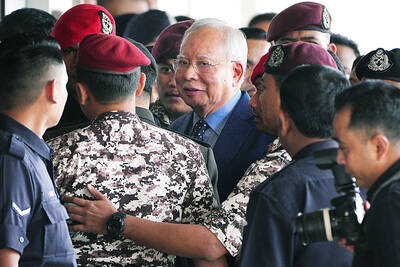
‘NO COUNTRY BUMPKIN’: The judge rejected arguments that former prime minister Najib Razak was an unwitting victim, saying Najib took steps to protect his position Imprisoned former Malaysian prime minister Najib Razak was yesterday convicted, following a corruption trial tied to multibillion-dollar looting of the 1Malaysia Development Berhad (1MDB) state investment fund. The nation’s high court found Najib, 72, guilty on four counts of abuse of power and 21 charges of money laundering related to more than US$700 million channeled into his personal bank accounts from the 1MDB fund. Najib denied any wrongdoing, and maintained the funds were a political donation from Saudi Arabia and that he had been misled by rogue financiers led by businessman Low Taek Jho. Low, thought to be the scandal’s mastermind, remains

Near the entrance to the Panama Canal, a monument to China’s contributions to the interoceanic waterway was torn down on Saturday night by order of local authorities. The move comes as US President Donald Trump has made threats in the past few months to retake control of the canal, claiming Beijing has too much influence in its operations. In a surprising move that has been criticized by leaders in Panama and China, the mayor’s office of the locality of Arraijan ordered the demolition of the monument built in 2004 to symbolize friendship between the countries. The mayor’s office said in
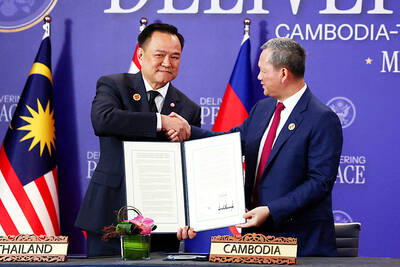
FIGHTING CONTINUES: Thai military dropped 40 bombs on border areas, Cambodia said, while Bangkok said Phnom Penh launched heavy attacks and damaged homes Cambodia yesterday accused Thailand of intensifying its bombardment of disputed border areas, even as officials from the two countries attend a multi-day meeting aimed at negotiating an end to deadly clashes. The neighbors’ long-standing border conflict reignited this month, shattering an earlier truce and killing more than 40 people, according to official counts. About 1 million people have also been displaced. Cambodian and Thai officials were in their third day of talks at a border checkpoint, with ministers of defense from the two countries scheduled to meet today. However, the Cambodian Ministry of National Defense said Thailand’s military carried out a heavy


 RSS
RSS