


Italian police officers sweep through the mosquito-infested clothes workshop, rifling through personal belongings and cracking jokes about the foreign food as six Chinese workers look on in fear.
Boxes filled with sparkling black shrugs and red party dresses spill onto the floor of the warehouse — one of 3,400 small Chinese businesses in Prato in central Italy that produce clothes for companies including Zara and H&M.
“I don’t understand what the problem is, we did everything correctly,” said Giujir, who declined to give her surname because of the police investigation, as she waited by a row of leopard-print dresses for her turn for questioning.
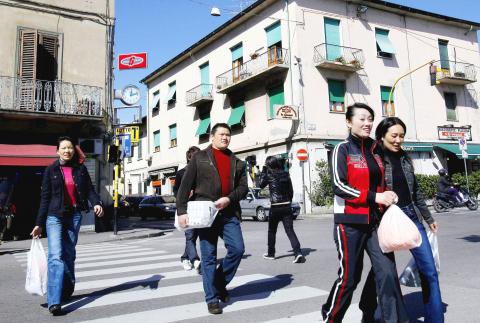
PHOTO: AFP
“There isn’t much work this year because of the crisis, and we have to pay the rent. I know the police have to carry out lots of controls, but it just makes the situation worse,” the worn-out 30-year-old said.
This is the first raid of the week in the historic town of Prato in Tuscany — a place local authorities see as a sort of new Chinese gangland, but immigrants defend as a revitalized hub of Italy’s flagging textile industry.
Chinese immigrants began arriving in Prato some 20 years ago, initially working for Italian companies before setting up their own businesses.
There are now about 17,000 Chinese out of a population of 188,000 — 50,000 if you include the estimated number of undocumented immigrants.
Though Chinese workers are now involved in every stage of production — even the cloth is imported because it costs 10 times less than Italian fabric — the companies can legally sell their clothes with the “Made in Italy” label.
The clothes are sold wholesale — at around 5 euros (US$6.50) for a dress or 10 euros for a coat — and bundled into vans from eastern and northern Europe that come and go seven days a week.
Few Italian shops remain in Prato’s Chinatown, located just next to the town’s historic center. The area is dotted with Chinese restaurants and supermarkets and almost all the signs are written in Chinese.
Prato’s residents last year voted in a new mayor — himself a textile business owner — who promised to tackle the Chinese community’s monopoly of the textile industry and crack down on Chinese--related crime.
Police raids in what Italian media calls “little China” have increased hugely since Mayor Roberto Cenni’s election, including investigations of mafia groups involved in money-laundering, loan-sharking and human trafficking.
The raid on Giujir’s workshop was for a much smaller infraction — workers were living illegally inside the building in unsafe and unsanitary conditions.
According to Silvia Pieraccini, journalist and author of a book on the Chinese textile industry in Prato, the workers live in the warehouses because they work 18 hours a day and sleep where they drop.
“The Chinese work a great deal. They are very quick to understand where the market is going, but they work in deplorable conditions, without contracts and in buildings that are unsafe and often unhygienic” she said.
Forty-seven-year-old Surong Badeng from Xinjiang, a police interpreter, said the Chinese community worked hard through choice not exploitation.
“They come to Italy to make money and have no time to integrate. They are ready to make huge sacrifices to get rich,” he said.
Prato’s mayor insists that the police crackdown to clean up the textile industry is about protecting exploited Chinese.
“We want to get closer to those who are being exploited in the hope that we can persuade them to rebel,” Cenni said.
That is not the way the Chinese embassy sees it.
“It’s wrong of Italy to carry out raids with helicopters and dogs. It’s completely over the top. We’re not at war, this is a civil country,” Tang Youjing, a counselor at the Chinese embassy, said in an interview.

DISPUTED WATERS: The Philippines accused China of building an artificial island on Sabina Shoal, while Beijing said Manila was trying to mislead the global community The Philippine Coast Guard (PCG) is committed to sustaining a presence in a disputed area of the South China Sea to ensure Beijing does not carry out reclamation activities at Sabina Shoal (Xianbin Reef), its spokesperson said yesterday. The PCG on Saturday said it had deployed a ship to Sabina Shoal, where it accused China of building an artificial island, amid an escalating maritime row, adding two other vessels were in rotational deployment in the area. Since the ship’s deployment in the middle of last month, the PCG said it had discovered piles of dead and crushed coral that had been dumped

Experts have long warned about the threat posed by artificial intelligence (AI) going rogue, but a new research paper suggests it is already happening. AI systems, designed to be honest, have developed a troubling skill for deception, from tricking human players in online games of world conquest to hiring humans to solve “prove-you’re-not-a-robot” tests, a team of researchers said in the journal Patterns on Friday. While such examples might appear trivial, the underlying issues they expose could soon carry serious real-world consequences, said first author Peter Park, a postdoctoral fellow at the Massachusetts Institute of Technology specializing in AI existential safety. “These

The most powerful solar storm in more than two decades struck Earth on Friday, triggering spectacular celestial light shows from Tasmania to the UK — and threatening possible disruptions to satellites and power grids as it persists into the weekend. The first of several coronal mass ejections (CMEs) — expulsions of plasma and magnetic fields from the sun — came just after 4pm GMT, according to the US National Oceanic and Atmospheric Administration’s Space Weather Prediction Center. It was later upgraded to an “extreme” geomagnetic storm — the first since the “Halloween Storms” of October 2003 caused blackouts in Sweden and damaged
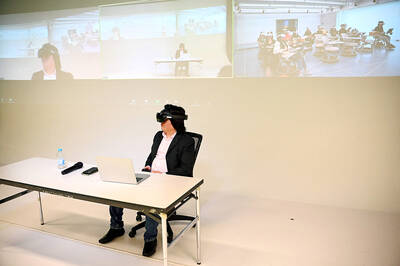
Using virtual-reality (VR) headsets, students at a Hong Kong university travel to a pavilion above the clouds to watch an artificial intelligence (AI)-generated Albert Einstein explain game theory. The students are part of a course at the Hong Kong University of Science and Technology (HKUST) that is testing the use of “AI lecturers” as the AI revolution hits campuses around the world. The mass availability of tools such as ChatGPT has sparked optimism about new leaps in productivity and teaching, but also fears over cheating, plagiarism and the replacement of human instructors. Pan Hui (許彬), a professor of computer science who is leading


 RSS
RSS