


At a center for disadvantaged children in Kabul, shy young girls step up to recite their duties as fasting Muslims for the visiting US ambassador.
Teachers look on with pride at young Afghans who were once left at the mercy of the street.
Yet the disturbing reality in this war-torn nation — where Western powers battle Islamist forces to maintain a friendly government in power — is that at least 600,000 street children have no safety net to catch them.
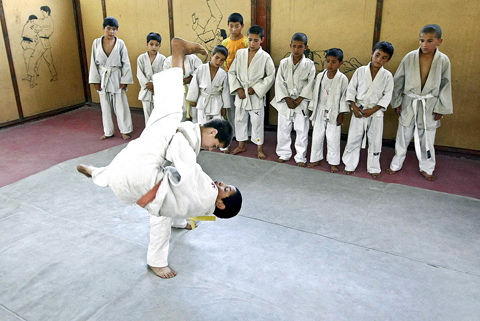
PHOTO: REUTERS
The problem, experts say, is getting worse because of the deepening war and the scourge of corruption, despite the inflow of more than US$35 billion from foreign donors since the Taliban were removed from power in 2001.
The dangers for children are many, they say: From drugs to the insurgency, from criminal gangs to sexual abuse.
“Poverty is getting worse in Afghanistan and children are forced to find work,” said Shafiqa Zaher, a social worker with Aschiana, the group receiving US aid for its work.
Zaher regularly trawls Kabul streets and parks where street children hang out and approaches them to see if they would be interested in an education.
“We take the children and show them what we do here and if they agree we go to the family and talk to them,” she said.
About 7,000 in the main cities of Afghanistan are attending Aschiana schools, where food and stationery costs are taken care of and some families are assigned sponsors.
Most have a home to go to, even if it is the shell of a building struck in the country’s unending wars, Zaher says, but their guardians are often disabled and cannot work.
A study by the Afghanistan Independent Human Rights Commission (AIHRC) in 2008 found around 60,000 minors involved in child labor in Kabul alone.
Nader Nadery, a senior commissioner at the AIHRC, says it’s a consequence of Afghanistan’s decades of conflict.
“In the last three to four years an increasing number of displaced from the war affected areas — Helmand, Kandahar, Ghazni — have poured into Kabul city to seek refuge,” he said.
A community of refugees mainly from Sangin in Helmand, where US forces led an operation against insurgents last year, relies on Aschiana help in a Kabul slum quarter of plastic awnings.
In three decades of war, the country’s population has doubled to more than 30 million and the dusty mountain capital has swelled to a city of 4 million, much of it potholed and crumbling, with chronic traffic.
“Historically, Kabul and Afghanistan have never had this crisis of people not having a ceiling or a roof. They’re all poor but at least they had a home,” Nadery said.
He says corruption, the subject of an ongoing diplomatic scuffle between Karzai and Washington and a major issue in parliamentary elections this month, makes a bad situation worse.
A UN report said in March that entrenched corruption was leaving the poor at the mercy of the powerful while security-obsessed foreign forces turn a blind eye.
“The direct link between poverty and corruption is always there,” Nadery said. “Most development projects are halted or don’t reach areas where it would affect the life of the poor because of the corruption involved.”
Afghans have been given a rude awakening to the extent of social problems through Omid (Hope), a daring television show that has been running on Saba TV for the past two years.
Investigating dozens of cases around the country, producer and researcher Zainab Rahimy found children whose parents were addicted to opium, boy soldiers drafted into fighting for the Taliban and an alarming frequency of sexual abuse.
Deprivation and abuse pushes some teenagers to join the insurgents, she said.
“The worst was children who the Taliban were forcing to go with them for an amount of money. They were from seven to 18 years old, with guns and regular training,” Rahimy said.
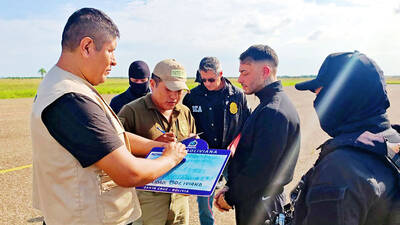
KINGPIN: Marset allegedly laundered the proceeds of his drug enterprise by purchasing and sponsoring professional soccer teams and even put himself in the starting lineups Notorious Latin American narco trafficker Sebastian Marset, who eluded police for years, was handed over to US authorities after his arrest on Friday in Bolivia. Marset, a Uruguayan national who was on the US most-wanted list, was passed to agents of the US Drug Enforcement Administration at Santa Cruz airport in Bolivia, then put on a US airplane, Bolivian state television showed. “The arrest and deportation were carried out pursuant to a court order issued by the US justice system,” Bolivian Minister of Government Marco Antonio Oviedo told reporters. The alleged kingpin was arrested in an upscale neighborhood of Santa
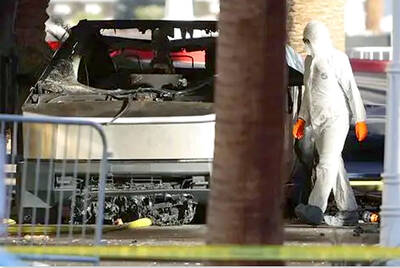
ACTIONABLE ADVICE: The majority of chatbots tested provided guidance on weapons, tactics and target selections, with Perplexity and Meta AI deemed to be the least safe From school shootings to synagogue bombings, leading artificial intelligence (AI) chatbots helped researchers plot violent attacks, according to a study published on Wednesday that highlighted the technology’s potential for real-world harm. Researchers from the nonprofit watchdog Center for Countering Digital Hate and CNN posed as 13-year-old boys in the US and Ireland to test 10 chatbots, including ChatGPT, Google Gemini, Perplexity, Deepseek and Meta AI. Eight of the chatbots assisted the make-believe attackers in more than half the responses, providing advice on “locations to target” and “weapons to use” in an attack, the study said. The chatbots had become a “powerful accelerant for
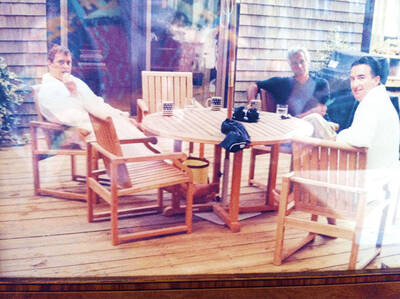
SCANDAL: Other images discovered earlier show Andrew bent over a female and lying across the laps of a number of women, while Mandelson is pictured in his underpants A photograph of former British prince Andrew and veteran politician Peter Mandelson sitting in bathrobes alongside late sex offender Jeffrey Epstein was unearthed on Friday in previously published documents. The image is believed to be the first known photograph of the two men with Epstein. They are currently engulfed in scandal in the UK over their ties to their mutual friend. The undated photograph, first reported by ITV News, shows King Charles III’s disgraced brother and former British ambassador to the US sitting barefoot outside on a wooden deck. They appear to have mugs with a US flag on them
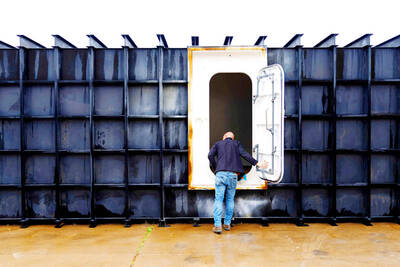
Since the war in the Middle East began nearly two weeks ago, the telephone at Ron Hubbard’s bomb shelter company in Texas has not stopped ringing. Foreign and US clients are rushing to buy his bunkers, seeking refuge in case of air raids, nuclear fallout or apocalypse. With the US and Israel pounding Iran, and Tehran retaliating with strikes across the region, Hubbard has seen demand for his product soar, mostly from Gulf nation customers in Bahrain, Qatar, Kuwait and the United Arab Emirates. “You can imagine how many people are thinking: ‘I wish I had a bomb shelter,’” Hubbard, 63, said in


 RSS
RSS