


Australian Prime Minister Julia Gillard won the support of a key independent lawmaker yesterday, leaving her just two seats from regaining power and within reach of ending a crippling political crisis.
Former Iraq war whistle-blower Andrew Wilkie said Gillard’s center-left Labor party was best placed to deliver “stable” and “competent” government after the Aug. 21 election returned the first hung parliament in 70 years.
“I have judged that it is the Australian Labor Party that best meets my criteria that the next government must be stable, must be competent and must be ethical,” Wilkie told journalists in Canberra.
Wilkie’s vote gives Gillard 74 seats in the 150-member lower house, just shy of an absolute majority of 76. However, Tony Abbott’s opposition coalition remains in the hunt with 73 seats, with three independents still undecided.
Wilkie urged the three remaining “kingmakers” to make their move soon, after nearly two weeks of political paralysis following the cliffhanger poll.
“I hope that this sends a signal to the other three independents and they move as soon as they can to make their decisions, and to decide to support a party or parties in a way that will bring stability to the parliament,” he said.
The final three independents — rural lawmakers Tony Windsor and Rob Oakeshott, and maverick Queenslander Bob Katter — have pledged to begin formal negotiations today.
Momentum is now firmly behind Gillard, Australia’s first woman prime minister, after she confirmed the support of parliament’s lone Greens lawmaker on Wednesday.
Gillard also received a boost when the opposition was accused of a policy blow-out of up to US$10 billion, prompting the remaining independents to question Abbott’s trustworthiness.
“Essentially what we’re after ... is a judgment on two different teams that want to be the government for the next period of three years,” Windsor said. “One of those things that we have to establish is trust in what they’re actually saying.”
New figures show that the opposition overstated savings from their election promises by up to A$10.6 billion (US$10 billion).
Abbot said yesterday that his coalition has the best economic credentials to govern, despite the figures released late on Wednesday by independent lawmakers.
Senior Liberal lawmakers have stuck by the accuracy of their own figures and explained that the discrepancies with official calculations by government ministries were “a difference of opinion” on methodology and underlying assumptions such as future interest rates.
“There are a whole lot of issues in play here and an, at times, arcane argument about costings is by no means the most important,” Abbott told reporters at Parliament House. “The bottom line is that there are two competing economic records here.”
He said that when Labor was elected in 2007, it had inherited A$60 billion in assets, which it turned into a A$90 billion debt through economic stimulus spending.
The three independents had requested briefings from Treasury and Finance ministry bureaucrats on confidential estimates of competing election pledges.
They said the questions of which party had the best economic blueprint, and which might have misled voters, were key factors in deciding whether to back a Liberal Party-led coalition or Labor Party government.
The trio released Treasury documents that contradicted Abbott’s claim that Australia’s bottom line would be A$11.5 billion better under his conservative coalition in three years, when both sides of politics have promised to return the budget to surplus.
Treasury found that the improvement could be as little as A$900 million.

Through the noise of rushing papers and whirring belts at a print factory in Kyoto, two creators watch their photo essay come to life in broadsheet form — part of an effort to win new audiences in the age of artificial intelligence (AI). Despite the decline of the publishing industry, self-publication and handmade “zine” magazines are growing in popularity in Japan, reflecting the nation’s enduring love of paper in the digital era. While speaking to Agence France-Presse at the plant, his hands black with ink, one of the creators, Kazuma Obara, said: “I think [paper] is a medium that engages all five
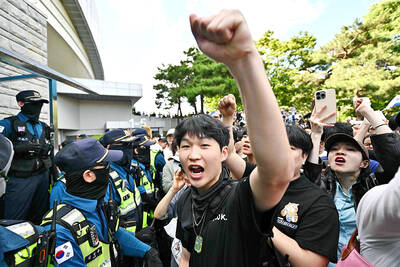
‘ABSURD MISTAKE’: The election commission said that there had been a failure to anticipate turnout after 14 polling stations ran short of ballot papers South Korean riot police yesterday cleared protesters from a Seoul polling station after a 35-hour blockade sparked by a shortage of ballot papers during local elections earlier this week. Wednesday’s election was the first nationwide vote since South Korean President Lee Jae-myung took office following the ouster of Yoon Suk-yeol over his short-lived martial law declaration. Lee’s ruling Democratic Party swept most races, but failed to flip the crucial Seoul mayoral seat. The South Korean National Election Commission apologized, blaming a failure to anticipate turnout after 14 polling stations in Seoul ran short of ballot papers. Some polling stations stayed open until 10pm to

Australian researchers have trained lab-grown brain cells on a silicon computer chip to play the 1990s shooter game Doom and said they are just scratching the surface of what the neurons could be capable of doing. It is the science-fiction work of biotech boffins at Cortical Labs, who researched and developed the technology that harnesses the workings of the brain’s networking system. Each so-called “biological computer” contains about 200,000 living human brain cells, grown from stem cells that were harvested from blood donations. Having mastered the simple computer game Pong, where a paddle is moved up and down to send a ball

France experienced its hottest spring on record, the French weather service said on Tuesday, after an exceptional early heat wave that also broke highs for the season in England and Wales. Meteo-France said the average nationwide temperature over March to May was 13.8°C — about 1.7°C above the norm, and surpassing records set in 2011 and 2020. “The warmest spring since records began in 1900,” it said in a bulletin. All three months were warmer than average, but the onset of an “unprecedented heatwave” late last month pushed the mercury to highs typically seen at the height of the summer. “Our country had never


 RSS
RSS