


Growing up in the West Bank, Mujahid Sarsur knew next to nothing about the Jewish Holocaust and saw little ground to sympathize with a people he saw as his occupier.
However, thanks to an Israeli roommate overseas, the 21-year-old Palestinian student learned about the Nazi murder of 6 million Jews during World War II and discovered a new understanding of his Israeli neighbors.
Now he wants other Arabs to do the same. Sarsur heads one of a handful of Palestinian grassroots groups seeking knowledge about the Holocaust.
On Wednesday, he led a delegation of 22 students to Israel’s official Holocaust memorial, Yad Vashem. The students, fasting for Ramadan, listened closely to their Arabic-speaking guide’s explanations and were left wide-eyed by the gruesome images of the death camps.
Girls in Muslim headscarves turned away in horror at the sight of Jewish corpses being shoveled into pits. They huddled together as they watched film from Auschwitz, where about 1 million Jews were put to death.
“The Holocaust is a huge part of Israeli society. We live so close to them and we need to understand them better if we are ever to live in peace,” said Sarsur, a junior at Bard College in New York. “If we change the way we think about the Holocaust, we can create bridges.”
Arab sentiment toward the Holocaust ranges from ignorance about its details to outright denial. Some hold a more complex belief system, acknowledging that the Holocaust did happen, but that they are paying the price by the loss of their land with the creation of the state of Israel after World War II.
Last year, in an incident that got international attention, a Palestinian youth orchestra performed a concert for Holocaust survivors in Israel and caused such uproar among Palestinians that it was shut down. Its conductor was banished and blocked from entering a West Bank refugee camp out of concern for her safety.
Two years ago, Yad Vashem launched an Arabic version of its Web site to combat Holocaust denial in the Arab world and provide credible historic material to those who seek it. A similar version in Farsi was aimed at Iran, whose president has called the Holocaust a “myth.”
Noor Amer, a 15-year-old Palestinian who attends high school in Jordan, said he compares Jewish suffering in the Holocaust with Palestinian suffering in the West Bank and Gaza. While he still rejects Zionism, he said the Yad Vashem visit helped him understand that “the Jews had nowhere else to go” after the Holocaust.
He said Palestinians have trouble seeing their enemies as victims to be sympathized with.
“The conflict is so complicated that people cannot forget it or put it aside,” he said. “If we say that the Holocaust happened, if we accept it, then we accept that Israelis are human just like us and I think that here is the twist — we do not want to consider Jews as humans because of all the suffering that we go through we cannot believe that human beings can do such a thing.”
Palestinians maintain that Israelis generally have failed to come to grips with their responsibility for the Palestinians’ six decades of dispossession and exile, though a new generation of Israeli historians has challenged their country’s widely held narrative of blamelessness.
Surveys show that Holocaust denial is common even among the 20 percent of Israeli citizens who are Arab and grew up under the Israeli educational curriculum.
Aumamah Sarsur, 22, an Israeli Arab and cousin of Mujahid Sarsur, said the Yad Vashem visit taught her that Jews were tortured and killed by the Nazis.
“I am not giving them legitimacy to come here and make their own country, but I get their point of view,” she said.
Dorit Novak, the director of Yad Vashem’s international school for Holocaust studies, called the visit a “blessed initiative” and hoped for continued dialogue to break down the stereotypes on both sides.
“I appreciate their principles, their courage, their curiosity and their willingness to come, listen and learn,” she said. “The Arab world is exposed to the Holocaust in a very distorted way. I know this is limited outreach, but I am willing to suffice with something limited in the reality in which we live.”
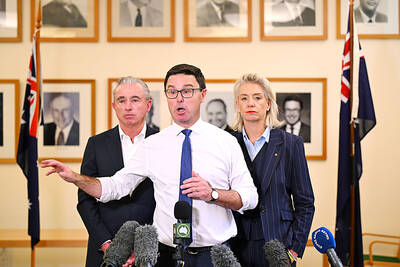
BACKLASH: The National Party quit its decades-long partnership with the Liberal Party after their election loss to center-left Labor, which won a historic third term Australia’s National Party has split from its conservative coalition partner of more than 60 years, the Liberal Party, citing policy differences over renewable energy and after a resounding loss at a national election this month. “Its time to have a break,” Nationals leader David Littleproud told reporters yesterday. The split shows the pressure on Australia’s conservative parties after Prime Minister Anthony Albanese’s center-left Labor party won a historic second term in the May 3 election, powered by a voter backlash against US President Donald Trump’s policies. Under the long-standing partnership in state and federal politics, the Liberal and National coalition had shared power

CONTROVERSY: During the performance of Israel’s entrant Yuval Raphael’s song ‘New Day Will Rise,’ loud whistles were heard and two people tried to get on stage Austria’s JJ yesterday won the Eurovision Song Contest, with his operatic song Wasted Love triumphing at the world’s biggest live music television event. After votes from national juries around Europe and viewers from across the continent and beyond, JJ gave Austria its first victory since bearded drag performer Conchita Wurst’s 2014 triumph. After the nail-biting drama as the votes were revealed running into yesterday morning, Austria finished with 436 points, ahead of Israel — whose participation drew protests — on 357 and Estonia on 356. “Thank you to you, Europe, for making my dreams come true,” 24-year-old countertenor JJ, whose
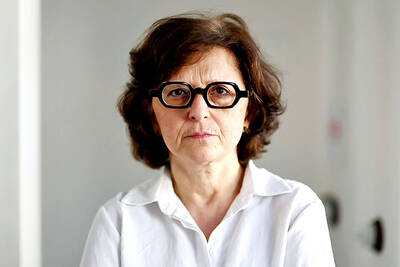
A documentary whose main subject, 25-year-old photojournalist Fatima Hassouna, was killed in an Israeli airstrike in Gaza weeks before it premiered at Cannes stunned viewers into silence at the festival on Thursday. As the cinema lights came back on, filmmaker Sepideh Farsi held up an image of the young Palestinian woman killed with younger siblings on April 16, and encouraged the audience to stand up and clap to pay tribute. “To kill a child, to kill a photographer is unacceptable,” Farsi said. “There are still children to save. It must be done fast,” the exiled Iranian filmmaker added. With Israel

Africa has established the continent’s first space agency to boost Earth observation and data sharing at a time when a more hostile global context is limiting the availability of climate and weather information. The African Space Agency opened its doors last month under the umbrella of the African Union and is headquartered in Cairo. The new organization, which is still being set up and hiring people in key positions, is to coordinate existing national space programs. It aims to improve the continent’s space infrastructure by launching satellites, setting up weather stations and making sure data can be shared across


 RSS
RSS