


Pakistani Prime Minister Yousuf Raza Gilani said yesterday 20 million people had been affected by the worst floods in the country’s history as the UN confirmed the first cholera case.
Independence Day celebrations were cancelled as floods continued to bring misery to millions and aid agencies warned of a “second wave” of deaths from disease.
“The floods affected some 20 million people, destroyed standing crops and food storages worth billions of dollars, causing colossal loss to national economy,” Gilani said in a televised address to the nation. “I would appeal to the world community to extend a helping hand to fight this calamity.”
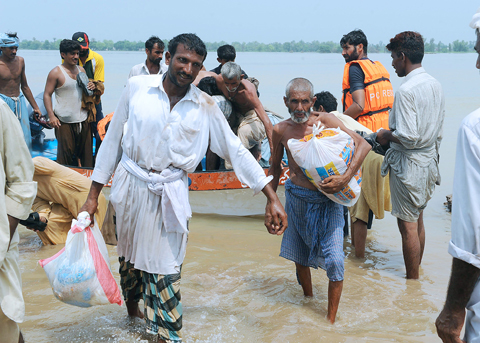
PHOTO: AFP
The UN has appealed for US$460 million to deal with the immediate aftermath of the floods, but charities say the figure falls far short of what is needed.
UN Secretary-General Ban Ki-moon was due to arrive in Pakistan later yesterday to discuss the relief effort and visit flood-hit areas.
“This is the worst-ever calamity for us and the entire nation will have to show courage to face it,” Gilani said. “I am pretty confidant that the nation will once again emerge victorious from this crisis.”
“Outbreak of epidemics in the flood-hit areas is a serious threat, which can further compound the already grave situation,” Gilani added, as the UN authorities confirmed the first cholera case.
“There has been at least one cholera confirmed case in Mingora,” Maurizio Giuliano, spokesman for the UN Office for Humanitarian Affairs, told reporters, referring to the main town in the northwestern district of Swat.
Giuliano said at least 36,000 people were reportedly suffering from acute watery diarrhea.
“We’re not suggesting that everyone who has acute watery diarrhea has cholera, but cholera is certainly a concern and that’s why we’re stepping up our efforts to treat cholera,” he said.
Charities said relief for those affected by the worst natural disaster in Pakistan’s history was lagging far behind what was needed.
“There are millions of people needing food, clean water and medical care and they need it right now,” said Jacques de Maio, head of operations for South Asia at the International Committee of the Red Cross.
“Clearly at this point in time, the overall relief effort cannot keep pace with the overall scale of the emergency,” he said.
Humanitarian agencies in Pakistan were monitoring the risk of “a second wave of deaths induced by the floods in the shape of waterborne diseases”, de Maio said, adding that it was impossible to measure the full scale of the disaster.
Celebrations marking the anniversary yesterday of Pakistan’s 1947 independence from British colonial rule have been scrapped by Pakistani President Asif Ali Zardari, his spokesman, Farhatullah Babar, announced.
The embattled leader has come under fire from flood victims and the opposition after pressing on with a trip to Europe last week, despite the mounting emergency.
Zardari arrived in Nowshera yesterday to visit flood-hit areas and attend a briefing on destruction caused by the floods and measures being taken by authorities to provide relief, Babar said.
“The best way to celebrate this day is to reach out to the victims of the natural disaster, heal their wounds and help them to help themselves,” Zardari said in his Independence Day message. “I salute the courage and heroism of flood victims and assure them that the government will do everything possible to alleviate their suffering.”
The UN believes 1,600 people have died in the disaster, while Islamabad has confirmed 1,343 deaths.
UN officials warn that the damage to infrastructure and the economy will put volatile Pakistan back years.
With up to 2 million people requiring emergency shelter and 6 million depending on humanitarian assistance to survive, troops distributed national flags among the people in the flood-hit northwestern town of Nowshera.
“We lost our houses and everything in the floods. We urgently need food and medicines, not flags,” 80-year-old Rasul Khan told reporters.
Archeologists in Peru on Thursday said they found the 5,000-year-old remains of a noblewoman at the sacred city of Caral, revealing the important role played by women in the oldest center of civilization in the Americas. “What has been discovered corresponds to a woman who apparently had elevated status, an elite woman,” archeologist David Palomino said. The mummy was found in Aspero, a sacred site within the city of Caral that was a garbage dump for more than 30 years until becoming an archeological site in the 1990s. Palomino said the carefully preserved remains, dating to 3,000BC, contained skin, part of the

‘WATER WARFARE’: A Pakistani official called India’s suspension of a 65-year-old treaty on the sharing of waters from the Indus River ‘a cowardly, illegal move’ Pakistan yesterday canceled visas for Indian nationals, closed its airspace for all Indian-owned or operated airlines, and suspended all trade with India, including to and from any third country. The retaliatory measures follow India’s decision to suspend visas for Pakistani nationals in the aftermath of a deadly attack by shooters in Kashmir that killed 26 people, mostly tourists. The rare attack on civilians shocked and outraged India and prompted calls for action against their country’s archenemy, Pakistan. New Delhi did not publicly produce evidence connecting the attack to its neighbor, but said it had “cross-border” links to Pakistan. Pakistan denied any connection to

TRUMP EFFECT: The win capped one of the most dramatic turnarounds in Canadian political history after the Conservatives had led the Liberals by more than 20 points Canadian Prime Minister Mark Carney yesterday pledged to win US President Donald Trump’s trade war after winning Canada’s election and leading his Liberal Party to another term in power. Following a campaign dominated by Trump’s tariffs and annexation threats, Carney promised to chart “a new path forward” in a world “fundamentally changed” by a US that is newly hostile to free trade. “We are over the shock of the American betrayal, but we should never forget the lessons,” said Carney, who led the central banks of Canada and the UK before entering politics earlier this year. “We will win this trade war and

Armed with 4,000 eggs and a truckload of sugar and cream, French pastry chefs on Wednesday completed a 121.8m-long strawberry cake that they have claimed is the world’s longest ever made. Youssef El Gatou brought together 20 chefs to make the 1.2 tonne masterpiece that took a week to complete and was set out on tables in an ice rink in the Paris suburb town of Argenteuil for residents to inspect. The effort overtook a 100.48m-long strawberry cake made in the Italian town of San Mauro Torinese in 2019. El Gatou’s cake also used 350kg of strawberries, 150kg of sugar and 415kg of


 RSS
RSS