


As home to the painter Salvador Dali and inspiration for some of his greatest and strangest artistic endeavors, the fishing port of Cadaques on Spain’s Costa Brava is used to the surreal.
However, the latest project involving the northeastern Spanish town has astonished even the cosmopolitan inhabitants of a place that boasts more art galleries per square kilometer than anywhere else in the country.
A Chinese developer has decided to build a replica of the town half-way across the globe in Xiamen Bay, where China looks out toward Taiwan.
Architects from developers China Merchants Zhangzhou visited Cadaques in June, taking measurements, photographing buildings and worrying about whether Chinese fire engines would fit down its tiny streets.
Sources at the company said they had found a spot that was geographically similar to Cadaques, with its gently sloping hills and protected bay.
“Building work will start in September or October,” a spokesman said.
More than 40 hectares of land will be used to build a near replica with a capacity to house some 15,000 Chinese holidaymakers who want to enjoy the Costa Brava experience without having to travel 10,000km.
The Chinese version will not have the sparkling Mediterranean, the madness-inducing Tramontana wind or as many jellyfish as Cadaques, but the promoters say they will try to get as close to possible to the real thing.
“We will recreate the essence of the fishing town and will reproduce the most characteristic elements of the architecture,” one of the architects, Hu Zheng, told the Spanish newspaper La Vanguardia.
That will mean copying the narrow streets and the white-painted buildings that look out across the perfect, open-mouthed bay where small, brightly painted fishing craft bob up and down.
The promoters of the Chinese resort have decided they can improve a bit on the original, however, and will be adding an artificial island.
Among other buildings the architects were keen to see were the warren-like collection of fishermen’s cottages in neighboring Portlligat, where Dali lived.
Topped with a giant egg sculpture, this is where the Spanish surrealist painted many of his most famous works — including a portrait of his Russian wife Gala looking out to sea.
It is also where he indulged his fondness for voyeurism, encouraging selected guests to perform sex acts in front of him.
Visitors to the house today are greeted by the same stuffed, wild bear with which Dali tried to frighten away unwanted guests.
The Chinese developers told officials in Cadaques that they also wanted to make art a central part of the new town, with space for galleries and offers to some local Spanish artists to show their work there.
“We like the idea and the way they are treating us,” Cadaques Mayor Joan Borrell said. “We are small, but well-known. If they want to imitate you, then it means you must have got something right.”
Borrell said he hoped the Xiamen version would eventually attract Chinese tourists to the real thing
“As with a work of art, seeing the copy often makes you want to see the original,” he said. “That would be wonderful for Cadaques and for the whole of the Costa Brava.”
This is the second attempt to build a replica of the fishing town somewhere else in the world.
An attempt was made in the Dominican Republic, but Cadaques says it was not consulted and does not recognize it as a genuine imitation.

Four contenders are squaring up to succeed Antonio Guterres as secretary-general of the UN, which faces unprecedented global instability, wars and its own crushing budget crisis. Chile’s Michelle Bachelet, Argentina’s Rafael Grossi, Costa Rica’s Rebeca Grynspan and Senegal’s Macky Sall are each to face grillings by 193 member states and non-governmental organizations for three hours today and tomorrow. It is only the second time the UN has held a public question-and-answer, a format created in 2016 to boost transparency. Ultimately the five permanent members of the UN’s top body, the Security Council, hold the power, wielding vetoes over who leads the

A humanoid robot that won a half-marathon race for robots in Beijing on Sunday ran faster than the human world record in a show of China’s technological leaps. The winner from Honor, a Chinese smartphone maker, completed the 21km race in 50 minutes and 26 seconds, said a WeChat post by the Beijing Economic-Technological Development Area, also known as Beijing E-Town, where the race began. That was faster than the human world record holder, Ugandan Jacob Kiplimo, who finished the same distance in about 57 minutes in March at the Lisbon road race. The performance by the robot marked a significant step forward

An earthquake registering a preliminary magnitude of 7.7 off northern Japan on Monday prompted a short-lived tsunami alert and the advisory of a higher risk of a possible mega-quake for coastal areas there. The Cabinet Office and the Japan Meteorological Agency said there was a 1% chance for a mega-quake, compared to a 0.1% chance during normal times, in the next week or so following the powerful quake near the Chishima and Japan trenches. Officials said the advisory was not a quake prediction but urged residents in 182 towns along the northeastern coasts to raise their preparedness while continuing their daily lives. Prime
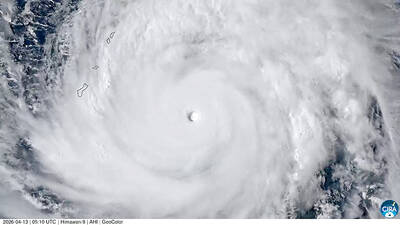
HAZARDOUS CONDITION: The typhoon’s sheer size, with winds extending 443km from its center, slowed down the ability of responders to help communities, an official said The US Coast Guard was searching for six people after losing contact with their disabled boat off the coast of Guam following Typhoon Sinlaku. The crew of the 44m dry cargo vessel, the US-registered Mariana, on Wednesday notified the coast guard that the boat had lost its starboard engine and needed assistance, Petty Officer 3rd Class Avery Tibbets said yesterday. The coast guard set up a one-hour communication schedule with the vessel, but lost contact on Thursday. A Coast Guard HC-130 Hercules aircraft was launched to search for the six people on board, but it had to return to Guam because of


 RSS
RSS