


In China, tobacco companies sponsor schools. Almost half of all male doctors smoke and one wedding dinner ritual involves the bride lighting cigarettes for each of her male guests.
China has committed to banning smoking at public indoor venues by Jan. 9 next year, in accordance with a global anti-tobacco treaty backed by the WHO. However, smoking is such a way of life that China is unlikely to meet the deadline and even the government seems resigned to failure.
“There are only some months left,” said Jiang Yuan (姜垣), deputy director of the National Office of Tobacco Control. “And I feel that it is extremely difficult to reach that goal ... China is facing a tremendous challenge in tobacco control.”
Smoking is linked to the deaths of at least 1 million people in China every year. The WHO cites a projection by Richard Peto of Oxford University that of the young Chinese men alive today, one in three will die from tobacco.
“You’re talking about one in three of the Tsinghua University male graduates, one in three of the male [chief executive officers] of high-tech businesses, one in three engineers, one in three scientists, one in three policymakers and military leaders,” said Sarah England, who runs the WHO’s Tobacco Free Initiative in China. “It becomes a question of national interest.”
Over the past several years, China has banned tobacco advertising on radio, television and newspapers and outlawed smoking in some places, such as on airplanes. During the 2008 Olympics, Beijing and other host cities in China went smoke-free.
In recent months, China banned smoking at pavilions and restaurants in the Shanghai Expo, as well as the Ministry of Health’s own 19-story office building in Beijing, the first central government agency to prohibit puffing indoors. Weeks ago, authorities also instructed kindergartens and elementary, secondary and vocational schools to ban smoking on campus and bar teachers from lighting up in front of students.
However, health authorities are still losing the fight against a habit that has wafted into nearly every corner of society, backed by a powerful state-owned tobacco monopoly. The rate of smoking has not changed significantly and tobacco production has actually gone up.
Earlier this year, the Chinese media buzzed with reports of a three-year-old girl hooked on smoking. Photos posted on the Internet showed round-cheeked Xing Yawen sitting on a chair taking a drag from a cigarette.
The child’s mother said Yawen started smoking possibly because of trauma after being hit by a truck in February last year.
“In the past, we worked too hard and maybe we neglected her,” 33-year-old Gao Shuli said by telephone. “The child is too small and knows nothing, but smoking will affect her entire future.”
The WHO agreement requires countries to fight smoking through measures that include raising cigarette prices and taxes, mandating health warnings on cigarette packs and banning tobacco advertising.
Parties are also expected to ensure that all indoor public places, workplaces and public transport are smoke-free within five years of the treaty coming into force, which in China’s case was on Jan. 9, 2006.
Parties must periodically report to one another on their efforts, and China is due to do so in January next year. Nearly 170 countries are signatories to the treaty, including the US, although it has not yet ratified it.
Making public spaces smoke-free is a challenge for many countries: Only 17 have policies that provide effective protection from secondhand smoke, WHO says, including New Zealand, Colombia, Britain and Iran. In China, cigarettes are handed out as gifts to family and bribes to officials. Even in large cities like Beijing, people light up in bars and restaurants, elevators, hotel lobbies and government buildings.
Forty percent of civil servants recently surveyed in Jiangsu Province smoke, lighting an average of 12.4 cigarettes a day. All but 5 percent do so at work, the provincial center for disease control and prevention said. Meanwhile, nearly half of male doctors in China smoke, Jiang said, who conducted a recent study in 31 provinces and cities.
“The biggest obstacle is the lack of awareness,” Jiang said. “If people realize passive smoking will also cause lung cancer, will they still allow people around them to smoke?”

Kouri Richins, a Utah mother who published a children’s book about grief after the death of her husband is to serve a life sentence for his murder without the possibility of parole, a judge ruled on Wednesday. Richins was convicted in March of aggravated murder for lacing a cocktail given to her husband, Eric Richins, with five times the lethal dose of fentanyl at their home near Park City in 2022. A jury also found her guilty of four other felonies, including insurance fraud, forgery and attempted murder for trying to poison her husband weeks earlier on Feb. 14, 2022, with a
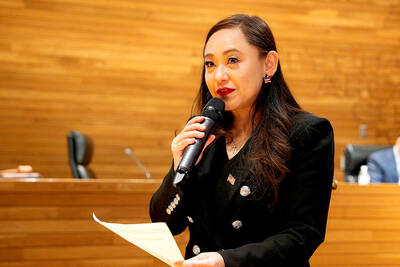
‘PERSONAL MISTAKES’: Eileen Wang has agreed to plead guilty to the felony, which comes with a maximum sentence of 10 years in federal prison A southern California mayor has agreed to plead guilty to acting as an illegal agent for the Chinese government and has resigned from her city position, officials said on Monday. Eileen Wang (王愛琳), mayor of Arcadia, was charged last month with one count of acting in the US as an illegal agent of a foreign government. She was accused of doing the bidding of Chinese officials, such as sharing articles favorable to Beijing, without prior notification to the US government as required by law. The 58-year-old was elected in November 2022 to a five-person city council, from which the mayor is selected
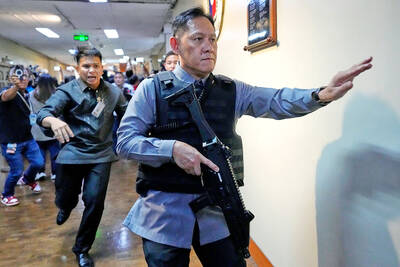
DELA ROSA CASE: The whereabouts of the senator, who is wanted by the ICC, was unclear, while President Marcos faces a political test over the senate situation Philippine authorities yesterday were seeking confirmation of reports that a top politician wanted by the International Criminal Court (ICC) had fled, a day after gunfire rang out at the Philippine Senate where he had taken refuge fearing his arrest. Senator Ronald “Bato” dela Rosa, the former national police chief and top enforcer of former Philippine president Rodrigo Duterte’s “war on drugs,” has been under Senate protection and is wanted for crimes against humanity, the same charges Duterte is accused of. “Several sources confirmed that the senator, Senator Bato, is no longer in the Senate premises, but we are still getting confirmation,” Presidential
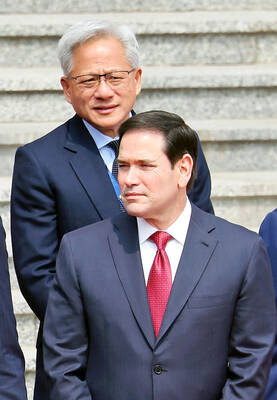
HELP DENIED? The US Department of State said that the Cuban leadership refuses to allow the US to provide aid to Cubans, ‘who are in desperate need of assistance’ US Secretary of State Marco Rubio on Wednesday said that Cuba’s leadership must change, as Washington renewed an offer of US$100 million in aid if the communist nation agrees to cooperate. Cuba has been suffering severe economic tumult led by an energy shortage that plunged 65 percent of the country into darkness on Tuesday. Cuba’s leaders have blamed US sanctions, but Rubio, a Cuban American and critic of the government established by Fidel Castro, said the system was to blame, including corruption by the military. “It’s a broken, nonfunctional economy, and it’s impossible to change it. I wish it were different,” he told


 RSS
RSS