


Dozens of flights were delayed and concerns grew over public health yesterday as Moscow choked in the worst smog in living memory, blown over the Russian capital from spreading wildfires.
The city’s iconic landmarks like the Kremlin towers and the wedding-cake Stalin-era skyscrapers were completely obscured from a distance as the acrid smoke that has suffocated the capital for days showed no signs of shifting.
The wildfires have sparked a major crisis in central Russia, with the authorities rushing to protect strategic sites including the country’s main nuclear research facility from the flames.
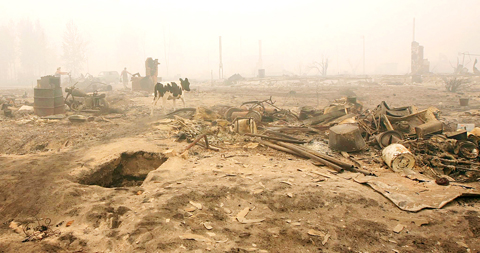
PHOTO: EPA
Drivers put on their car headlights in broad daylight to see through the smog while the sun shone as a hazy disc easily viewed by the naked eye with little discomfort.
Up to 2,000 passengers were stranded at Moscow’s Domodedovo International Airport when major delays hit their flights after they had crossed security and passport control to the departures area, the ITAR-TASS news agency said.
Domodedovo, in the south of Moscow, was the airport worst hit by the smog with dozens of departing flights delayed early yesterday and only a handful of aircraft able to land, its departures information showed.
Of Moscow’s other international airports, Vnukovo to the east was also experiencing delays, although the impact of the smog appeared to be less severe, while Sheremetyevo to the north was largely unaffected, officials said.
Residents of Moscow have rushed to escape the smog-drenched capital, with travel agents reporting package tours to destinations popular with Russians like Egypt, Montenegro and Turkey completely sold out.
“In the last week, the demand for tickets from Moscow sold online has gone up by 20 percent,” Irina Turina, spokeswoman of the Russian Union of Tour Operators, told Moscow Echo radio.
State air pollution monitoring service Mosekomonitoring said that carbon monoxide levels in the Moscow air were now over six-and-a-half times higher than acceptable levels.
Tiny invisible particles from the fires were also present in concentrations over twice higher than the norm, with specialists warning these could prove highly dangerous if they entered the human system.
Controversially, Moscow’s high-profile Mayor Yuri Luzhkov had refused break off his holidays and return to the city. However, reports said yesterday he had after all decided to return to the capital.
Moscow residents and tourists tried to protect themselves from the smog by donning medical masks or even just clutching wet rags to their faces. However, health officials have warned that the best precaution was to stay at home.
The smoke — easily visible from space in NASA images — penetrated into homes and offices and was even detected inside the Moscow metro, one of the deepest underground systems in the world.
The wildfires that have killed 52 people were still spreading in central Russia, the Russian Ministry of Emergency Situations said, as weather forecasters said Russia’s worst heatwave in decades would continue in the coming days.
“Unfortunately, the number of fires have doubled in the Moscow region in the past 24 hours because of people playing with firecrackers near forests,” Vladimir Stepanov, a senior official with the Russian Ministry of Emergency Situations said on Saturday.
There were worries the flames could hit Russia’s main nuclear research site in Sarov, a city closed to foreigners, but officials said the situation was under control and soldiers deployed there would be sent elsewhere.
The authorities were also closely watching the situation around the region of Bryansk in western Russia where the soil is still contaminated by the 1986 Chernobyl nuclear disaster.
Weather forecasters warned that with a lack of wind forecast in the capital over the next days, the smog was unlikely to shift until the middle of next week.
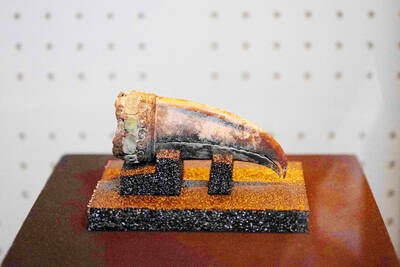
Archeologists in Peru on Thursday said they found the 5,000-year-old remains of a noblewoman at the sacred city of Caral, revealing the important role played by women in the oldest center of civilization in the Americas. “What has been discovered corresponds to a woman who apparently had elevated status, an elite woman,” archeologist David Palomino said. The mummy was found in Aspero, a sacred site within the city of Caral that was a garbage dump for more than 30 years until becoming an archeological site in the 1990s. Palomino said the carefully preserved remains, dating to 3,000BC, contained skin, part of the
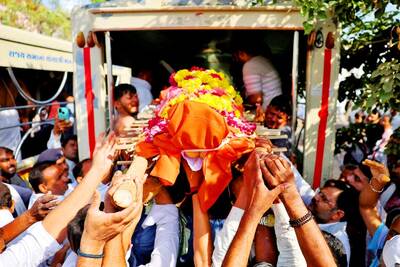
‘WATER WARFARE’: A Pakistani official called India’s suspension of a 65-year-old treaty on the sharing of waters from the Indus River ‘a cowardly, illegal move’ Pakistan yesterday canceled visas for Indian nationals, closed its airspace for all Indian-owned or operated airlines, and suspended all trade with India, including to and from any third country. The retaliatory measures follow India’s decision to suspend visas for Pakistani nationals in the aftermath of a deadly attack by shooters in Kashmir that killed 26 people, mostly tourists. The rare attack on civilians shocked and outraged India and prompted calls for action against their country’s archenemy, Pakistan. New Delhi did not publicly produce evidence connecting the attack to its neighbor, but said it had “cross-border” links to Pakistan. Pakistan denied any connection to

TRUMP EFFECT: The win capped one of the most dramatic turnarounds in Canadian political history after the Conservatives had led the Liberals by more than 20 points Canadian Prime Minister Mark Carney yesterday pledged to win US President Donald Trump’s trade war after winning Canada’s election and leading his Liberal Party to another term in power. Following a campaign dominated by Trump’s tariffs and annexation threats, Carney promised to chart “a new path forward” in a world “fundamentally changed” by a US that is newly hostile to free trade. “We are over the shock of the American betrayal, but we should never forget the lessons,” said Carney, who led the central banks of Canada and the UK before entering politics earlier this year. “We will win this trade war and
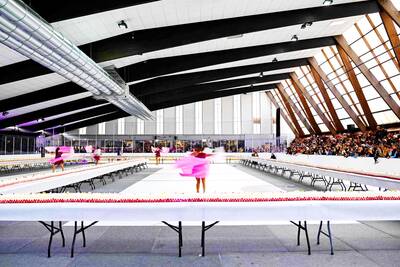
Armed with 4,000 eggs and a truckload of sugar and cream, French pastry chefs on Wednesday completed a 121.8m-long strawberry cake that they have claimed is the world’s longest ever made. Youssef El Gatou brought together 20 chefs to make the 1.2 tonne masterpiece that took a week to complete and was set out on tables in an ice rink in the Paris suburb town of Argenteuil for residents to inspect. The effort overtook a 100.48m-long strawberry cake made in the Italian town of San Mauro Torinese in 2019. El Gatou’s cake also used 350kg of strawberries, 150kg of sugar and 415kg of


 RSS
RSS