


The US has said it is in negotiations to share nuclear fuel and technology with Vietnam, but declined to say whether they were discussing allowing Hanoi to enrich uranium on its own.
“The United States and Vietnam are engaged in a so-called ... 1-2-3 negotiation that ... would involve ... civilian nuclear technology,” US State Department spokesman Philip Crowley said on Thursday.
The Wall Street Journal earlier reported that congressional critics of the deal say the terms would undercut the more stringent demands placed on US partners in the Middle East, which had been required to renounce uranium enrichment in exchange for nuclear cooperation.
The US and the United Arab Emirates signed such a deal on Jan. 15 last year.
The UN Security Council recently launched a new round of sanctions against Iran over its contested nuclear program, especially over its refusal to freeze uranium enrichment.
However, Crowley declined to confirm or deny whether Washington and Hanoi were negotiating a deal under which Vietnam — a former Cold War foe — would enrich uranium on its own soil, saying talks were ongoing.
As a broad policy aim Crowley said “we do want to see ... fewer countries enriching uranium around the world,” as part of efforts to limit the spread of bomb-grade uranium.
“We definitely want to see the evolution of an international system where there are guaranteed sources of enriched uranium, and under appropriate international supervision,” Crowley said.
The Wall Street Journal cited US officials as saying that negotiators have given a full nuclear cooperation proposal to Vietnam, and that they have started briefing the US House of Representatives and the US Senate foreign relations committees.
China, which shares a long border with Vietnam, has not been consulted, the officials were quoted as saying.
“We have a negotiation going on between the United States and Vietnam. That does not involve China,” Crowley said.
When asked for comment on the US-Vietnam talks, Chinese foreign ministry spokeswoman Jiang Yu (姜瑜) said Beijing “does not have knowledge of the relevant details.”
She reiterated China’s position that all countries have the right to the peaceful use of nuclear power, but added: “All countries should seriously fulfill their obligations to prevent [nuclear] proliferation.”
The Wall Street Journal said a deal would allow US firms like General Electric and Bechtel to sell nuclear components and reactors to Vietnam.
The US and Vietnam signed a memorandum of understanding with then-US president George W Bush’s administration in 2001 to pursue cooperation on securing fissile materials and developing civilian nuclear power.
In March this year, the two sides signed a further memorandum of understanding on nuclear energy cooperation, which they called “an important moment in our bilateral relations.”
US ambassador to Vietnam Michael Michalak said at the time: “This ... is a key step in furtherance of our common non-proliferation goals, and a significant building block in the development of Vietnam’s peaceful, civilian nuclear power program.”
Vuong Huu Tan, director of the Vietnam Atomic Energy Institute, told the Wall Street JournalVietnam did not plan to enrich uranium “as it is sensitive to Vietnam to do so.”


When a hiker fell from a 55m waterfall in wild New Zealand bush, rescuers were forced to evacuate the badly hurt woman without her dog, which could not be found. After strangers raised thousands of dollars for a search, border collie Molly was flown to safety by a helicopter pilot who was determined to reunite the pet and the owner. A week earlier, an emergency rescue helicopter found the woman with bruises and lacerations after a fall at a rocky spot at the waterfall on the South Island’s West Coast. She was airlifted on March 24, but they were forced to
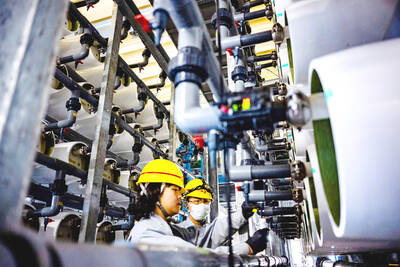
HIGH HOPES: The power source is expected to have a future, as it is not dependent on the weather or light, and could be useful for places with large desalination facilities A Japanese water plant is harnessing the natural process of osmosis to generate renewable energy that could one day become a common power source. The possibility of generating power from osmosis — when water molecules pass from a less salty solution to a more salty one — has long been known. However, actually generating energy from that has proved more complicated, in part due the difficulty of designing the membrane through which the molecules pass. Engineers in Fukuoka, Japan, and their private partners think they might have cracked it, and have opened what is only the world’s second osmotic power plant. It generates
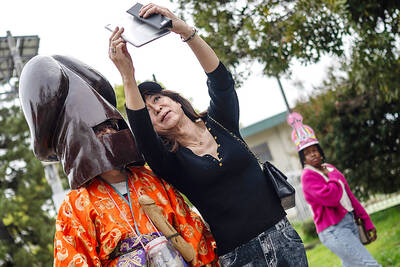
Showcasing phallus-shaped portable shrines and pink penis candies, Japan’s annual fertility festival yesterday teemed with tourists, couples and families elated by its open display of sex. The spring Kanamara Matsuri near Tokyo features colorfully dressed worshipers carrying a trio of giant phallic-shaped objects as they parade through the street with glee. The festival, as legend has it, honors a local blacksmith in the Edo Period (1603-1868) who forged an iron dildo to break the teeth of a sharp-toothed demon inhabiting a woman’s vagina that had been castrating young men on their wedding nights. A 1m black steel phallus sits in the courtyard of

Hundreds of Filipinos and tourists flocked to a sun-bleached field north of Manila yesterday, on Good Friday, to witness one of the country’s most blood-soaked displays of religious fervor, undeterred by rising fuel prices. Scores of bare-chested flagellants with covered faces walked barefoot through the dusty streets of Pampanga Province’s San Fernando as they flogged their backs with bamboo whips in the scorching heat. Agence France-Presse (AFP) journalists said they saw devotees deliberately puncturing their skin with glass shards attached to a small wooden paddle to ensure their bleeding during the ritual, a way to atone for sins and seek miracles from


 RSS
RSS