


Another protester was killed yesterday in revolt-hit Indian Kashmir when security forces opened fire at demonstrators, bringing to five the number killed in two days.
The young man was shot dead as he and other demonstrators tried to attack a police camp northwest of Srinagar, the summer capital of Muslim-majority Indian Kashmir, police said.
The man was killed when “security forces opened fire as a group of protesters tried to attack a police camp,” a police officer said, asking not to be named.
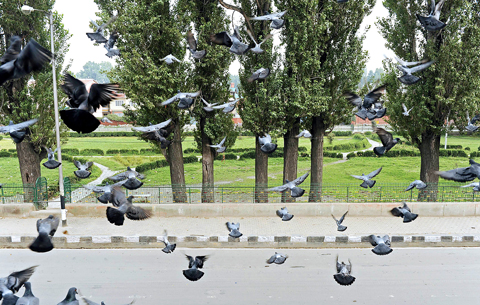
PHOTO: AFP
The death brings to five the number of people who have died in clashes with security forces since Friday afternoon. Several other demonstrators were injured, one of them seriously, in the incident in northern Naidkhai village, he said.
The deaths come as troops enforced a curfew in major towns in Indian Kashmir.
Yesterday, police said a fourth man, who had been seriously injured in the shooting at Patan, died in hospital early in the morning, raising the death toll to four.
Three people were killed on Friday in two separate incidents when security forces opened fire to disperse angry anti-India protesters in the northern towns of Sopore and Patan.
The fresh death came as authorities placed most of the Muslim-majority Kashmir valley under curfew.
“A curfew is in force in Srinagar and other major towns of the Kashmir Valley,” a police spokesman said.
Srinagar wore a deserted look as troops carrying rifles and batons patrolled the streets. Police and paramilitary forces were also deployed in strength in big towns to prevent demonstrations, the spokesman said.
Srinagar has been the focus of protests since June 11 when a 17-year-old student died after being hit by a police teargas shell.
Indian police and paramilitary forces, who have been struggling to control the wave of protests in the valley, have been accused of killing 22 civilians in less than two months.
Each death has sparked a new cycle of violence despite appeals for calm from state Chief Minister Omar Abdullah and Indian Home Minister P Chidambaram.
The insurgency against New Delhi’s rule of Kashmir has claimed tens of thousands of lives, though the recent unrest is the worst for two years.
Nuclear-armed India and Pakistan each hold Kashmir in part but claim it in full and have fought two of their three wars over the region since the partition of the subcontinent in 1947.
Separatist politicians and armed rebels reject Indian rule in Kashmir and want to merge with Muslim-majority Pakistan or carve out an independent state.

Hungarian authorities temporarily detained seven Ukrainian citizens and seized two armored cars carrying tens of millions of euros in cash across Hungary on suspicion of money laundering, officials said on Friday. The Ukrainians were released on Friday, following their detention on Thursday, but Hungarian officials held onto the cash, prompting Ukraine to accuse Hungary’s Russia-friendly government of illegally seizing the money. “We will not tolerate this state banditism,” Ukrainian Minister of Foreign Affairs Andrii Sybiha said. The seven detained Ukrainians were employees of the Ukrainian state-owned Oschadbank, who were traveling in the two armored cars that were carrying the money between Austria and
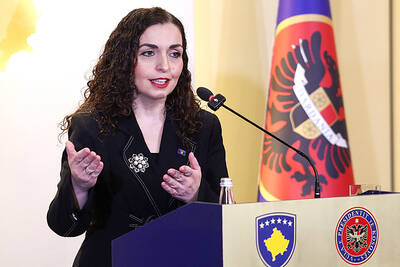
Kosovar President Vjosa Osmani on Friday after dissolving the Kosovar parliament said a snap election should be held as soon as possible to avoid another prolonged political crisis in the Balkan country at a time of global turmoil. Osmani said it is important for Kosovo to wrap up the upcoming election process and form functional institutions for political stability as the war rages in the Middle East. “Precisely because the geopolitical situation is that complex, it is important to finish this electoral process which is coming up,” she said. “It is very hard now to imagine what will happen next.” Kosovo, which declared

MORE BANS: Australia last year required sites to remove accounts held by under-16s, with a few countries pushing for similar action at an EU level and India considering its own ban Indonesia on Friday said it would ban social media access for children under 16, citing threats from online pornography, cyberbullying, online fraud and Internet addiction. “Accounts belonging to children under 16 on high-risk platforms will start to be deactivated, beginning with YouTube, TikTok, Facebook, Instagram, Threads, X, Bigo Live and Roblox,” Indonesian Minister of Communications and Digital Meutya Hafid said. “The government is stepping in so that parents no longer have to fight alone against the giants of the algorithm. Implementation will begin on March 28, 2026,” she said. The social media ban would be introduced in stages “until all platforms fulfill their
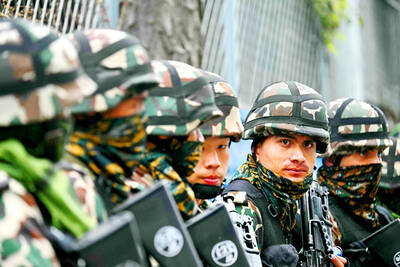
Counting was under way in Nepal yesterday, after a high-stakes parliamentary election to reshape the country’s leadership following protests last year that toppled the government. Key figures vying for power include former Nepalese prime minister K. P. Sharma Oli, rapper-turned-mayor Balendra Shah, who is bidding for the youth vote, and newly elected Nepali Congress party leader Gagan Thapa. In Kathmandu’s tea shops and city squares, people were glued to their phones, checking results as early trends flashed up — suggesting Shah’s centrist Rastriya Swatantra Party (RSP) was ahead. Nepalese Election Commission spokesman Prakash Nyupane said the counting was ongoing “in a peaceful manner”


 RSS
RSS