


US lawmakers on Tuesday easily approved urgent funding for US President Barack Obama’s escalation in Afghanistan, despite a huge leak of secret military files that stoked anger at the unpopular war.
The 308-114 vote in the US House of Representatives set the stage for Obama to sign the legislation, which provides some US$37 billion to fund the conflict in Iraq and pay for his “surge” of 33,000 more troops to Afghanistan.
However, more than 100 Democrats voted against the measure, which also provides funds for disaster relief in Haiti.
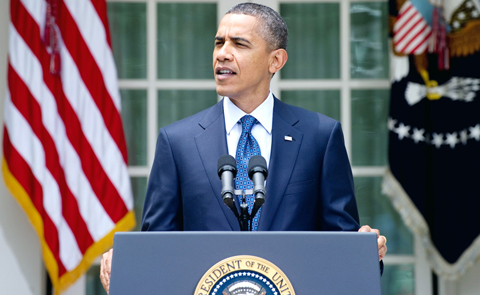
PHOTO: AFP
The House also beat back a blunt challenge to Obama’s war strategy, defeating a resolution calling for the removal of US forces from Pakistan by a crushing 38-372 margin.
The margins called into question what impact the stunning disclosure of some 92,000 previously secret Pentagon documents on the war by the whistleblowing Web site WikiLeaks would have on the US debate on the conflict.
However, lawmakers — who face a war-weary public in November mid-term elections — argued passionately about the nearly nine-year-old conflict and Obama’s plan to right the faltering campaign in time to start a draw-down by July next year.
“Wake up, America. WikiLeaks’ release of secret war documents gave us 92,000 reasons to end the wars. Pick one,” Democratic Representative Dennis Kucinich, author of the Pakistan measure, said as debate began.
Representative Buck McKeon, the top Republican on the House Armed Services Committee, invoked US forces on the frontlines and declared that “cutting off their funding in the middle of that fight is tantamount to abandonment.”
However, Democratic Representative Dave Obey, chairman of the powerful Appropriations Committee, said he was “reluctantly” voting no out of doubts “that this operation will hurt our enemies more than us.”
“The Afghan government has not demonstrated the focused determination, reliability and judgment necessary to bring this effort to a rational and successful conclusion,” Obey said.
As the US Army launched a criminal investigation into the WikiLeaks disclosures, Obama said the documents showed he was right to craft a new Afghan war-fighting approach and vowed to stick with it.
“We have to see that strategy through,” said the president, who declared leaked documents “don’t reveal any issues that haven’t already informed our public debate on Afghanistan.”
The disclosures so far have shed new light on a difficult five-year span of the war, ending in December last year when Obama unveiled his new strategy, but appeared short on blockbuster revelations.
Foes of the war were drawing strength from the leaks by the whistleblower’s Web site, which seemed to buttress criticisms of what Kucinich dubbed “corrupt” governments in Kabul and Islamabad and a sometimes unfocused US approach.
Republican Representative Ron Paul and Kucinich had seized the chance to introduce a so-called “War Powers” resolution, named after a Vietnam-era law aimed at boosting congressional control over overseas military deployments, to force Obama to pull forces out of Pakistan.
The Obama administration and its allies in the Congress — many of whom have expressed grave doubts about the conflict — sought to play down the impact of the leak and denied any shift in policy on Pakistan.

‘CROSSING THE LINE’: China’s embassy in Seoul criticized US Forces Korea Commander General Xavier Brunson, asking if his ‘hostile’ remarks were authorized by Washington South Korea and the US are in talks over recent public remarks by the commander of US Forces Korea, Seoul’s presidential office said yesterday, after the comments drew sharp criticism from China. In a recent podcast interview, US Forces Korea Commander General Xavier Brunson described South Korea as “the dagger in the heart of Asia” from China’s east coast, prompting the Chinese embassy in Seoul to say that he had “truly crossed the line.” The interview came amid growing speculation that Washington might seek to expand the role of US Forces Korea in countering the growing regional influence of China, a key

Through the noise of rushing papers and whirring belts at a print factory in Kyoto, two creators watch their photo essay come to life in broadsheet form — part of an effort to win new audiences in the age of artificial intelligence (AI). Despite the decline of the publishing industry, self-publication and handmade “zine” magazines are growing in popularity in Japan, reflecting the nation’s enduring love of paper in the digital era. While speaking to Agence France-Presse at the plant, his hands black with ink, one of the creators, Kazuma Obara, said: “I think [paper] is a medium that engages all five

Australian researchers have trained lab-grown brain cells on a silicon computer chip to play the 1990s shooter game Doom and said they are just scratching the surface of what the neurons could be capable of doing. It is the science-fiction work of biotech boffins at Cortical Labs, who researched and developed the technology that harnesses the workings of the brain’s networking system. Each so-called “biological computer” contains about 200,000 living human brain cells, grown from stem cells that were harvested from blood donations. Having mastered the simple computer game Pong, where a paddle is moved up and down to send a ball

France experienced its hottest spring on record, the French weather service said on Tuesday, after an exceptional early heat wave that also broke highs for the season in England and Wales. Meteo-France said the average nationwide temperature over March to May was 13.8°C — about 1.7°C above the norm, and surpassing records set in 2011 and 2020. “The warmest spring since records began in 1900,” it said in a bulletin. All three months were warmer than average, but the onset of an “unprecedented heatwave” late last month pushed the mercury to highs typically seen at the height of the summer. “Our country had never


 RSS
RSS