


James Clapper, the man nominated to head the US spy community, told US senators on Tuesday that he fears a period of “direct attacks” by North Korea on its southern neighbor.
Clapper testified on Tuesday before senators who must confirm his nomination as director of national intelligence (DNI) — a post intended to coordinate the sprawling and often inefficient US intelligence bureaucracy.
In a written response to questions from members of the Senate Intelligence Committee, Clapper said he fears new violence on the Korean peninsula.
South Korea, the US and other nations accuse the North of sending a submarine to torpedo a South Korean navy corvette near the tense Yellow Sea border in March.
The North denies involvement in the sinking, which claimed 46 lives, and says any retaliation could spark war.
“The most important lesson for all of us in the intelligence community from this year’s provocations by Pyongyang is to realize that we may be entering a dangerous new period when North Korea will once again attempt to advance its internal and external political goals through direct attacks on our allies in the Republic of Korea,” Clapper wrote. “Coupled with this is a renewed realization that North Korea’s military forces pose a threat that cannot be taken lightly.”
Clapper, who currently serves as US Defense Secretary Robert Gates’s top intelligence adviser and as the Pentagon’s liaison to the Director of National Intelligence, knows the region well — he was posted in South Korea in the 1980s.
Clapper faced members of the Intelligence Committee on Tuesday for a public hearing in which he pledged to wield strong leadership over the 16 agencies that fall under the DNI’s purview.
He is the fourth nominee in five years to the post, which has been criticized as an ineffectual office lacking either the mandate or the will to corral a bureaucracy that plays a crucial role in keeping Americans safe.
“I would not have agreed to take this position on if I were to be a titular figurehead or a hood ornament,” Clapper said.
He told lawmakers the DNI’s office already has “the explicit or implicit authority” to oversee the agencies that fall under its purview.
“There needs to be a clear, defined and identifiable leader of the intelligence community,” Clapper said, adding that he would seek to “push the envelope” in terms of the DNI’s authority.
Committee chair Dianne Feinstein, a Democrat, emphasized that the post requires a strong leader who “must assure coordination between intelligence agencies to eliminate duplication and improve information sharing.”
Obama tapped Clapper, a retired Air Force general and veteran of US spy efforts, to replace retired US Navy Admiral Dennis Blair, who left after 16 months on the job.
Blair quit after a string of high-profile security lapses including the failure to detect a Christmas Day airline bomb plot.
If confirmed Clapper would be the latest in a string of officials who have attempted to improve coordination between 16 US intelligence agencies, which employ an estimated 200,000 people and have a combined budget of about US$75 billion.
Australians were downloading virtual private networks (VPNs) in droves, while one of the world’s largest porn distributors said it was blocking users from its platforms as the country yesterday rolled out sweeping online age restriction. Australia in December became the first country to impose a nationwide ban on teenagers using social media. A separate law now requires artificial intelligence (AI)-powered chatbot services to keep certain content — including pornography, extreme violence and self-harm and eating disorder material — from minors or face fines of up to A$49.5 million (US$34.6 million). The country also joined Britain, France and dozens of US states requiring

Hungarian authorities temporarily detained seven Ukrainian citizens and seized two armored cars carrying tens of millions of euros in cash across Hungary on suspicion of money laundering, officials said on Friday. The Ukrainians were released on Friday, following their detention on Thursday, but Hungarian officials held onto the cash, prompting Ukraine to accuse Hungary’s Russia-friendly government of illegally seizing the money. “We will not tolerate this state banditism,” Ukrainian Minister of Foreign Affairs Andrii Sybiha said. The seven detained Ukrainians were employees of the Ukrainian state-owned Oschadbank, who were traveling in the two armored cars that were carrying the money between Austria and
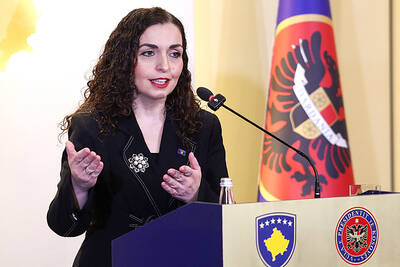
Kosovar President Vjosa Osmani on Friday after dissolving the Kosovar parliament said a snap election should be held as soon as possible to avoid another prolonged political crisis in the Balkan country at a time of global turmoil. Osmani said it is important for Kosovo to wrap up the upcoming election process and form functional institutions for political stability as the war rages in the Middle East. “Precisely because the geopolitical situation is that complex, it is important to finish this electoral process which is coming up,” she said. “It is very hard now to imagine what will happen next.” Kosovo, which declared

MORE BANS: Australia last year required sites to remove accounts held by under-16s, with a few countries pushing for similar action at an EU level and India considering its own ban Indonesia on Friday said it would ban social media access for children under 16, citing threats from online pornography, cyberbullying, online fraud and Internet addiction. “Accounts belonging to children under 16 on high-risk platforms will start to be deactivated, beginning with YouTube, TikTok, Facebook, Instagram, Threads, X, Bigo Live and Roblox,” Indonesian Minister of Communications and Digital Meutya Hafid said. “The government is stepping in so that parents no longer have to fight alone against the giants of the algorithm. Implementation will begin on March 28, 2026,” she said. The social media ban would be introduced in stages “until all platforms fulfill their


 RSS
RSS