


Fifteen years after a divisive decision to normalize relations with Vietnam, the US is finding to its surprise that the onetime foe has quickly emerged as one of its growing partners.
Even if the Vietnam War — which claimed 58,000 US and 3 million Vietnamese lives — remains a contentious topic, as does Vietnam’s human rights record, the two nations have steadily boosted cooperation on a range of issues.
“As I look at all the friends in Southeast Asia, I think we have the greatest prospects in the future with Vietnam,” said Kurt Campbell, the US assistant secretary of state for East Asian affairs.
US Secretary of State Hillary Rodham Clinton this week visits Hanoi for a regional meeting as well as talks on building relations with Vietnam. US officials see scope for growing ties in defense, including military exchanges.
Hanoi triumphed over US-backed South Vietnam in 1975, but Vietnam also has historic tensions and territorial disputes with China, a factor US experts see as driving Vietnam’s friendliness toward Washington.
When former US president Bill Clinton championed normal relations with Vietnam, he faced stiff opposition from a number of lawmakers, mostly from the rival Republican Party, who said Hanoi had not fully accounted for missing US troops.
The former president praised Vietnam’s dedication to finding the remains of US servicemen and said he now barely heard criticism of the 1995 normalization.
“Sometimes I think the only single issue that all Democrats and Republicans seem to agree on is that it’s a good thing we’re getting along with Vietnam,” he said. “In a world where it is very easy to become cynical or despondent, the flowering of our relationship, that goes far beyond commerce, should remind us all that we must not forget our history, but we are not condemned to repeat it.”
Republican Senator John McCain, who spent more than five years as a prisoner of war but supported normalization, said he never imagined Vietnam would become “one of America’s most important and most promising partners in the Asia-Pacific region.”
“It just goes to show that if you live long enough, anything is possible,” McCain said.
However, McCain said he hoped Vietnam would also one day allow “peaceful dissent” and “rule by the consent of the governed.”
“Perhaps my greatest hope for the US-Vietnam relationship is this: that our current partnership of common interests will ultimately become a partnership of common values as well,” McCain said.
Nineteen members of the House of Representatives wrote to Hillary Rodham Clinton last week urging her to use Vietnam’s eagerness for relations as leverage to press for improvements in human rights.
Vietnamese-Americans, many of whom supported the South, have been among the most outspoken in urging the US to take a firm line on rights.
Duy Hoang, spokesman for Viet Tan, a pro-democracy group banned by Hanoi, said that even though Vietnam has moved from a centrally planned economy, the communist party “remains insistent on monopolizing political power.”
“It will be helpful if US policy toward Vietnam is mindful of what’s in the long-term interest of both countries — a free and modern Vietnam,” he said.
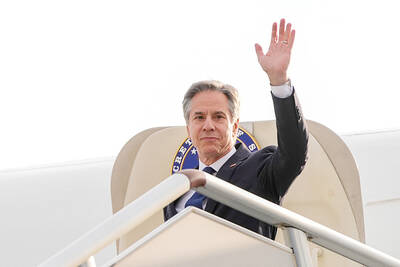
‘IN A DIFFERENT PLACE’: The envoy first visited Shanghai, where he attended a Chinese basketball playoff match, and is to meet top officials in Beijing tomorrow US Secretary of State Antony Blinken yesterday arrived in China on his second visit in a year as the US ramps up pressure on its rival over its support for Russia while also seeking to manage tensions with Beijing. The US diplomat tomorrow is to meet China’s top brass in Beijing, where he is also expected to plead for restraint as Taiwan inaugurates president-elect William Lai (賴清德), and to raise US concerns on Chinese trade practices. However, Blinken is also seeking to stabilize ties, with tensions between the world’s two largest economies easing since his previous visit in June last year. At the

UNSETTLING IMAGES: The scene took place in front of TV crews covering the Trump trial, with a CNN anchor calling it an ‘emotional and unbelievably disturbing moment’ A man who doused himself in an accelerant and set himself on fire outside the courthouse where former US president Donald Trump is on trial has died, police said yesterday. The New York City Police Department (NYPD) said the man was declared dead by staff at an area hospital. The man was in Collect Pond Park at about 1:30pm on Friday when he took out pamphlets espousing conspiracy theories, tossed them around, then doused himself in an accelerant and set himself on fire, officials and witnesses said. A large number of police officers were nearby when it happened. Some officers and bystanders rushed

Beijing is continuing to commit genocide and crimes against humanity against Uyghurs and other Muslim minorities in its western Xinjiang province, U.S. Secretary of State Antony Blinken said in a report published on Monday, ahead of his planned visit to China this week. The State Department’s annual human rights report, which documents abuses recorded all over the world during the previous calendar year, repeated language from previous years on the treatment of Muslims in Xinjiang, but the publication raises the issue ahead of delicate talks, including on the war in Ukraine and global trade, between the top U.S. diplomat and Chinese
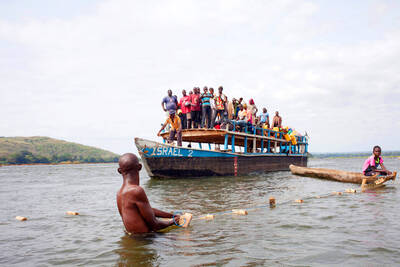
RIVER TRAGEDY: Local fishers and residents helped rescue people after the vessel capsized, while motorbike taxis evacuated some of the injured At least 58 people going to a funeral died after their overloaded river boat capsized in the Central African Republic’s (CAR) capital, Bangui, the head of civil protection said on Saturday. “We were able to extract 58 lifeless bodies,” Thomas Djimasse told Radio Guira. “We don’t know the total number of people who are underwater. According to witnesses and videos on social media, the wooden boat was carrying more than 300 people — some standing and others perched on wooden structures — when it sank on the Mpoko River on Friday. The vessel was heading to the funeral of a village chief in


 RSS
RSS