


There are more poor people in eight states of India than in the 26 countries of sub-Saharan Africa, a study revealed yesterday.
More than 410 million people live in poverty in the Indian states, including Bihar, Uttar Pradesh and West Bengal, researchers at Oxford University, England, found. The “intensity” of the poverty in parts of India is equal to, if not worse than, that in Africa.
When the vast central Indian Madhya Pradesh state, which has a population of 70 million, was compared with the Democratic Republic of the Congo, the war-racked African state of 62 million inhabitants, the two were found to have near-identical levels of poverty.
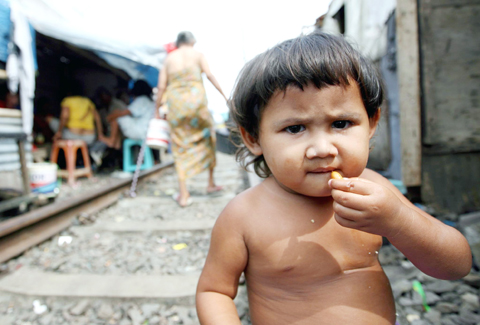
PHOTO: EPA
The study is based on an innovatory “multidimensional poverty index,” or MPI, developed by specialists at Oxford. To be used for the first time in the authoritative and influential UN Human Development Report when it is published this autumn, it will replace a simpler method of calculating poverty introduced over a decade ago.
The index uses 10 major variables including access to good cooking fuel, schooling, electricity, nutrition and sanitation.
“[It] is like a high-resolution lens which reveals a vivid spectrum of challenges facing the poorest households,” said Sabina Alkire, director of the Oxford Poverty and Human Development Initiative and a co-developer of the index. “Before, you might know a person was poor but did not know if their children went to school, if they had a floor or if they cooked on wood.”
In Madhya Pradesh poverty levels were higher because of malnutrition. In Congo, access to schooling was a problem.
The study’s conclusions will reinforce claims that distribution of the wealth generated by India’s rapid economic growth — recently around 10 percent year on year — is deeply unequal. Indian Prime Minister Manmohan Singh has repeatedly said he wants to see “inclusive” development.
Poverty has long proved difficult to define. The World Bank bases its definition on household income and estimates that a quarter of the developing world lives on US$1.25 a day or less. However, relying simply on money “excludes everything that is outside the cash economy and doesn’t look at issues such as housing [or] access to safe water,” said William Orme, a spokesman for the UN Development Programme in New York.
To compile the index, researchers analyzed data from 104 countries — which did not include Taiwan — with a combined population of 5.2 billion, 78 percent of the world total. About 1.7 billion — a third — live in multidimensional poverty, they found. This is 400 million more than are estimated by the World Bank to be in “extreme” poverty. The new index is also designed to track variations within countries much better. So while the poverty rate is more than 80 percent in the rural state of Bihar, it is about 16 percent in the southern state of Kerala.
Some countries have dropped steeply down the poverty rankings in the new list. Turkey, Egypt, Pakistan and Morocco were found to have much more poverty under the new index than when using simple household income. Others, such as Tanzania, Nicaragua, Uzbekistan, Vietnam and China were found to have less. China was ranked 46 out of 104, three places behind Brazil. India came in 63rd, just after Togo but ahead of Haiti.
“In many cases, it is probably linked to previously high levels of social investment,” Alkire said. “It shows that a low per capita GDP income doesn’t necessarily mean high poverty.”

‘CROSSING THE LINE’: China’s embassy in Seoul criticized US Forces Korea Commander General Xavier Brunson, asking if his ‘hostile’ remarks were authorized by Washington South Korea and the US are in talks over recent public remarks by the commander of US Forces Korea, Seoul’s presidential office said yesterday, after the comments drew sharp criticism from China. In a recent podcast interview, US Forces Korea Commander General Xavier Brunson described South Korea as “the dagger in the heart of Asia” from China’s east coast, prompting the Chinese embassy in Seoul to say that he had “truly crossed the line.” The interview came amid growing speculation that Washington might seek to expand the role of US Forces Korea in countering the growing regional influence of China, a key

Through the noise of rushing papers and whirring belts at a print factory in Kyoto, two creators watch their photo essay come to life in broadsheet form — part of an effort to win new audiences in the age of artificial intelligence (AI). Despite the decline of the publishing industry, self-publication and handmade “zine” magazines are growing in popularity in Japan, reflecting the nation’s enduring love of paper in the digital era. While speaking to Agence France-Presse at the plant, his hands black with ink, one of the creators, Kazuma Obara, said: “I think [paper] is a medium that engages all five

Australian researchers have trained lab-grown brain cells on a silicon computer chip to play the 1990s shooter game Doom and said they are just scratching the surface of what the neurons could be capable of doing. It is the science-fiction work of biotech boffins at Cortical Labs, who researched and developed the technology that harnesses the workings of the brain’s networking system. Each so-called “biological computer” contains about 200,000 living human brain cells, grown from stem cells that were harvested from blood donations. Having mastered the simple computer game Pong, where a paddle is moved up and down to send a ball

France experienced its hottest spring on record, the French weather service said on Tuesday, after an exceptional early heat wave that also broke highs for the season in England and Wales. Meteo-France said the average nationwide temperature over March to May was 13.8°C — about 1.7°C above the norm, and surpassing records set in 2011 and 2020. “The warmest spring since records began in 1900,” it said in a bulletin. All three months were warmer than average, but the onset of an “unprecedented heatwave” late last month pushed the mercury to highs typically seen at the height of the summer. “Our country had never


 RSS
RSS