


From the outside, Jerry Erwin’s home in the northwestern US state of Oregon is a nondescript house with a manicured front lawn and little to differentiate it from those of his neighbors.
Tucked away out of sight in his backyard are the signs of his preparations for doomsday, a catastrophic societal collapse that Erwin, 45, now believes is likely within his lifetime.
“I’ve got, under an awning, stacks of firewood, rain catching in barrels, I’ve got a shed with barbed concertina wire, like the military uses,” he said.
He and his wife also have also stockpiled thousands of rounds of ammunition and enough food for about six months.
“Several years ago I worked on paying off the house, replacing all the windows, and just very recently, I’m proud to say, we’ve replaced all our exterior doors with more energy-efficient ones, with as much built-in security features as I could get,” Erwin said. “Plus I’m going to be adding some more structural improvements to the door frames to make it hopefully virtually impossible to take a battering ram to them.”
Erwin and others like him in the US and elsewhere see political upheaval and natural disasters as clear signs that civilization is doomed.
“We’re hitting on all cylinders as far as symptoms that have led other great powers to decline or collapse: resource depletion, damage to the environment, climate change, those are the same things that affected other great societies,” he said.
For Erwin, the decline is irreversible and the best approach is to prepare for the inevitable.
His pessimism is shared by a wide range of people, from left-wing environmentalists who believe climate change and capitalist greed will doom human society to Christian fundamentalists who think sin will do the same.
They label themselves “preppers,” “doomers,” and “survivalists,” and take a variety of different approaches to the same question: How best to prepare for the coming apocalypse?
Jim Rawles, who Erwin describes as “the patron saint of survivalism,” prefers an isolationist, Christian-influenced approach.
He homeschooled his children, declines to say where he lives, and advises readers of his Web site to “relocate to a safe area and live there year-round.”
“When planning your retreat house, think: medieval castle,” he adds, extolling the benefits of using sandbags to protect any new home.
Rawles, like many on the most conservative end of the survivalist spectrum, is also anti-tax, pro-gun rights, and suspicious of anything that smacks of socialism.
The survivalist movement also includes left-wing community activists, who are devoted to living off the land and have never fired a weapon, and people like Chris Martenson, who quit a job with a six-figure salary that he felt was “an unnecessary diversion from the real tasks at hand.”
He began growing his own food and developed a “Crash Course” that urges people to better prepare for societal instability. He also took over management of his investments and boasts of a 166 percent return on his portfolio.
For Martenson, the wake-up call was the September 11, 2001 attacks, when he felt gripped by uncertainty and totally unprepared.
Erwin had always felt that society would eventually disintegrate, but he and many other US survivalists say the dysfunctional response to the 2005 Hurricane Katrina was what spurred them to action.
“I thought, okay, things are not going to get better ... maybe this society, our civilization, the American empire, will collapse during my lifetime,” Erwin said.
For John Milandred, no single event pushed him to leave his suburban home and set up a farm in Oklahoma.
“We just got fed up of working all the time to pay bills and not accomplishing anything,” he said.
A member of the American Preppers Network, Milandred said he and his wife aspired to “grow our own foods and be self sufficient ... to live like the pioneers, like our great-grandparents.”
It is unclear how many people subscribe to the lifestyle, but there are hundreds of Web sites devoted to the movement, and Erwin’s site attracts visitors from around the world.
The global financial crisis has increased interest in survivalism “big-time,” Erwin said, but he feels sorry for latecomers to the movement.
“We’ll help them if we can … but a lot of people are climbing on board at the last minute and its going to be hard for them,” he said.

SPEAKING OUT: After Siranudh Scott’s allegations surfaced, celebrities and public figures took to social media to share their own experiences of sexual misconduct and abuse A high-profile alleged sexual abuse case within a wealthy Thai beer brewing family has prompted a wave of painful accounts from survivors of unconnected abuse in the conservative nation. Siranudh Scott, a member of the billionaire Thai family that founded the ubiquitous Singha beer brand, posted an emotional video this month accusing his elder brother Sunit of repeatedly abusing him when he was a teenager. Sunit, who is in his 30s, later denied the allegations in a video posted online, but Singha parent Boonrawd dismissed him from his executive role with the company on Tuesday last week. “I felt I needed to speak

A Hong Kong astronaut is to join a Chinese space mission for the first time as part of a three-person crew launching today, as Beijing edges closer to its goal of landing people on the moon. The Tiangong space station — crewed by teams of three astronauts that are typically rotated every six months — is the crown jewel of China’s space program, boosted by billions in state investment in a bid to catch up with the US and Russia. The Shenzhou-23 mission is to blast off at 11:08pm from the Jiuquan Satellite Launch Center in northwestern China, carrying three astronauts to
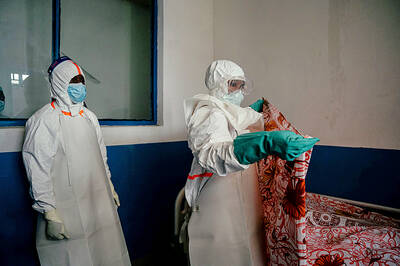
UPGRADED ALERT: The risk inside DR Congo is now considered ‘very high,’ while neighboring countries face a ‘high’ threat as the outbreak continues, the WHO said Ebola is spreading faster than responders can track it in eastern Congo, where health workers managed to follow up with barely one in five identified contacts in a single day. Authorities in the Democratic Republic of the Congo (DR Congo) reported 83 confirmed infections, 746 suspected cases and 1,603 identified contacts as of Thursday, but health workers were able to follow up on only 342 contacts that day — about 21 percent of the total under monitoring — data released by the DR Congo Ministry of Public Health on Friday showed. The figures suggest the response is falling behind the outbreak itself,

SEEKING ORDER: Rodrigo Paz said that ‘anyone who wants to destroy the nation will have to deal with this president and the full force of the constitution’ Bolivian President Rodrigo Paz on Wednesday said that the nation was at a “breaking point” after nearly a month of protests that have caused shortages of food, fuel and medicine. Paz, who took office six months ago amid the worst economic crisis there in four decades, is battling a groundswell of fury over his policies. The political capital, La Paz, has been besieged by low-income workers and members of the indigenous majority calling for his resignation. “The country needs order and is reaching breaking point,” the 58-year-old said at a public event in La Paz, renewing his appeal for dialogue. On Tuesday, the Bolivian


 RSS
RSS