


Venezuelan President Hugo Chavez intends to inject new urgency into his socialist, anti-imperialist revolution because, he says, there is clear evidence that “capitalism is destroying the world.”
In a combative 60-minute interview with the BBC Hardtalk program in Caracas that was to air last night, Chavez blamed Venezuela’s deepening recession on the irresponsible economic policies of the US and expressed disappointment with US President Barack Obama’s “very negative signals” toward Latin America.
“I wish Obama would focus on governing the United States and would forget his country’s imperialist pretensions,” the 55-year-old leader said.
Chavez rarely grants extended interviews to the Western media. This one was arranged to coincide with the Caracas premiere of Oliver Stone’s new documentary, South of the Border. The film portrays a Latin America being transformed by leftist radicalism. The leaders of Brazil, Argentina, Bolivia and Ecuador all get walk-on parts, but it is their Venezuelan counterpart who has the starring role. Stone and Chavez shared a limousine to the red carpet launch.
“What’s being going on in Venezuela for the last 10 years is amazing. The least I can do is introduce this man and this movement to the American people,” said Stone, Chavez beaming by his side.
Whether many Venezuelans will ever see the film remains unclear. The premiere was full of Socialist party bigwigs and activists who hooted with delight as their president was seen adopting the mantle of a 21st-century Castro. But no amount of support from a maverick US filmmaker can disguise a simple truth; domestic support for Chavez’s “Bolivarian socialism” is being sorely tested by a second consecutive year of recession.
Venezuela possesses the biggest oil reserves outside the Middle East and supplies more than one-tenth of US oil imports, but still the economy has woefully underperformed others in Latin American. Inflation is at 30 percent and seems likely to rise further. The bolivar has been devalued and is still sinking. In the capital’s sprawling barrios jobs are scarce and Chavez’s party is looking electorally vulnerable just three months before parliamentary elections.
He blamed the economic woes on the US’ “rampant, irresponsible capitalism” that was taking the world “on the road to hell.”
“In England and in Europe you should know this,” he said. “You have more problems than we do.”
Chavez quoted a stream of statistics to illustrate his claim that his 11 years in power had “begun to redress the balance between a very rich Venezuelan minority and a very poor majority” — unemployment halved, extreme poverty down from 25 percent to 5 percent.
Domestic critics of his nationalization program — which has turned the oil, power and agriculture sectors into vast state bureaucracies — accuse him of creating a “Bolivarian bourgeoisie” of corrupt officials and cronies. But Chavez emphasized he intended to go further with his socialist model. Privately owned enterprises are now being expropriated with increasing frequency.
“Eleven years ago I was quite gullible,” he said. “I thought it was possible to put a human face on capitalism, but I was wrong. The only way to save the world is through socialism, but a socialism that exists within a democracy; there’s no dictatorship here.”
However, a crackdown on opposition was highlighted this month with an arrest warrant issued for the owner of the TV channel Globovision, which takes a critical line against Chavez. Guillermo Zuloaga has since gone into hiding.
During the interview Chavez became visibly agitated when questioned about his government’s respect for an independent judiciary, freedom of the press and the rights of political opponents.
Chavez claimed Venezuela’s press was “100 times more free than that in the US,” but when challenged over the suspension of the privately run RCTV, ostensibly for failing to abide by a legal requirement to air his numerous addresses to the nation, he again went on the attack.
“Another lie of yours. You’re a great compiler of lies. Where did you get these huge lies from?” he said.
Chavez refused to say whether he would seek another term in elections scheduled for 2012. Though few doubt that he will, having pushed through the abolition of term-limits.
“[Former Cuban president] Fidel [Castro] has spent his whole life on his [revolution],” Chavez said. “Whatever life I have left I will dedicate to this peaceful democratic revolution in Venezuela.”

Crowds in Bangladesh are flocking to snap photographs with an unlikely social media star — an albino buffalo with flowing blond hair nicknamed “Donald Trump” that is due to be sacrificed within days. Owner Zia Uddin Mridha, 38, said his brother named the 700kg bull over its flowing helmet of hair resembling the signature look of the US president. “My younger brother picked this name because of the buffalo’s extraordinary hair,” he said at his farm in Narayanganj, just outside the capital, Dhaka. Mridha said that a constant stream of curious visitors — social media fans, onlookers and children — have come throughout
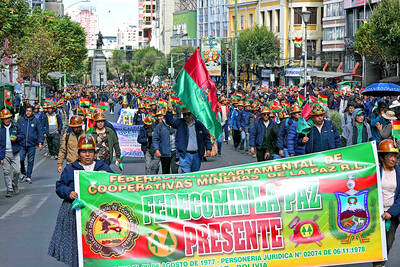
The Bolivian government on Friday struck a deal with protesting miners, but was still grappling with blockades and demonstrations by other workers across La Paz. Other groups are still blocking access roads into the city, which is also the seat of the government. Police on Thursday prevented the miners from entering the main square by using tear gas, while the demonstrators hurled stones and explosives with slingshots. Protests against the policies of Bolivian President Rodrigo Paz have convulsed the Andean nation since early this month, and roadblocks were choking routes into La Paz throughout Friday, the national road authority said. Miners demanded that Paz
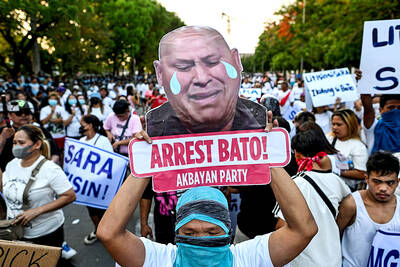
The Philippines said it has asked the country’s Supreme Court to allow it to arrest former Philippine president Rodrigo Duterte’s chief drug war enforcer to stand trial in an international tribunal. The International Criminal Court (ICC) last week unsealed an arrest warrant against Philippine Senator Ronald dela Rosa, accusing him along with Duterte and other “coperpetrators” of the “crime against humanity of murder.” Dela Rosa briefly sought refuge in the Philippine Senate last week while asking the Philippine Supreme Court to stop an ongoing attempt by government agents to arrest him. “By his own conduct, he has placed himself outside the protection of

The researchers in Ireland looked at their computer screen, marveling at a medieval book tracked down in a Roman library. They flipped through its digitized pages and found their sought-after treasure: the oldest surviving English poem. “We were extremely surprised. We were speechless. We couldn’t believe our eyes when we first saw that,” said Elisabetta Magnanti, a visiting research fellow at Trinity College Dublin’s school of English. The poem was also within the main body of Latin text, she said, calling it “extraordinary.” Composed in Old English by a Northumbrian agricultural worker in the 7th century, Caedmon’s Hymn appears within some copies of


 RSS
RSS