


The Sri Lankan government is threatening to execute Sarath Fonseka, the army commander who delivered victory over the Tamil Tigers, if he continues to suggest top officials may have ordered war crimes during the final hours of the civil war.
The threat, issued by Sri Lankan Defense Secretary Gotabaya Rajapaksa, is the latest sign of a bitter feud within the Sri Lankan political establishment, little more than a year after the end of the Tamil war.
Rajapaksa, who worked closely with Fonseka on the aggressive military strategy that crushed the Tigers and who is the brother of Sri Lankan President Mahinda Rajapaksa, told the BBC’s Hardtalk program that the general had proved himself to be a liar and a traitor.
Fonseka resigned from the military soon after the defeat of the Tigers. He is a member of parliament (MP) and was the main opposition candidate in January’s presidential election — winning 40 percent of the vote — but within days of his defeat he was arrested. The former war hero is in detention facing a court martial on charges of corruption and politicking while in uniform.
Fonseka roused the fury of the ruling Rajapaksa clan when he joined the opposition, a rift that deepened when he said there was eyewitness evidence of the defense secretary ordering army officers to shoot and kill surrendering Tamil Tiger leaders at the end of the war.
That witness is said to be a Sri Lankan embedded journalist who is in hiding overseas.
In a clandestine telephone interview, Fonseka confirmed that he had heard this account. He said he would be prepared to testify to an independent investigation of alleged abuses during the Tamil war.
“I will not hide anything,” he said.
Gotabaya Rajapaksa responded angrily to the prospect of Fonseka giving evidence.
“He can’t do that. He was the commander,” Gotobaya Rajapaksa said. “That’s a treason. We will hang him if he does that. I’m telling you ... How can he betray the country? He is a liar, liar, liar.”
The defense secretary also ruled out any possibility of an independent, third-party investigation of alleged war crimes committed by both the Sri Lankan army and the Tamil Tigers in the final phase of the war.
“We are an independent country, we have the ability to investigate all these things,” he said.
Colombo said that no civilians were killed by the army during their final assault on the Tigers’ last redoubt, despite evidence from the UN and international NGOs that points to thousands of civilian deaths.
With a strong electoral mandate and a big majority in parliament, Mahinda Rajapaksa seems intent on ruling postwar Sri Lanka without heed to critics at home or abroad. He has turned his administration into something of a family business. As well as his brother in defense, another brother is minister of economic development, another is speaker of the parliament and his son is a newly elected MP. In all, the Rajapaksas are responsible for spending more than two-thirds of the state budget.
Sri Lanka’s budget deficit, at some 8 percent of GDP, is significantly above targets set by the IMF in return for a US$2.6 billion loan package, but the government is committed to a big program of postwar spending.
In and around Kilinochchi, the former capital of the Tamil Tiger northern fiefdom, investment is essential. Houses are destroyed, farmland is lost to jungle and swaths of territory are off-limits to civilians as the army continues to clear mines. The de facto internment camp at Menic Farm, which was filled with almost 300,000 Tamil civilians a year ago, is emptying fast. Every day, families line up for hours for buses heading to their home villages across the northern Vanni region, but they wait with precious little sense of expectation.
Thambirasa Karunamurthy, a farmer with three children, said: “We came here with one plastic bag of belongings and we’re going home with no money, no assets, nothing. We have to start life again in a barren land ... we don’t know what we are going to do.”
On every road and around every settlement, soldiers man guard posts and checkpoints. The government has promised to integrate the north into the national economy. It has ruled out significant Tamil autonomy.
“If there is no political solution, the conclusion will be that the government wants to impose military victory on the Tamil people, and that the Tamils will never accept,” said Rajavarothiam Sampanthan, the veteran leader of the Tamil National Alliance.
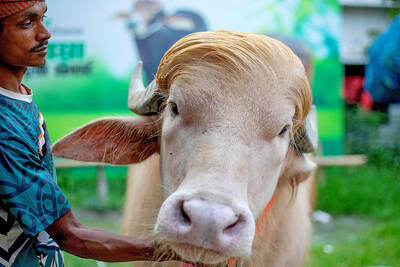
Crowds in Bangladesh are flocking to snap photographs with an unlikely social media star — an albino buffalo with flowing blond hair nicknamed “Donald Trump” that is due to be sacrificed within days. Owner Zia Uddin Mridha, 38, said his brother named the 700kg bull over its flowing helmet of hair resembling the signature look of the US president. “My younger brother picked this name because of the buffalo’s extraordinary hair,” he said at his farm in Narayanganj, just outside the capital, Dhaka. Mridha said that a constant stream of curious visitors — social media fans, onlookers and children — have come throughout
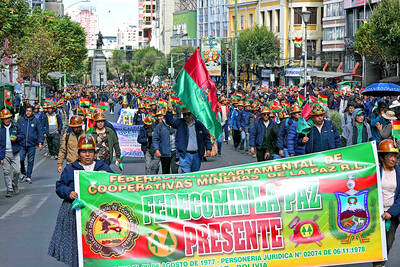
The Bolivian government on Friday struck a deal with protesting miners, but was still grappling with blockades and demonstrations by other workers across La Paz. Other groups are still blocking access roads into the city, which is also the seat of the government. Police on Thursday prevented the miners from entering the main square by using tear gas, while the demonstrators hurled stones and explosives with slingshots. Protests against the policies of Bolivian President Rodrigo Paz have convulsed the Andean nation since early this month, and roadblocks were choking routes into La Paz throughout Friday, the national road authority said. Miners demanded that Paz
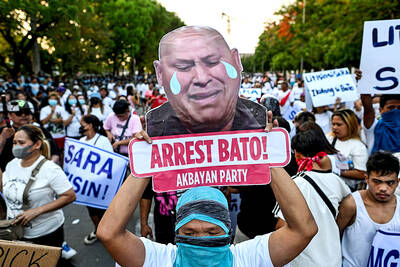
The Philippines said it has asked the country’s Supreme Court to allow it to arrest former Philippine president Rodrigo Duterte’s chief drug war enforcer to stand trial in an international tribunal. The International Criminal Court (ICC) last week unsealed an arrest warrant against Philippine Senator Ronald dela Rosa, accusing him along with Duterte and other “coperpetrators” of the “crime against humanity of murder.” Dela Rosa briefly sought refuge in the Philippine Senate last week while asking the Philippine Supreme Court to stop an ongoing attempt by government agents to arrest him. “By his own conduct, he has placed himself outside the protection of

The researchers in Ireland looked at their computer screen, marveling at a medieval book tracked down in a Roman library. They flipped through its digitized pages and found their sought-after treasure: the oldest surviving English poem. “We were extremely surprised. We were speechless. We couldn’t believe our eyes when we first saw that,” said Elisabetta Magnanti, a visiting research fellow at Trinity College Dublin’s school of English. The poem was also within the main body of Latin text, she said, calling it “extraordinary.” Composed in Old English by a Northumbrian agricultural worker in the 7th century, Caedmon’s Hymn appears within some copies of


 RSS
RSS