


Syria has revealed some details of past nuclear experiments to UN inspectors but is still blocking access to a desert site where secret atomic activity may have taken place, a confidential report said on Monday.
The International Atomic Energy Agency (IAEA) report said Syria was not allowing follow-up access to a bombed desert site, which US intelligence reports said had been a North Korean-designed nuclear reactor under construction, geared for atomic bomb fuel.
Israel bombed the site to rubble in 2007. Syria allowed the IAEA to inspect the site in June 2008, but has not allowed the agency to revisit it since then.
The agency says it needs to take more samples at the site to remove any doubts about Syria’s past atomic activities. It also repeated a call for access to three military sites, whose appearance was altered by landscaping after the IAEA first asked to check them.
“Such access is essential to enable the agency to establish the facts and make progress in its verification, while protecting military and other information which Syria considers to be sensitive,” IAEA Director-General Yukiya Amano wrote.
Syria, an ally of Iran that is under IAEA investigation over nuclear proliferation suspicions, has denied ever having an atom bomb program and says the intelligence suggesting it had is fabricated.
Syria has allowed inspectors to visit a research reactor in Damascus, where they have been checking whether there is a link with the bombed Dair Alzour desert site after discovering unexplained particles of processed uranium at both.
Some analysts say the uranium traces raise the question of whether it used some natural uranium intended for the alleged reactor at Dair Alzour in tests applicable to learning how to separate out bomb-grade plutonium from spent nuclear fuel.
On a recent visit to the Damascus reactor, Syria belatedly revealed that it had conducted experiments to irradiate and convert uranium-derived material during 2004, the report said. It also provided the IAEA with information about amounts of previously undisclosed nuclear material.
“These were [experiments] with small quantities in order to learn the processes,” a senior official familiar with the IAEA probe said. “They should have been reported to the IAEA under the safeguards agreement.”
The official said it was not clear if the past work was just experimental, as Syria claimed, or if it could have had other uses. The report said the IAEA was examining further samples.
It urged Syria to cooperate with the agency’s open questions about the work as soon as possible and said it should adopt the IAEA’s Additional Protocol, which permits unfettered inspections beyond declared nuclear sites to hunt out any covert atomic activity.

It began as a satirical online project. Now millions of young people in India are flocking to it as an outlet for their frustration. A parody political party called the Cockroach Janta Party, with the insect as its symbol, has exploded across India’s social media by turning absurdist humor into protest. Memes and short videos mocking corruption, joblessness and political dysfunction have flooded social media sites, where millions of users are embracing the cockroach — known for its ability to survive harsh conditions — as a tongue-in-cheek symbol of endurance. The online movement’s rise has been unusually rapid. The Cockroach Janta Party (CJP)

SPEAKING OUT: After Siranudh Scott’s allegations surfaced, celebrities and public figures took to social media to share their own experiences of sexual misconduct and abuse A high-profile alleged sexual abuse case within a wealthy Thai beer brewing family has prompted a wave of painful accounts from survivors of unconnected abuse in the conservative nation. Siranudh Scott, a member of the billionaire Thai family that founded the ubiquitous Singha beer brand, posted an emotional video this month accusing his elder brother Sunit of repeatedly abusing him when he was a teenager. Sunit, who is in his 30s, later denied the allegations in a video posted online, but Singha parent Boonrawd dismissed him from his executive role with the company on Tuesday last week. “I felt I needed to speak

A Hong Kong astronaut is to join a Chinese space mission for the first time as part of a three-person crew launching today, as Beijing edges closer to its goal of landing people on the moon. The Tiangong space station — crewed by teams of three astronauts that are typically rotated every six months — is the crown jewel of China’s space program, boosted by billions in state investment in a bid to catch up with the US and Russia. The Shenzhou-23 mission is to blast off at 11:08pm from the Jiuquan Satellite Launch Center in northwestern China, carrying three astronauts to
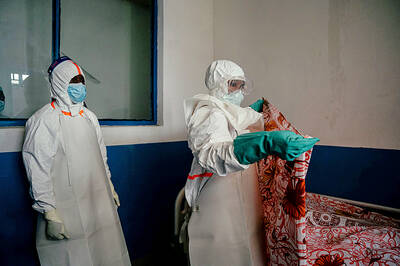
UPGRADED ALERT: The risk inside DR Congo is now considered ‘very high,’ while neighboring countries face a ‘high’ threat as the outbreak continues, the WHO said Ebola is spreading faster than responders can track it in eastern Congo, where health workers managed to follow up with barely one in five identified contacts in a single day. Authorities in the Democratic Republic of the Congo (DR Congo) reported 83 confirmed infections, 746 suspected cases and 1,603 identified contacts as of Thursday, but health workers were able to follow up on only 342 contacts that day — about 21 percent of the total under monitoring — data released by the DR Congo Ministry of Public Health on Friday showed. The figures suggest the response is falling behind the outbreak itself,


 RSS
RSS