


A dried-up and polluted lake in eastern India has become a major pilgrimage site attracting thousands of people a day after claims that its mud cures cancer and other diseases.
At the lake in Nakali village, 70km south of Calcutta, families smear each other in the dark, gluey “miracle mud,” defying government attempts to prevent the site becoming a religious attraction.
Each Tuesday and Saturday — auspicious days for Bengalis — large crowds of devotees who have traveled from across the region gather before dawn to completely immerse themselves in the sludge at the bottom of the small lake.

PHOTO: AFP
“They arrive overnight in trucks, chartered buses and trains from different parts of the state,” said Suman Mondal, a 28-year-old selling lemon water to the mainly Hindu pilgrims.
“People are not only bathing and covering their body and hair with mud, they are drinking water and taking mud from the pond as well. It’s a miracle pond,” Mondal said.
West Bengal State Minister for the Sunderbans region Kanti Ganguly said the government wanted to end the increasingly popular pilgrimage.
“People started to throng to the pond for a bathe after a rumor did the rounds of local villages last year that a man was cured of liver cancer by taking dips,” he said.
“Authorities have imposed a ban on gathering in and around the pond as its waters are so polluted that drinking the water or taking a bathe could be unhealthy,” he said.
Ganguly said policemen had been stationed around the lake, but people poured in nonetheless.
“We can’t hurt their faith,” he said.
The phenomenon has continued to grow even though the “cured” man has now died. He was a member of the family that owns the lake.
“It all started after my brother, Hiranmoy, had a dream about a snake goddess telling him that a dip in the pond could produce miracle cures of killer diseases,” Tarini Raj, 45, said.
“He was cured of cancer for a while, but later died,” Raj said.
Raj pointed to rows of images of snake goddesses beside the pond, offered by those who believed they had been cured of their diseases.
“It’s a ritual to offer prayers to the snake goddess,” he said. “Those who come are mainly poor people suffering from chronic ailments. The number is nearly half a million but now on the wane because of the summer heat.”
Some say the family is motivated by the money it collects from food and drink stalls that serve pilgrims, but devotees like Biswajit Haldar, 56, are in no doubt about the pond’s curative powers.
“We are not bothered what the government says. My wife was suffering from throat cancer for over two years. She is now better after smearing her body with mud of the pond,” he said, sitting in the knee-deep mire.
Bathing in sacred water plays a central part in the Hindu religion, with many believing a dip in the holy Ganges river can cure diseases as well as wash away sin and break the cycle of life and rebirth.
Tens of millions of people bathed in the Ganges during the Kumbh Mela festival in northern India that finished last month.
But not all Indians subscribe to these beliefs. Prabir Ghosh, general secretary of the Calcutta-based Science and Rationalist Association of India, has been campaigning against the Nakali lake’s sudden rise to religious prominence.
“It’s just a superstition. Authorities should deal with such a thing. This stinking pond is only a health hazard,” he said.
Ghosh said some rationalist campaigners had been beaten up when they went to the pond to express their views.
“But we are not scared, we will continue our campaign against this false belief,” he said.

Hungarian authorities temporarily detained seven Ukrainian citizens and seized two armored cars carrying tens of millions of euros in cash across Hungary on suspicion of money laundering, officials said on Friday. The Ukrainians were released on Friday, following their detention on Thursday, but Hungarian officials held onto the cash, prompting Ukraine to accuse Hungary’s Russia-friendly government of illegally seizing the money. “We will not tolerate this state banditism,” Ukrainian Minister of Foreign Affairs Andrii Sybiha said. The seven detained Ukrainians were employees of the Ukrainian state-owned Oschadbank, who were traveling in the two armored cars that were carrying the money between Austria and

Kosovar President Vjosa Osmani on Friday after dissolving the Kosovar parliament said a snap election should be held as soon as possible to avoid another prolonged political crisis in the Balkan country at a time of global turmoil. Osmani said it is important for Kosovo to wrap up the upcoming election process and form functional institutions for political stability as the war rages in the Middle East. “Precisely because the geopolitical situation is that complex, it is important to finish this electoral process which is coming up,” she said. “It is very hard now to imagine what will happen next.” Kosovo, which declared

MORE BANS: Australia last year required sites to remove accounts held by under-16s, with a few countries pushing for similar action at an EU level and India considering its own ban Indonesia on Friday said it would ban social media access for children under 16, citing threats from online pornography, cyberbullying, online fraud and Internet addiction. “Accounts belonging to children under 16 on high-risk platforms will start to be deactivated, beginning with YouTube, TikTok, Facebook, Instagram, Threads, X, Bigo Live and Roblox,” Indonesian Minister of Communications and Digital Meutya Hafid said. “The government is stepping in so that parents no longer have to fight alone against the giants of the algorithm. Implementation will begin on March 28, 2026,” she said. The social media ban would be introduced in stages “until all platforms fulfill their
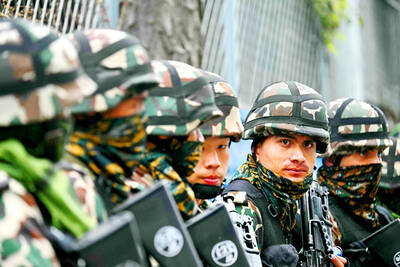
Counting was under way in Nepal yesterday, after a high-stakes parliamentary election to reshape the country’s leadership following protests last year that toppled the government. Key figures vying for power include former Nepalese prime minister K. P. Sharma Oli, rapper-turned-mayor Balendra Shah, who is bidding for the youth vote, and newly elected Nepali Congress party leader Gagan Thapa. In Kathmandu’s tea shops and city squares, people were glued to their phones, checking results as early trends flashed up — suggesting Shah’s centrist Rastriya Swatantra Party (RSP) was ahead. Nepalese Election Commission spokesman Prakash Nyupane said the counting was ongoing “in a peaceful manner”


 RSS
RSS