


Thailand’s capital whirred back into life yesterday after last week’s deadly unrest, as businesses and schools reopened and citizens returned to streets cleared of debris left by arson and looting.
Thoroughfares which for six weeks had been occupied by “Red Shirts” anti-government protesters, who established a fortified encampment in the top shopping district, were finally open to traffic.
Office workers returned to their jobs, children went to school and retailers rolled back shutters after the worst civil unrest in recent memory which since mid-March has left 88 dead and nearly 1,900 injured.
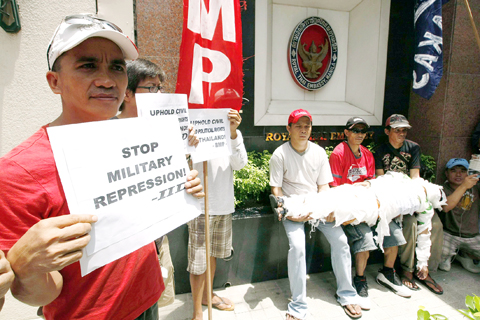
PHOTO: EPA
The Red Shirts, who are campaigning for fresh elections to replace a government they condemn as illegitimate, disbanded last Wednesday in the face of a military offensive that forced their leaders to surrender.
Enraged militants within the movement went on a rampage of looting and arson that left 36 major buildings ablaze including the stock exchange and Thailand’s biggest mall, which now stands in ruins.
Downtown Bangkok was scrubbed clean over the weekend in a frenzied operation involving thousands of city workers wielding brooms and power houses, as well as enthusiastic volunteers, including foreigners.
The embassies of Australia and Japan, located near the disbanded Red Shirts encampment, reopened while the US said it expected to resume full services at its mission as of yesterday.
“It’s very much back to normal, we’re trying to get things back together this week,” Kim Clarke, press officer for the British embassy said.
Dozens of people stood outside Central World yesterday, solemnly snapping photos of the wreckage with cellphones and digital cameras.
“Almost every weekend my family and I came here to go shopping, see movies and eat some food. Now everything is gone, so I’m very sad,” said Mito Shiko, 50, a Japanese construction company owner who has lived in Bangkok two decades.
Sangchai Saetang, a 55-year-old food vendor, stood in his apron after taking a break from his roadside stall to see the damage at Central World, which five days after the fire is still being doused with hoses.
“It’s too much. Whoever did this should not have done it,” he said, lamenting that he had been forced to shut his small business for a month.
While Bangkok was fast returning to normal, authorities have extended a curfew in force in Bangkok and 23 other provinces, saying the measures would remain in place for seven days “for security reasons.”
The Red Shirts are mostly supporters of former prime minister Thaksin Shinawatra, who was removed in a 2006 coup. The billionaire was accused of gross rights abuses and corruption, but won grassroots support with his populist policies.

‘CROSSING THE LINE’: China’s embassy in Seoul criticized US Forces Korea Commander General Xavier Brunson, asking if his ‘hostile’ remarks were authorized by Washington South Korea and the US are in talks over recent public remarks by the commander of US Forces Korea, Seoul’s presidential office said yesterday, after the comments drew sharp criticism from China. In a recent podcast interview, US Forces Korea Commander General Xavier Brunson described South Korea as “the dagger in the heart of Asia” from China’s east coast, prompting the Chinese embassy in Seoul to say that he had “truly crossed the line.” The interview came amid growing speculation that Washington might seek to expand the role of US Forces Korea in countering the growing regional influence of China, a key

Through the noise of rushing papers and whirring belts at a print factory in Kyoto, two creators watch their photo essay come to life in broadsheet form — part of an effort to win new audiences in the age of artificial intelligence (AI). Despite the decline of the publishing industry, self-publication and handmade “zine” magazines are growing in popularity in Japan, reflecting the nation’s enduring love of paper in the digital era. While speaking to Agence France-Presse at the plant, his hands black with ink, one of the creators, Kazuma Obara, said: “I think [paper] is a medium that engages all five

Australian researchers have trained lab-grown brain cells on a silicon computer chip to play the 1990s shooter game Doom and said they are just scratching the surface of what the neurons could be capable of doing. It is the science-fiction work of biotech boffins at Cortical Labs, who researched and developed the technology that harnesses the workings of the brain’s networking system. Each so-called “biological computer” contains about 200,000 living human brain cells, grown from stem cells that were harvested from blood donations. Having mastered the simple computer game Pong, where a paddle is moved up and down to send a ball

France experienced its hottest spring on record, the French weather service said on Tuesday, after an exceptional early heat wave that also broke highs for the season in England and Wales. Meteo-France said the average nationwide temperature over March to May was 13.8°C — about 1.7°C above the norm, and surpassing records set in 2011 and 2020. “The warmest spring since records began in 1900,” it said in a bulletin. All three months were warmer than average, but the onset of an “unprecedented heatwave” late last month pushed the mercury to highs typically seen at the height of the summer. “Our country had never


 RSS
RSS