


Thailand picked up the pieces yesterday after violence and mayhem triggered by a crackdown on anti-government protests, as the focus swung to recovery and reconciliation in a divided nation.
The army said it had nearly completed an operation to secure central Bangkok, crushing resistance from militants in the “Red Shirts” movement who went on the rampage after their leaders surrendered.
Across central Bangkok, a huge clean-up was under way after a terrifying outbreak of looting and burning that saw some 36 major buildings go up in flames, including the stock exchange and the nation’s biggest mall.
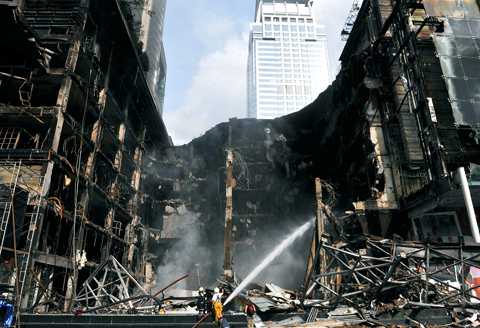
PHOTO: AFP
City workers used everything from brooms to bulldozers to clear debris left behind after two months of rolling demonstrations, including the remnants of towering barricades the Red Shirts used to occupy a top shopping district.
In the hotspots where protesters have battled with security forces over the past week, roads were being cleared of burned tires, concrete blocks and stones that had been used as missiles.
“Time to Rebuild,” the Nation newspaper said in a front-page banner, as reports said the damage bill from the torched buildings alone could reach 40 billion baht (US$1.2 billion).
Thailand has suffered regular bouts of civil unrest in its turbulent history, including 18 actual or attempted coups since 1932, and its citizens are famed for their resilience and resourcefulness.
Even after Bangkok’s shopping centers and five-star hotels are hosed down and reopened, however, the emotional wounds of unrest that has left 83 dead since mid-March will take much longer to heal.
Thailand is largely split between the Red Shirts, mostly urban and rural poor who are demanding the ouster of a government they condemn as undemocratic, and the rival pro-establishment “Yellow Shirts,” who represent the nation’s elites.
“No one knows how long it will take to close the deep divisions that have been opened within Thai families and society,” the Bangkok Post said in a front-page editorial. “Whatever our future, there is no doubt that all Thais — no matter what our personal beliefs and views — must play a role in ensuring that such a dismal state of affairs never happens again.”
The Red Shirts are mostly supporters of former prime minister Thaksin Shinawatra, who was ousted in a 2006 coup. The billionaire tycoon was accused of gross rights abuses and corruption, but won grassroots support with his populist policies.
Thaksin’s elected allies were then ejected in a controversial court ruling, paving the way for the administration of Thai Prime Minister Abhisit Vejjajiva to be appointed in a 2008 army-backed parliamentary vote.
Bangkok and 23 other provinces in the rural north and northeast — the Red Shirts’ heartland — have been put under a curfew until tomorrow to try to contain the conflict and prevent it from spreading across the nation.
With dire travel warnings issued by foreign governments, the outlook for the tourism sector is bleak, even though the main beach destinations of Phuket and Samui are far from the troubles in the capital.
“Clearly, with the events that took place over the past several weeks and the pictures of these events flashing across TV screens across the world, it is going to have a very disastrous impact on tourism,” Thai Finance Minister Korn Chatikavanij said in Tokyo.
The government also faces a difficult task to convince investors they should support the “Land of Smiles,” said Nandor von der Luehe, chairman of the Joint Foreign Chambers of Commerce in Thailand.
“Decisions are made outside Thailand and executives who see Thailand is burning will not put their investments in that country,” he told reporters. “You build a reputation over a long period of time and you can destroy it overnight.”
Businesses large and small have borne a heavy burden during the conflict and tens of thousands have been put out of work with the capital’s main shopping district paralyzed.
“I have suffered a lot from what has happened,” said Kanda Singla, a 27-year-old streetside food vendor who searched for customers in vain in the Nana tourist district.
“I really hope it will end soon and my life and my business can go back to normal because things have been very dangerous,” she said, adding that with so many jobless she was fearful of outbreaks of looting and thefts.
Meanwhile, a leading international human rights agency expressed alarm yesterday that Thai authorities have used a “draconian” emergency decree passed during political violence to hold prisoners in secret detention.
New York-based Human Rights Watch said it was concerned Red Shirt protesters were vulnerable to mistreatment after they were arrested by Thai security forces and taken to undisclosed locations without being charged.
“Secret detention sites and unaccountable officials are a recipe for human rights abuses,” Elaine Pearson, acting Asia director for Human Rights Watch, said in a statement. “Those arrested should be promptly brought before a judge and charged with a criminal offense or released.”
The government arrested eight Red Shirt leaders and many of their supporters this week.
As dozens of buildings lay in ruins after the military crackdown, Human Rights Watch expressed “alarm” at reports the emergency decree’s broad powers were being used to secretly hold people in military camps instead of jails.
The organization said the risk of “disappearances,” torture and other abuses was significantly increased when detainees are held incommunicado by the military, which lacks civilian law enforcement training.
The organization this week accused both Thai security forces and the Red Shirts of “serious abuses” during the Bangkok crackdown.

Australians were downloading virtual private networks (VPNs) in droves, while one of the world’s largest porn distributors said it was blocking users from its platforms as the country yesterday rolled out sweeping online age restriction. Australia in December became the first country to impose a nationwide ban on teenagers using social media. A separate law now requires artificial intelligence (AI)-powered chatbot services to keep certain content — including pornography, extreme violence and self-harm and eating disorder material — from minors or face fines of up to A$49.5 million (US$34.6 million). The country also joined Britain, France and dozens of US states requiring

Hungarian authorities temporarily detained seven Ukrainian citizens and seized two armored cars carrying tens of millions of euros in cash across Hungary on suspicion of money laundering, officials said on Friday. The Ukrainians were released on Friday, following their detention on Thursday, but Hungarian officials held onto the cash, prompting Ukraine to accuse Hungary’s Russia-friendly government of illegally seizing the money. “We will not tolerate this state banditism,” Ukrainian Minister of Foreign Affairs Andrii Sybiha said. The seven detained Ukrainians were employees of the Ukrainian state-owned Oschadbank, who were traveling in the two armored cars that were carrying the money between Austria and

Kosovar President Vjosa Osmani on Friday after dissolving the Kosovar parliament said a snap election should be held as soon as possible to avoid another prolonged political crisis in the Balkan country at a time of global turmoil. Osmani said it is important for Kosovo to wrap up the upcoming election process and form functional institutions for political stability as the war rages in the Middle East. “Precisely because the geopolitical situation is that complex, it is important to finish this electoral process which is coming up,” she said. “It is very hard now to imagine what will happen next.” Kosovo, which declared

MORE BANS: Australia last year required sites to remove accounts held by under-16s, with a few countries pushing for similar action at an EU level and India considering its own ban Indonesia on Friday said it would ban social media access for children under 16, citing threats from online pornography, cyberbullying, online fraud and Internet addiction. “Accounts belonging to children under 16 on high-risk platforms will start to be deactivated, beginning with YouTube, TikTok, Facebook, Instagram, Threads, X, Bigo Live and Roblox,” Indonesian Minister of Communications and Digital Meutya Hafid said. “The government is stepping in so that parents no longer have to fight alone against the giants of the algorithm. Implementation will begin on March 28, 2026,” she said. The social media ban would be introduced in stages “until all platforms fulfill their


 RSS
RSS